

























 0
0
Two figures stand out during the first half of the year: June came within just 87 tons (t) of Argentina's all-time pork import record, while May unequivocally saw the highest export volume of the past five years.
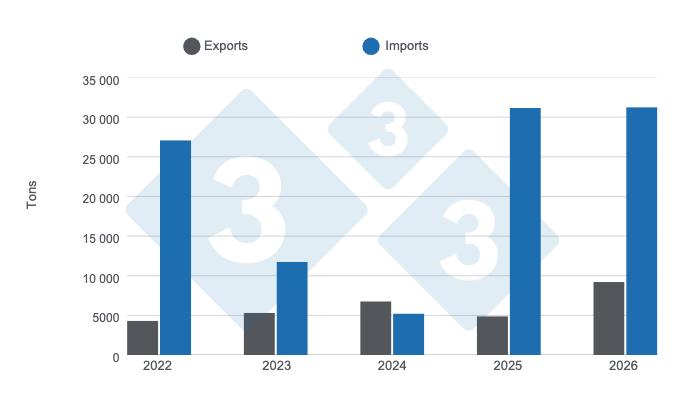
Evolution of Argentina's pork exports and imports in the first half of the last five years. Prepared by 333 Latin America with data from the Secretariat of Agriculture, Livestock and Fisheries of the Ministry of Economy of Argentina.

Imports
June 2026 is perhaps the month that best summarizes the upward trend in imports: it closed with 6,133 tons, 39.8% higher than June 2025, and consolidated its position as the best June in the entire analyzed period. Although this figure could be considered a historical record, April 2025 remains the peak, with 6,220 tons. This precision is important because it allows us to infer that there was no unprecedented jump in June, but rather the confirmation of an already high and sustained level of imports—March, April, May, and June of 2026 were all above 5,700 tons, with imports almost doubling between January (3,072 tons) and June within the first half of the year (+99.6%). However, the cumulative for the first half of the year showed a mere 0.3% increase in volume compared to the previous year, as the monthly average for 2026 (5,211 tons) is virtually identical to that of 2025 (5,193 tons). In fact, 2026 did not start from a low level: it maintained the upward trend that already characterized the previous year. Meanwhile, the dollar value of imports fell by 3.6%, due to a 3.9% drop in the implicit price. Evolution of Argentina's monthly pork imports over the last four years and the first half of 2026. Prepared by 333 Latin America with data from the Secretariat of Agriculture, Livestock and Fisheries of the Ministry of Economy of Argentina.
With 1,912 tons of pork exported, May 2026 surpassed all other months in the last five years, including the previous record (July 2024, with 1,860 tons), by 2.8%. But, as with imports, the figure for a single outstanding month doesn't tell the whole story, since the average monthly exports for the first half of the year nearly doubled compared to 2025 (from 817 tons to 1,535 tons, a cumulative increase of 87.9%), with a compound annual growth rate of 20.7% in volume and 28.3% in value between 2022 and 2026—nearly six times the compound annual growth rate of imports over the same period. Even February, the lowest month of the first half of the year (1,212 tons), would have been a remarkable month just two or three years ago. Meanwhile, the implicit export price also improved by 24.8%, a sign that the expansion of exports combined a higher volume with better external placement conditions. Evolution of Argentina's monthly pork exports over the last four years and half of 2026. Prepared by 333 Latin America with data from the Secretariat of Agriculture, Livestock and Fisheries of the Ministry of Economy of Argentina.
Trade Balance
With trade flows moving strongly during the first half of the year, the trade deficit narrowed by 11.3% compared to the first half of 2025, falling from -US$93.7 million to -US$83.1 million. Meanwhile, export coverage increased from 15.7% to 29.5% in a year, almost doubling in the first half of the year, although improvements varied from month to month. Even so, it's important to keep things in perspective, as the first half of 2024 had a considerably smaller deficit (-US$10.6 million), albeit for a very different and less favorable reason: a general collapse in imports rather than export growth comparable to that of 2026.
Conclusion
The most important takeaway from the first half of 2026 is that international pork trade flows tell the same story. Overall, the first half of the year ranked among the best six months for imports and the ten best for exports in the entire historical record. Behind these two figures lie two dynamics progressing at different speeds: imports stabilizing at a high level, a trend that has persisted since 2025 (with almost flat compound growth of 3.6% over four years), and exports growing at a structurally faster rate (20.7% compound annual growth). If this differential holds, the sector's trade balance should continue to reduce its deficit in the coming semesters, although we are still far from achieving equilibrium.
333 Latin America with data from the Secretariat of Agriculture, Livestock and Fisheries of the Ministry of Economy of Argentina.