

























 0
0
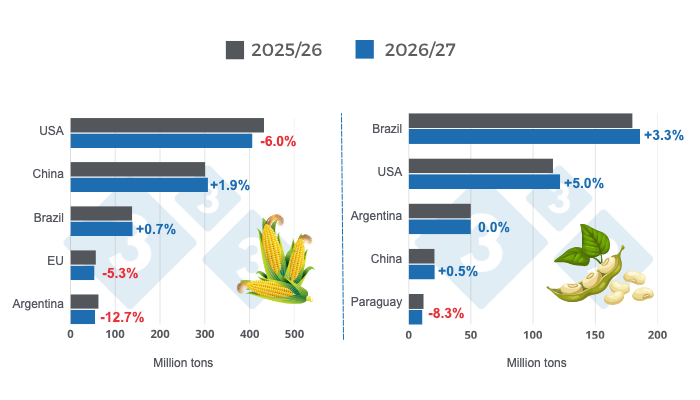
These are the highlights of the grain and oilseed estimates for the 2026/27 marketing year released by the USDA on July 10, 2026:
Corn

One factor to watch closely in the 2026/27 season is the surge in Argentine corn shipments to China. According to data from the shipping agency NABSA, COFCO International—China's largest state-owned agricultural conglomerate—more than 600,000 tons since April 2026 have shipped, with Argentine prices between $10 and $15/ton below the competition. Phytosanitary access was agreed upon starting in 2024, but it is only now generating significant volumes; its continuation will depend on the second Brazilian harvest, trade negotiations between China and the United States, and less dynamic Chinese demand than anticipated.
Production
- Global corn production for the 2026/27 season is expected to be around 1297.1 million tons (Mt), a decrease of 2.3% compared to the 2025/26 season, last estimated at 1327.7 Mt.
- U.S. production is expected to reach 406.4 Mt, a decrease of 6.0% compared to the previous season (432.3 Mt). China's harvest is forecast to increase by 1.9% to 307.0 Mt. The European Union is projected to see a 5.3% decrease to 53.8 Mt, while Ukraine, with 30.0 Mt, would decrease by 2.9% compared to 30.9 Mt in the previous season.
- For South American harvests, Brazil is expected to reach 139.0 Mt, up 0.7% from the 2025/26 season (138.0 Mt), while Argentina's harvest would be around 55.0 Mt, 12.7% below the last season (63.0 Mt).
Exports
- Global corn exports are forecast to decrease by 4.9% in this season reaching 209.9 Mt.
- The U.S. is expected to lead exports with 81.3 Mt, although this would be a 3.8% decrease from the previous season (84.5 Mt), followed by Brazil, Argentina, and Ukraine with 44.0, 38.0, and 23.0 Mt, respectively.
Imports
- Globally, corn imports are expected to increase from 196.7 Mt in the 2025/26 season to 204.0 Mt in this new season, an increase of 3.7%.
- Mexico would be the largest importer of corn with 27.7 Mt and a growth of 2.6% compared to the previous season (27.0 Mt).
- The European Union is expected to reach 22.5 Mt, 21.6% more than the previous season (18.5 Mt). Japan is forecast keep its purchases stable at 15.5 Mt, with no change compared to the previous season. Vietnam is expected to increase purchses by 12.6%, reaching 15.2 Mt (13.5 Mt in the previous season).
- Colombia is forecast to increase its corn imports by 2.4%, reaching 8.6 Mt in this new season.
Stocks
- Ending stocks are expected to decrease by 7.8% globally, reaching 275.3 Mt. U.S. stocks would decrease by 11.4%, while China and Brazil would see contractions of 6.8% and 9.8% respectively.
Soybeans
The growth of crushing capacity in Brazil remains the structural driver of the market. The USDA projects that Brazilian crushing will reach 65 million tons in 2026/27 (+3.5 million tons), supported by a record harvest and new processing plants that have increased installed capacity by nearly 30% since 2020. This growth responds both to international demand for soybean meal—which is expected to rise 4% this season, led by the European Union, Indonesia, Vietnam, Mexico, and Thailand—and to Brazil's biodiesel mandate, which was upgraded from B14 to B15 by mid-2025 with the goal of reaching B20.
Production
- Global soybean production for the 2026/27 season would increase by 2.9% compared to the previous season, going from 429.5 to 441.7 Mt.
- Estimates for South American harvests indicate a 3.3% increase for Brazil, reaching 186.0 Mt, while for Argentina the harvest would remain unchanged compared to the previous season, reaching 50.0 Mt.
- Paraguay would reduce its harvest by 8.3% compared to the 2025/26 season (12.1 Mt), consolidating 11.1 Mt.
- The U.S. is forecast to harvest 121.8 Mt, up 5.0% compared to the previous season (116.0 Mt).
Exports
- Global soybean exports are expected to increase by 1.8% in this new season, reaching 190.4 Mt.
- Export activity would be led by Brazil with 118.0 Mt, up 2.6% from the 2025/26 season (115.0 Mt), while the U.S. would reach an export volume of 45.2 Mt, indicating a 9.2% growth compared to the previous season (41.4 Mt).
- Exports from Argentina are projected to total 6.2 Mt, down 31.1% from the previous period (9.0 Mt).
Imports
- Global soybean imports would increase by 1.6% from 186.3 Mt in the 2025/26 season to 189.3 Mt in this new season.
- China is expected to import 115.0 Mt, 1.8% above the previous season (113.0 Mt), while the European Union would consolidate 13.2 Mt, down 4.3% compared to the previous season (13.8 Mt).
- For Mexico, imports of 6.8 Mt are expected in this new season, up 0.7% compared to the previous season (6.7 Mt).
Stocks
- Global ending stocks of soybeans are expected to decline slightly, reaching 124.2 million metric tons (Mt), 0.9% lower than the previous season (125.3 Mt). U.S. stocks are projected to decrease by 6.0%, while Argentina's are expected to increase by 1.7%. Brazil and China are expected to see contractions of 2.1% and 0.2%, respectively.
July 10, 2026/ 333 Latin America with data from USDA.
https://apps.fas.usda.gov/