


























 0
0
Modern swine production has made remarkable strides in genetics and performance over the past few decades, but this progress has brought a side effect that packing plants know all too well: a sharp rise in carcass condemnations linked to locomotor disorders. The prevalence of severe claw lesions at slaughter has nearly doubled in ten years — from roughly 30% to over 60% — and understanding this phenomenon is critical for anyone looking to protect profitability across the entire production chain.
The problem starts long before slaughter
The root cause lies in a fundamental mismatch between the rate of muscle growth and the maturation of the skeletal system. When we genetically select animals to grow faster and reach higher slaughter weights, we place mechanical demands on joints and digits that these structures are often not yet equipped to handle. The result is a locomotor system that is inherently more vulnerable — one that accumulates microtraumas over the course of the finishing period, progressively compromising claw integrity.

The rearing environment amplifies the problem considerably. Slatted floors, abrasive, wet, or worn surfaces, and high stocking densities all increase the mechanical impact on the claw capsule daily. It is a compounding set of factors that turns already-stressed tissue into a predictable point of failure.
The white line: where it all begins to break down
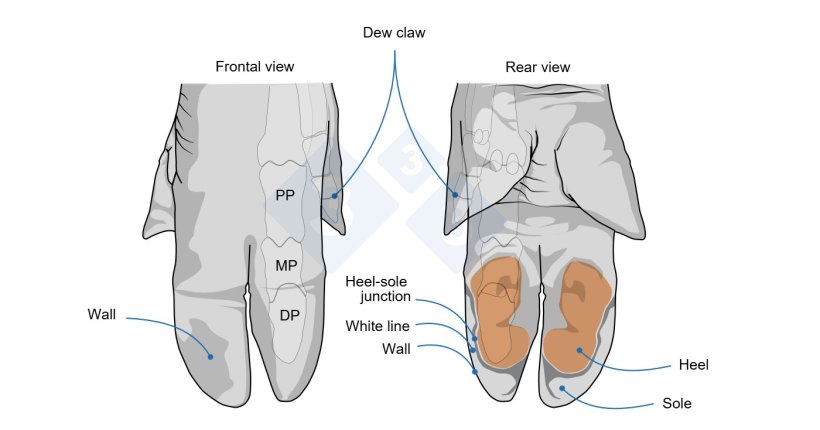
Among podal lesions, severe white line lesions deserves particular attention. The white line, the junction between the claw wall and the sole, is composed of a less dense, more porous horn tissue, making it the structural weak point of the entire digit. Mechanical overload, excessive moisture, and debris accumulation all find their way in exactly at this interface.
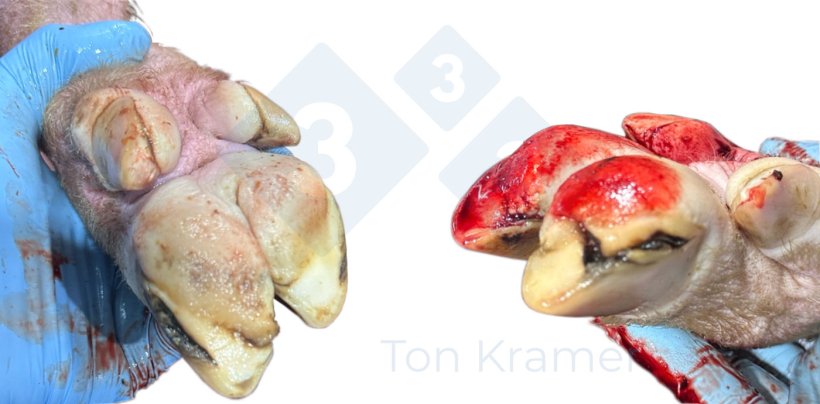
Microcracks in the white line allow bacteria and organic matter to penetrate, creating ideal conditions for inflammatory and infectious processes. Clinically, the most common outcome is laminitis, with moderate to severe lameness. A lame animal in pain reduces feed intake, loses daily gain, and shifts its weight to contralateral limbs, compounding the clinical picture further.
From the farm to the packing plant: the path of infection
What is still underappreciated by many producers is that a claw lesion is not just a welfare or performance issue on the farm. It is frequently the starting point of a systemic infection that will only become apparent at post-mortem inspection, and sometimes in anatomical structures far removed from the affected digit. And this is underestimated.
Once the cutaneous or corneal barrier is breached, pathogens such as Trueperella pyogenes, Staphylococcus spp., and Streptococcus spp. gain access to the lymphatic and vascular circulation. From there, hematogenous spread can seed septic foci in bones and joints throughout the body. Vertebral and mandibular osteomyelitis are among the potential outcomes and already account for most of total carcass condemnations in some high-throughput plants. The presence of osseous abscesses or multiple purulent foci is sufficient for inspection services to condemn the entire carcass to the rendering facility. No exceptions.
Beyond infectious sequelae, animals with compromised locomotion are significantly more prone to falls and fractures during transport and ante-mortem handling. The resulting extensive bruising often requires aggressive trimming or partial condemnation of high-value cuts such as the ham.
What does this actually cost?
The economic losses associated with locomotor disorders are considerably larger than farm-level reports typically capture. Direct losses, as fully condemned carcasses or those downgraded due to trimming, are the most visible. But the indirect losses incurred throughout the production cycle are equally significant:
- reduced average daily gain
- poorer feed conversion
- less uniform groups at marketing
- increased reliance on antimicrobials and nonsteroidal anti-inflammatory drugs (NSAIDs),
- a heavier labor burden for managing compromised animals
In a market that is increasingly scrutinizing animal welfare standards, high rates of locomotor lesions at slaughter are also beginning to affect access to premium bonus programs and higher-value market segments, a competitive cost that extends well beyond the packing plant.
What can be done
Systematic monitoring of claw lesions and lameness scoring must become a standard component of management protocols, both on the farm and at the plant. Early detection, density adjustments, rigorous floor maintenance, and genetic selection criteria that account for skeletal robustness, not just productive performance, are the pillars of any effective strategy.
Recognizing that a white line lesion identified on the farm is the precursor to a condemned carcass at slaughter fundamentally changes how we approach this problem. This is not simply a matter of individual animal welfare or finishing performance: it is a matter of economic sustainability across the entire operation.
