

























 0
0
Slaughter gained momentum after two years of moderate growth
If we analyze the half-yearly data for the past five years, a pattern emerges: slaughter volume in the first half of the year grew by 5.5% in 2023, just 1.1% in 2024, and 2.1% in 2025—a slowdown that, at the time, raised some doubts about the sector’s pace of expansion. However, we can see that 2026 decisively broke that trend: the cumulative total for the first half of the year reached 4,542,015 head, representing an 11.6% increase compared to the same period in 2025—more than five times the rate recorded a year earlier—and the highest half-yearly volume in the entire series analyzed. That said, June saw 820,841 head slaughtered, a figure that not only leads any first half of the year over the past five years but also ranks as the second-highest monthly total of the last five-year period, just below the peak set in December 2025 (831,491 head). In that regard, it would not be accurate to say that June broke the all-time slaughter record; what we can say is that it came very close to doing so, cementing the best first half of the year in five years.
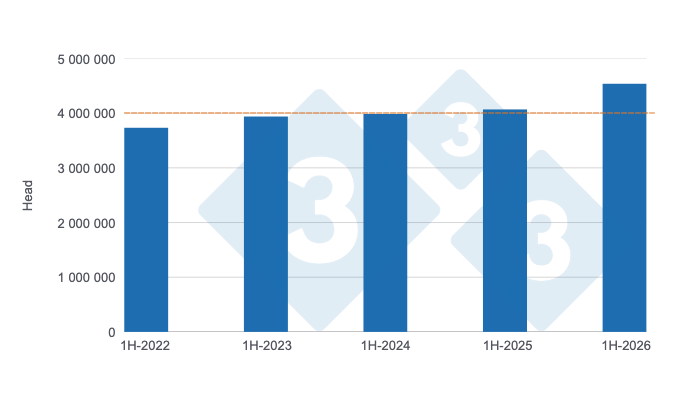
Figure 1. Trends in pig slaughter in the first half of the year over the past five years. Prepared by 333 Latin America with data from the Secretariat of Agriculture, Livestock, and Fisheries of Argentina’s Ministry of Economy.
Production: June set a record
Pork production totaled 435,605 metric tons (t) in the first half of the year, representing a 13.4% increase compared to the same period in 2025 and marking the sector’s best first half of the year in the five-year period. But perhaps the real standout is the month of June, which, with 81,002 t, not only recorded the highest production of the first half of the year but also surpassed any other month in the 2022-2026 series, including the previous highs of July 2024 (77,076 t) and December 2025 (76,921 t). What could explain this sharp acceleration? In part, the slaughter dynamics described above; but also, as we will see later, a moderate contribution from the average hog carcass weight. Between 2022 and 2026, semiannual pork production grew by 23.3%, representing a compound annual growth rate (CAGR) of approximately 5.4%—a pace slightly higher than that of slaughter (5.0% CAGR)—which confirms that not all of the growth came from slaughtering more animals.
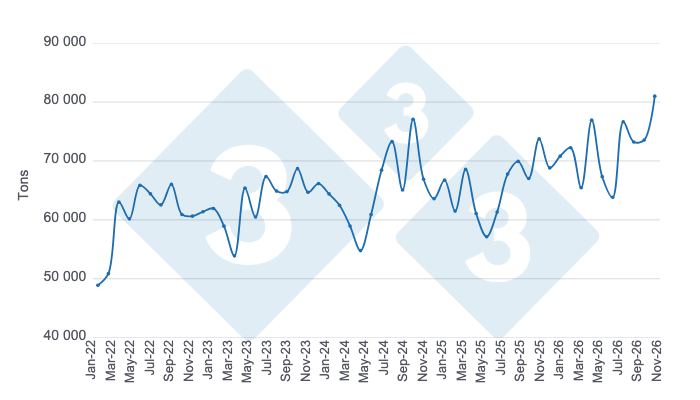
Figure 2. Trends in monthly pork production over the past five years. Prepared by 333 Latin America with data from the Secretariat of Agriculture, Livestock, and Fisheries of Argentina’s Ministry of Economy.

The gradual increase in average weights
Despite the strong performance in slaughter and production, average hog carcass weights have shown a relatively stable trend over the past five years. In fact, the average for the first half of the year rose from 94 kg in 2022 to 96 kg in 2026—a moderate increase of just 1.6% over five years—well below the growth rate of the other two indicators analyzed. June 2026 recorded an average of 99 kg for bone-in carcasses—the highest weight in the entire series—although, to be precise, it tied the all-time high set in July 2025. It is also worth mentioning a seasonal pattern that repeats year after year: weights tend to rise between May and July and fall between December and February, a trend that likely reflects specific dynamics of the Argentine pork market rather than an underlying structural trend. In short, while slaughter and production are at their highest levels in five years, weights are increasing at a much more conservative pace, which gives us a much clearer picture of the nature of this growth.
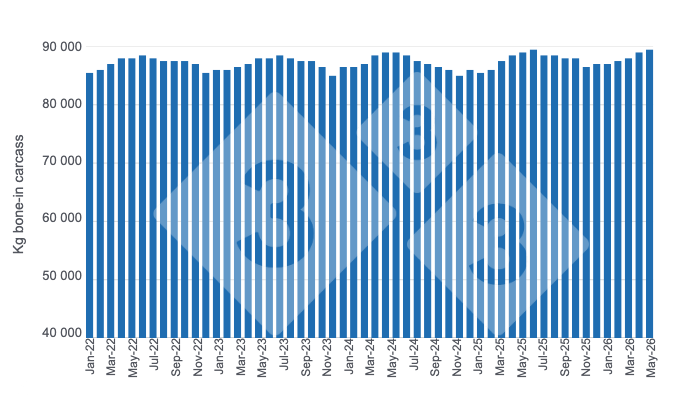
Figure 3. Trends in the average carcass weight of hogs over the past five years. Prepared by 333 Latin America with data from the Secretariat of Agriculture, Livestock, and Fisheries of Argentina’s Ministry of Economy.
Conclusion
What we’re seeing in the first half of 2026 is, above all, extensive growth: the Argentine swine industry is slaughtering more animals, but not necessarily much heavier ones. This does not detract from the sector’s performance—quite the contrary—but it does require us to temper our enthusiasm with some technical rigor: the all-time record for the series was set in June, while slaughter, despite its strength, still has the December 2025 figure as its historical peak. We will continue to closely monitor whether this acceleration in 2026 is sustained in the second half of the year, or whether—as occurred between 2024 and 2025—the sector returns to a more moderate growth trajectory. What is clear is that the Argentine pork industry is entering the second half of the year from its strongest starting point in the last five years.
333 Latin America with data from the Secretariat of Agriculture, Livestock and Fisheries of the Ministry of Economy of Argentina.
https://www.magyp.gob.ar/