

























 0
0
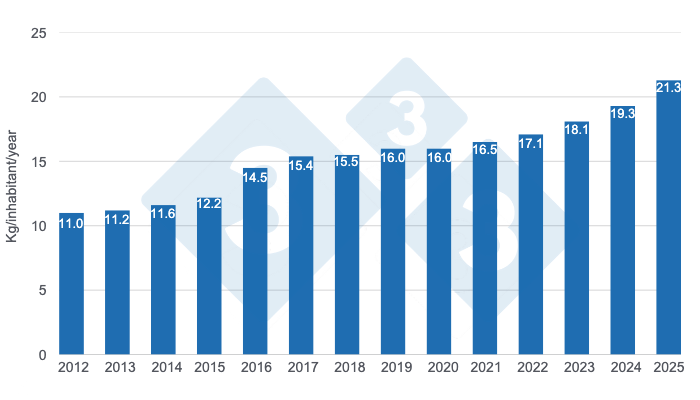
The available data shows a gradual, non-linear growth pattern: between 2012 and 2015, consumption remained relatively stable between 11.0 and 12.2 kg/capita, with a compound annual growth rate (CAGR) of 3.5%. The year 2016 marked the largest jump in the entire series, reaching 14.5 kg/capita (+18.9%), after which consumption plateaued for five years between 15.4 and 16.5 kg/capita (2017-2021, CAGR of 1.7%), with 2020 being the only year showing no change compared to the previous year.
Since 2022, consumption has resumed accelerated growth: it rose from 16.5 to 21.3 kg/capita in four years, an increase of 29.1% and a CAGR of 6.6%, more than double that recorded during the previous plateau. The acceleration was progressive year by year—increases of 0.6, 1.0, 1.2, and 2.0 kg between 2022 and 2025—with the 2025 increase (+10.4%) being the most pronounced since the surge in 2016.

With the 2025 result, Costa Rica ranks fourth in per capita pork consumption in Latin America, behind Chile, and enters the regional top 5, which currently ranges from 20 to 24 kg/person.
The apparent consumption balance indicates that the increase in demand was met by imported products: between 2023 and 2025, apparent consumption grew by 15.6%, rising from 89,666 to 103,670 tons, with an additional 16,309 tons coming from imports—which increased by 89.3%—compared to a 3.3% contraction in domestic production. In this balance, 66.7% of consumption in 2025 was comprised of local production and the remaining 33.3% of imported products, increasing the share of imports compared to the 20.4% recorded in 2023.
333 Latin America with data from CNP, SENASA, the Ministry of Finance, and CAPORC.
https://www.cnp.go.cr/