

























 2
2
Over the past decade, the Vietnamese swine sector has undergone profound structural changes and has faced significant challenges with the arrival of African swine fever. We review the current state of pig production in Vietnam between 2023 and 2025, examining production trends, consumption patterns, trade flows, disease challenges, industry consolidation, and the factors shaping the future development of one of Asia's most important pork-producing nations
The importance of pig production in Vietnam
Vietnam is among the world’s top pork producers, currently ranking sixth, behind only China, the EU, the US, Brazil, and Russia. In 2025, its live hog output totaled approximately 5.4 million tons live weight, a 5% increase from the year prior.

Table 1. Top Producing Countries according to USDA (2025/2026)
| Market | Production (mt) |
|---|---|
| China | 59.38 |
| European Union | 21.95 |
| United States | 12.52 |
| Brazil | 4.75 |
| Russia | 4.34 |
| Vietnam | 3.94 |
| Canada | 2.15 |
| South Korea | 1.43 |
| Mexico | 1.37 |
| Japan | 1.28 |
Domestic consumption
Pork remains Vietnam’s dominant animal protein, currently accounting for nearly 64% of total livestock product consumption. Vietnam’s pork consumption has increased steadily in recent years:
- 2021: 30 kg/person
- 2024: 37 kg/person
- 2025: 39 kg/person
Those figures place Vietnam fourth in the world for per capita pork consumption and making it the leading consumer in Southeast Asia.
Trade
In 2024, Vietnam imported 109,000 tons of pork, down nearly 9% year-on-year.
Table 2. Vietnam's pork imports in 2024. Source: Vietnam Import - Export Report 2024.
| Metric | 2024 value | YoY Change |
|---|---|---|
| Volume | 109,000 t | -8.9% |
| Value | $257.3 million | -12.2% |
| Avg. price | $2,338/t | -3.7% |
The main countries that exported to Vietnam in 2024 were:
- Brazil: 39.5% of total imports
- Russia: 30.33%, (decrease from 2023)
- Canada: 6.35%, (increase from 2023)
- Germany: 6.04%
- Netherlands: 3.89%
- Other countries: 13.45%
Table 3. Vietnam's pork exports in 2024. Source: Import - Export Report 2024.
| Exports of fresh/chilled/frozen pork | 2024 | Change vs. 2023 |
|---|---|---|
| Volume | 9,400 tonnes | -11.9% |
| Value | $58.88 million | -7.1% |
The dominant market was Hong Kong (China), which imports mainly frozen whole suckling pigs and pigs.
Import of raw materials for feed production
Vietnamese livestock feed industry is heavily import-dependent, with over 65% of raw materials and over 90% of feed additives sourced from abroad. The main imported products relevant to Vietnam's feed industry are corn (maize), soybeans, wheat, and premixes.
Table 4. Main imports for Vietnam's feed industry (2024).
| Product | Volumes 2024 | Main supplying countries |
|---|---|---|
| Corn (Maize) | 12.5 million tonnes | Argentina (6.4 Mt) Brazil (4.9 Mt) Laos (0.10 Mt) |
| Wheat | 5.74 million tonnes | Ukraine (1.5 Mt) Australia (1.2 Mt) Brazil (1.17 Mt) United States (0.49 Mt) |
| Soybeans | 2.2 million tonnes | Brazil (1.1 Mt) |
Pig production in Vietnam
Below are a map and chart showing where pig production is concentrated in the country and how the different areas have evolved over the last few years.
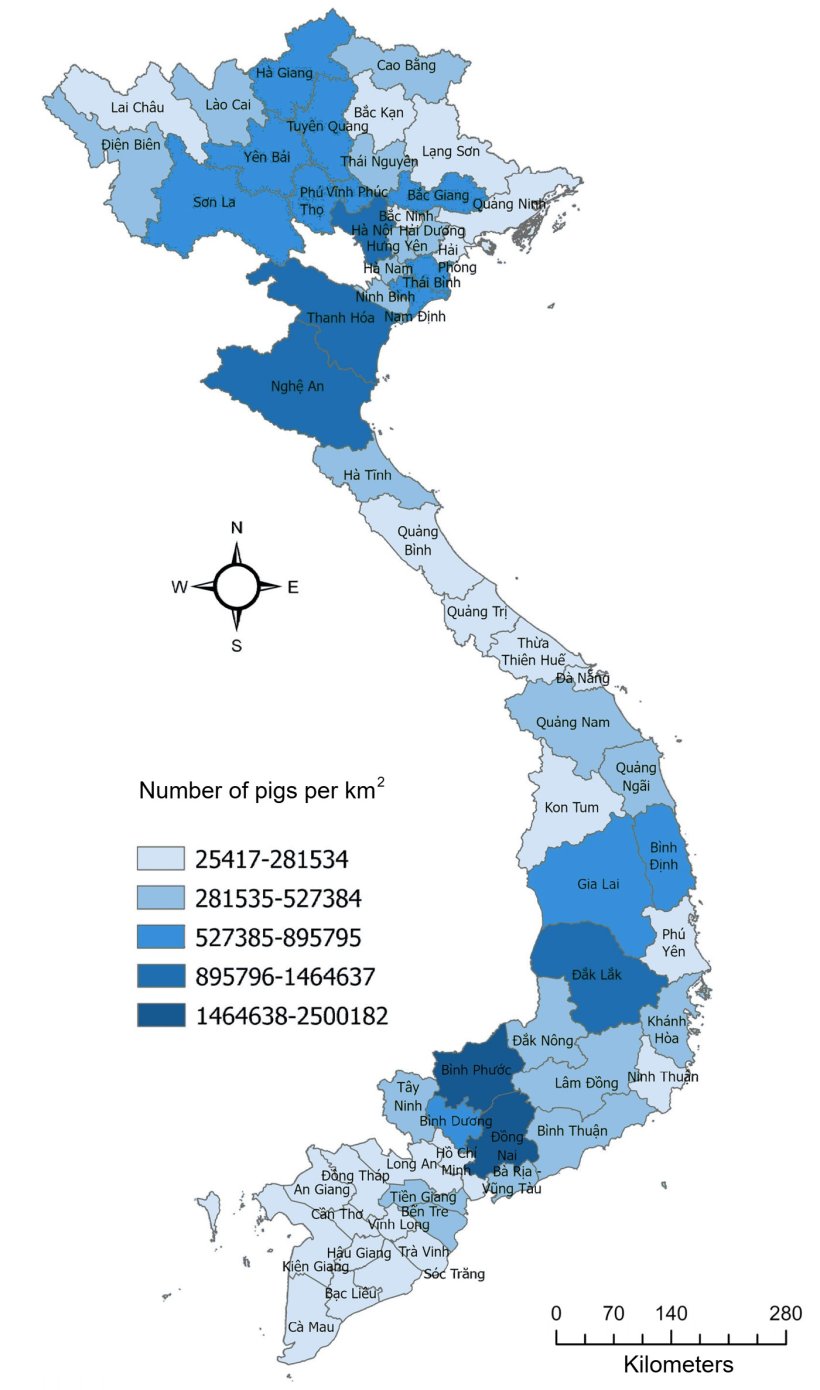
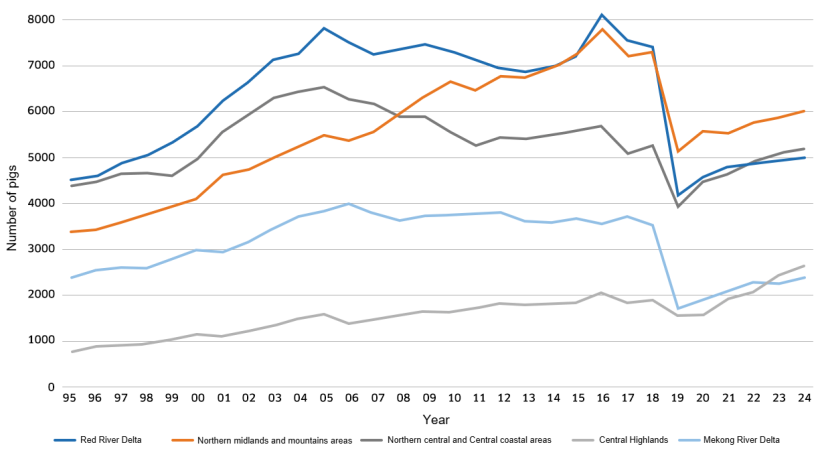
The marked decrease across all regions in 2019 was due to the African swine fever epidemic. The Red River Delta was historically the highest producing region, but after being heavily hit by ASF, it has been surpassed by the Northern midlands and mountain areas as well as the Northern Central and Central costal area. While the central highlands has the least census. It was the least affected by ASF and has seen steady growth since 2019.
How ASF has reshaped pig production in Vietnam
African swine fever (ASF) reached Vietnam in February 2019. During the initial phase of the ASF epidemic, nearly 6 million pigs died or were culled. This represented approximately a 25% decrease in the total pig population by December 2019 compared to 2018.
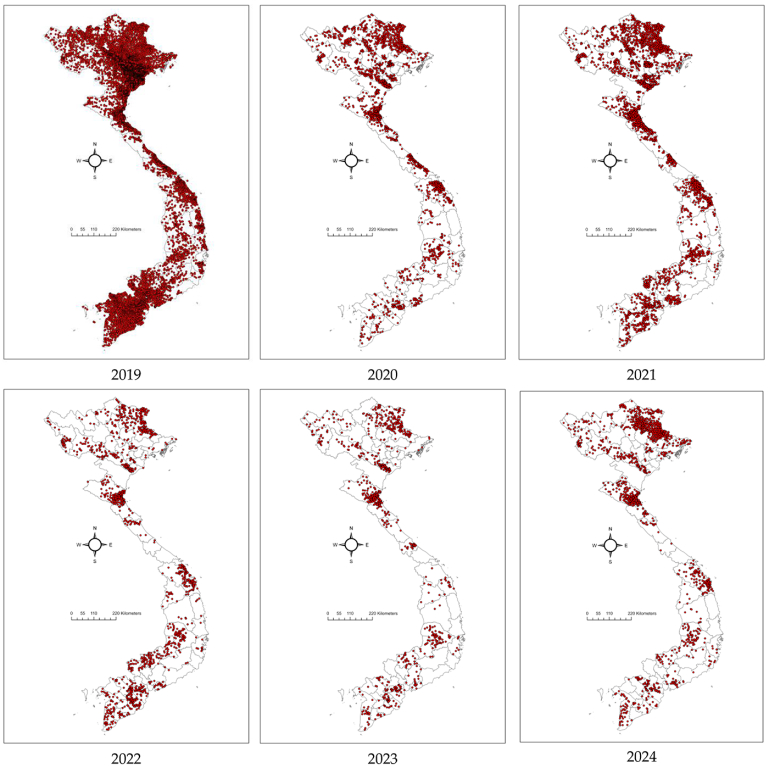
The ASFV strains circulating in Vietnam from 2019 to 2020 were genotype II and showed a complete genetic similarity with Chinese ASFV strains. This similarity suggests that the virus may have entered Vietnam from China through the uncontrolled cross-border trade.
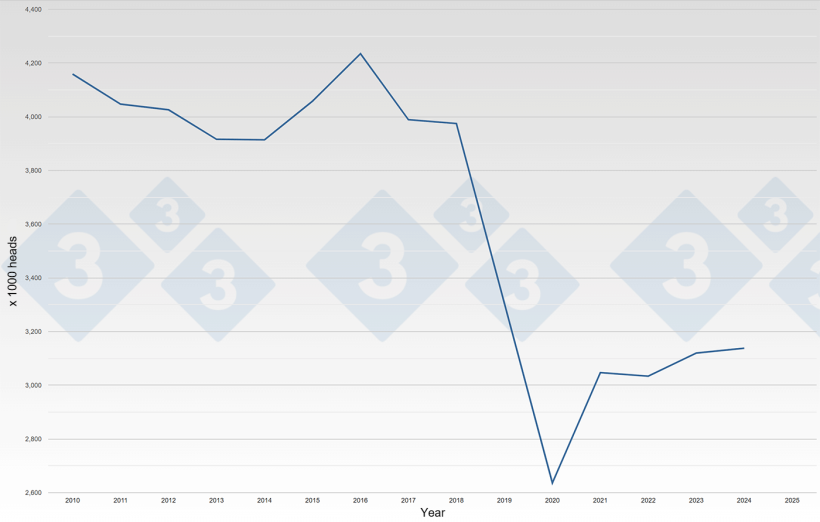
ASF continues to be the most significant threat to Vietnam’s swine sector. From January to September 2025, there were 1,780 ASF outbreaks across all 34 provinces, leading to the culling of over 650,000 pigs (Table 5).
Table 5. Summary of the ASF outbreaks from 2019 to 2024.(Chuong, V et al, 2025)
| Year | # of outbreaks | # of ASF-affected provinces/cities | # of pigs dead/culled |
|---|---|---|---|
| 2019 | 8,517 | 63/63 | 6,000,000 |
| 2020 | 1,808 | 50/63 | 87,668 |
| 2021 | 3,211 | 60/63 | 299,878 |
| 2022 | 1,407 | 54/63 | 66,715 |
| 2023 | 952 | 46/63 | 44,390 |
| 2024 | 1,669 | 48/63 | 92,707 |
| Total | 17,564 | 6,591,358 |
The majority of ASF cases have occurred on smallholder farms. Recombinant ASFV genotypes (I/II) were detected in Vietnam in 2023, complicating disease control.
Beyond ASF, other swine diseases including FMD, PRRS, and influenza remain problematic but receive less attention. Diseases such as ileitis, Mycoplasma suis (Eperythrozoonosis) have re-emerged following reduced antibiotic use in feed, highlighting the need for herd health improvements.
Trends in Vietnam’s pig production
The structure of Vietnam’s pig production has been changing from smallholder farms to commercial farms. Small farms are gradually exiting the industry or switching to contract farming. In the last five years, small-scale farming has been shrinking by about 5-7% per year with a more profound 15-20% drop from 2019 to 2022. Currently, household farms produce 38% of the country’s pork while larger farms account for 62%.
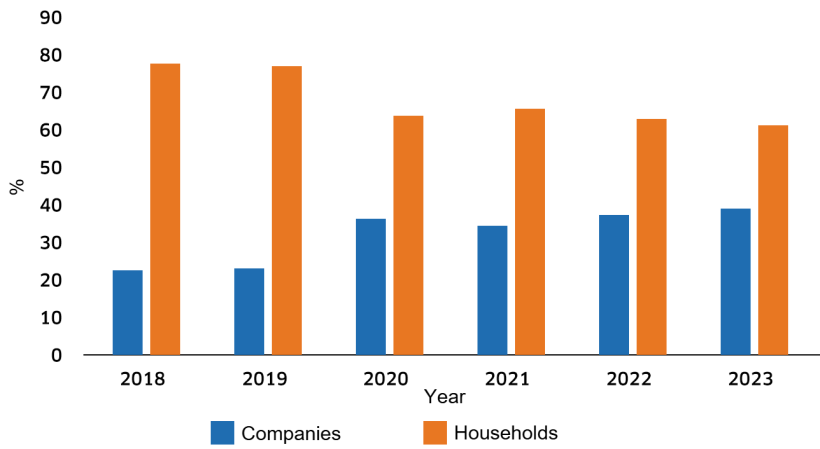
Foreign investments are shaping the industry. Foreign companies hold about 43% of the market share, giving them an overwhelming advantage in the industry.
Table 5. Example of Swine production companies in Vietnam.
| Company logo | Company name | Headquarters | Notes |
|---|---|---|---|
 |
CP Vietnam | Charoen Pokphand Foods Public Company – Thailand |
It is a fully integrated agro-industrial and food business, with production facilities established through investments and joint ventures across 17 countries. As of 31 December 2024, 21% of CP sales revenue come from its operation in Vietnam In 2020, CP Vietnam produced more than 5 million pigs |
 |
Japfa Comfeed Vietnam | Indonesia |
Feed- Farm- Food Since 1996 |
 |
Masan MeatLife (Masan Group) | Vietnam |
Feed-Farm- Food. In November 2021, they transferred its animal feed business and entered into a strategic partnership with De Heus Co., Ltd |
 |
New Hope | New Hope Group - China |
A private enterprise group with modern agriculture, animal husbandry and food industry as its main business. Over 930,000 pigs/year |
 |
De Heus Vietnam | The Netherlands |
Working with integration models. It has performed several acquisitions and strategic partnerships:
|
 |
CJ Vina Agri Co., Ltd. | CJ Korea Group | Closed 3F (Feed-Farm-Food) model. |
 |
Mavin Group | Mavin Group is the successor of Austfeed Join Venture, a joint venture project between Vietnam and Australia | Vertically integrated operations |
 |
Dabaco Group | Vietnam | Operates a vertically integrated animal feed, livestock farming, food processing and retailing business. |
 |
GreenFeed | Vietnam | 3F Plus food chain (Feed – Farm – Food) |
 |
BAF Vietnam | Vietnam |
Feed-Farm-Food 40 farms with 800,000 head On September 16, 2024, announced a strategic partnership with Muyuan Foods Co., Ltd |
 |
Truong Hai | Vietnam | The expected plan to sell commercial pigs in 2025 is 394,320 heads, and in 2030 is 436,000 heads |
 |
Hoa Phat | Vietnam | Over 660,000 head (380,000 market hogs + ~280,000 breeding piglets) |
Market situation
In 2024–2025, live pig prices varied regionally, with the southern provinces recording the highest prices due to short supply, leading to movement of pigs for slaughter from north to south. The price gaps between regions can explain the movement of pigs, which also led to the spread of ASF around the country.
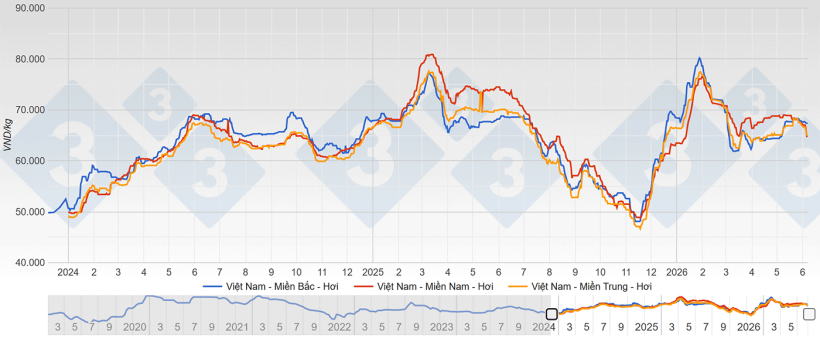
Investment analysis showed high establishment costs for farrow-to-finish farms illustrating the financial barriers for small producers. It seems to be that if the market price less than 50,000 dong/kg LW ($ 1.89- june26) would be the big problem for pig producers.
Conclusion
ASF remains the primary constraint for the swine industry, with long-term impacts on productivity and farmer confidence. Despite challenges, Vietnam’s pig sector retains strong growth potential, driven by domestic pork demand and ongoing industrialization.