


























 0
0
Once one understands that maternal microbial imprinting can influence the health and performance of piglets from their first hours of life (see "The sow shapes the piglet's future, part 1"), the next question is how to intervene in this process. In recent years, various nutritional strategies have been developed that can modulate the sow's microbiota and, consequently, influence microbial colonization and immune programming in her progeny. Although research continues to advance, the available evidence already allows us to identify several tools with the potential to promote more beneficial imprinting and improve both the robustness and productivity of piglets.
What tools do we have to modulate imprinting?
There are increasingly more strategies to modulate imprinting.

Probiotics
These are probably the most studied tool. Several studies have shown that supplementing the sow with Bacillus, Lactobacillus, or live yeast species modifies the composition of both the maternal and neonatal microbiota.
One of the most interesting studies demonstrated that administering Saccharomyces cerevisiae boulardii during lactation improved piglet growth and reduced the pulmonary inflammatory response following vaccination against Actinobacillus pleuropneumoniae, suggesting a clear maternal imprinting effect mediated by the gut-lung axis (Bravo de Laguna et al., 2022).
Similarly, prolonged supplementation with Bacillus amyloliquefaciens and Bacillus subtilis strains produced persistent modifications in the microbiota of sows and their piglets, with reproductive improvements and a high correlation between both microbiotas even after weaning (Saladrigas-García et al., 2022).
An intervention in the dam can transform the microbiome and immune response of her progeny.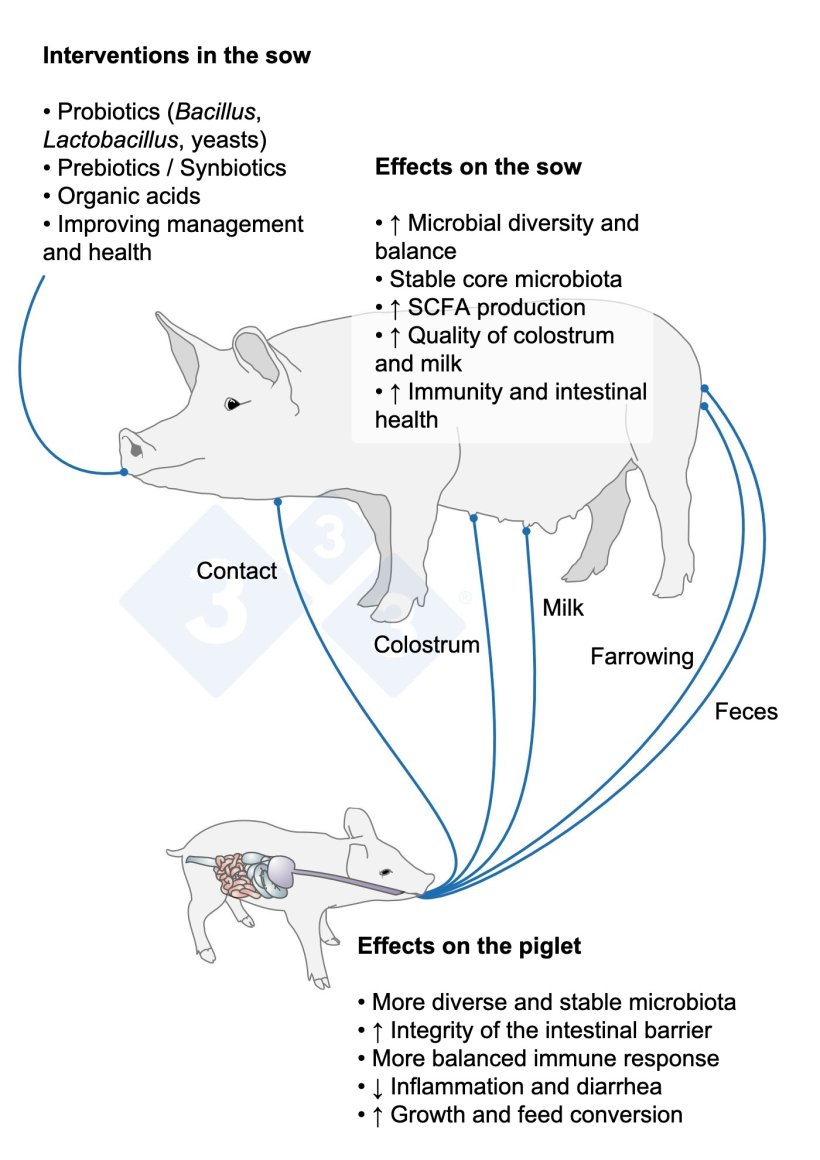
Prebiotics and synbiotics
Prebiotics do not provide bacteria, but rather the nutrients needed to promote the growth of beneficial populations. When combined with probiotics, they form what are known as synbiotics, which can promote more stable colonization by the administered bacteria. In addition, certain oligosaccharides present in colostrum act as natural prebiotics, promoting the growth of fermentative bacteria and limiting the development of potentially pathogenic microorganisms.
Organic acids
Organic acids are another particularly interesting tool. In addition to modifying intestinal pH, they promote certain bacterial groups that produce short-chain fatty acids, which are essential for the maturation of the intestinal epithelium. Their combination with probiotics appears to have synergistic effects on the stability of the microbial ecosystem.
When the microbiota changes, production changes
A project called IMPRINTING is currently being carried out by the University of Murcia and FARMFAES. The microbiota of sows and their piglets has been characterized at birth and at 21 days. One of its most interesting findings is that changes in the microbiota affect not only bacterial composition, but also the relationship between the microbiota and production performance parameters (unpublished data).
Under baseline conditions, some indicators of microbial quality showed a particularly strong association with reproductive parameters, such as the percentage of returns to estrus or the replacement rate. However, after the nutritional intervention, these relationships changed markedly: the ecological quality of the microbiota began to be associated primarily with growth parameters, such as average daily gain and weight at the end of the nursery period, while the association with reproductive parameters decreased.
This finding is especially relevant because it indicates that modifying the microbiota is not simply a matter of increasing or decreasing certain bacteria. What is truly important is modifying the functioning of the intestinal ecosystem and how it influences the animal's physiology. But we're not just talking about production parameters…
- The review by Jiang et al. (2022) summarizes the role of maternal imprinting in IUGR piglets.
- Beaumont et al. demonstrated that altering the primary colonizing microbiota persistently modifies epithelial homeostasis and imprints intestinal stem cells.
- As previously mentioned, Bravo de Laguna et al. (2022) demonstrated that Saccharomyces cerevisiae boulardii administered to sows reduces lung inflammation and improves piglet growth, and that the main influencing factor was administration to sows, more so than administration to piglets.
- Saladrigas-García et al. observed a strong correlation between the microbiota of sows and that of their piglets even after weaning.
Therefore, all indications suggest that intervening with the sow gives us several-week head start compared to direct intervention with the piglets (if we implement these interventions through their feed). And these early interventions will definitively shape the piglets' development and, consequently, their future health and productivity.
Conclusions
For decades, pig production has focused on optimizing genetics, nutrition, and piglet management. However, evidence accumulated in recent years shows that a significant part of productive performance begins long before farrowing.
The sow does not only pass on genes. She passes on microorganisms, metabolites, immunoglobulins, and immunological signals that influence gut development, immune system maturation, and, likely, the animal's lifetime productive efficiency.
This set of processes constitutes maternal microbial imprinting, a concept that is transforming our understanding of pig production.
Nutritional interventions targeting the sow—through probiotics, prebiotics, synbiotics, or management strategies—offer a unique opportunity to modulate this process in a controlled manner. Results obtained to date show that it is possible to improve the quality of the piglet's microbiota, promote a more stable intestinal ecosystem, and even modify the relationship between the microbiota and productive performance.
Perhaps the most important lesson of this new discipline is also the simplest: the piglet's microbiota doesn't begin in the piglet. It begins in the sow. Understanding this principle means moving from treating diseases once they appear to designing more robust animals from the start. This change in approach could become one of the most significant transformations in pig production in the coming years.
| KEY TAKE-AWAYS |
|---|
| The piglet is not born "sterile", it is born ready to receive an essential microbial legacy. |
| The sow is the first and most important architect of the holobiont of her progeny. |
| Acting on the sow is the most effective way to build a healthy and productive future. |
| Investing in maternal microbial imprinting is investing in the future of swine production. |
