


























 0
0
Changes in feed intake levels in animals are a very revealing clinical sign that we use in our daily clinical practice as veterinarians. The presence of animals that appear to have reduced feed intake is interpreted as a sign of a disorder, whether due to illness, environmental discomfort, feed problems, lack of access to water, etc.
Factors that can affect feed intake in growing pigs

- Irregular feed supply or difficult access to feed
- Spoiled feed or feed with an unpleasant odor/taste
- Illness
- Heat stress
- Limited access to drinking water
- Competition for resources in the pen
In such cases, changes in feed intake are interpreted as the consequence of an abnormal situation, the expression of a disorder that affects the pig and conditions its feeding behavior. However, information collected by feeding stations that accurately record each pig's daily consumption has made it possible to identify that a portion of feed consumption behavior can be explained by genetics.
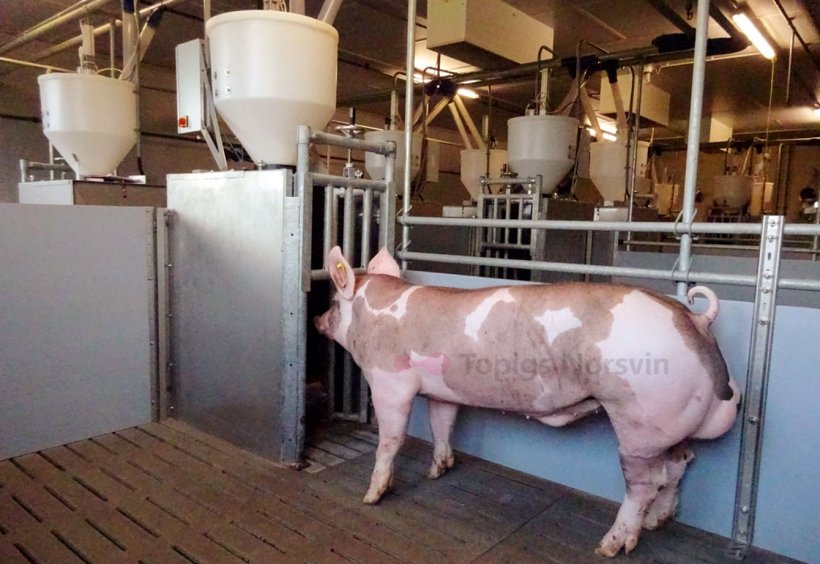
Figure 1. A Pietrain boar next to a feeding station that tracks the amount of feed consumed by each pig.
Can controlling the change in intake levels help us improve robustness?
The importance of robustness
The challenges imposed by the evolution of the industry, such as the drastic decrease in antibiotic use, the difficulty of finding qualified personnel, and frequent health challenges, have further highlighted the need to select more robust and resilient animals that are capable of continuing to perform well even under sub-optimal conditions.
From a genetic improvement standpoint, there are different strategies aimed at obtaining more robust animals:
- Direct selection against mortality, whether in pre weaning, nursery and finishing phases, or the reproductive life (sow mortality)
- Direct selection against some of the causes of this mortality, such as prolapses or lameness.
- The use of genomics in swine breeding programs, enabling the implementation, for example, of specific genetic markers related to disease resistance (WUR marker, PRRS resistance; Boddicker et al., 2012, 2014; Dunkelberger et al., 2017)
Furthermore, the large-scale collection of various data and measurements from animals (phenotypes) allows us to identify correlations between certain characteristics and greater animal robustness. This enables us to use these phenotypes as indirect indicators of robustness and to estimate genetic values that can be incorporated into the selection objectives for different genetic lines.
Feed intake variation is an excellent example of a phenotype that can be used in breeding programs to produce more robust animals.
A recent study by Putz et al. (2019) demonstrated that, under health challenge conditions, variation in daily feed intake could serve as an indicator of overall resilience to disease, as there is a negative correlation between this phenotype and mortality.
Animals with less variation in daily feed intake showed lower mortality, higher daily gain, and fewer medication treatments.
In addition, moderate heritability was estimated for this phenotype (0.21 ± 0.07), suggesting it could be used as a heritable measure of resilience in pigs.
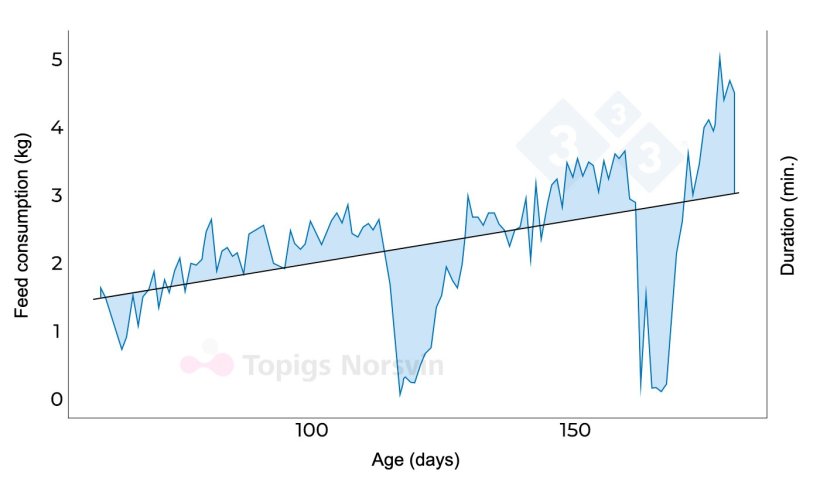
Figure 2. Example of a graphical representation of variation in daily intake. Adapted from Putz et al., 2019.
This study revealed some very interesting genetic correlations.
Table 1. Estimated genetic correlations between variation in daily feed intake and other evaluated parameters (mortality, number of treatments, and average daily gain). Adapted from Putz et al., 2019.
| Trait #1 | Trait #2 | Estimate |
|---|---|---|
Variation in daily intake  |
Mortality |
0.37 |
| Variation in daily intake |
# of Medication treatments |
0.52 |
| Variation in daily intake |
Final ADG  |
- 0.31 |
In this study, data were collected under conditions of health challenge in which the animals were subjected to experimental infections. However, on genetic selection farms, where feeding stations are typically available, data on individual feed intake for the selection of breeding stock are collected under High health conditions.
This raises the question: to what extent can a genetic value estimated under High health conditions serve as an effective predictor of robustness when animals are exposed to a disease challenge?
To test this:
Individual feed intake data were collected from 5,726 purebred pigs at a genetic nucleus, and genetic values for variation in daily feed intake were estimated based on this information
Out of the 5,726 animals, 20 boars were selected
The 20 boars were used for breeding at a commercial farm, resulting in 1,356 offspring
The 1,356 progeny were housed in an experimental facility where they were infected with PRRS virus and exposed to various pathogens, and their survival rate was assessed.
The results showed a negative correlation (-0.48) between the estimated genetic value for variation in daily feed intake and the progeny's survival rate. In other words, the progeny of boars estimated to have lower variation in daily intake exhibited lower mortality under challenge conditions (Harlizius et al., 2020).
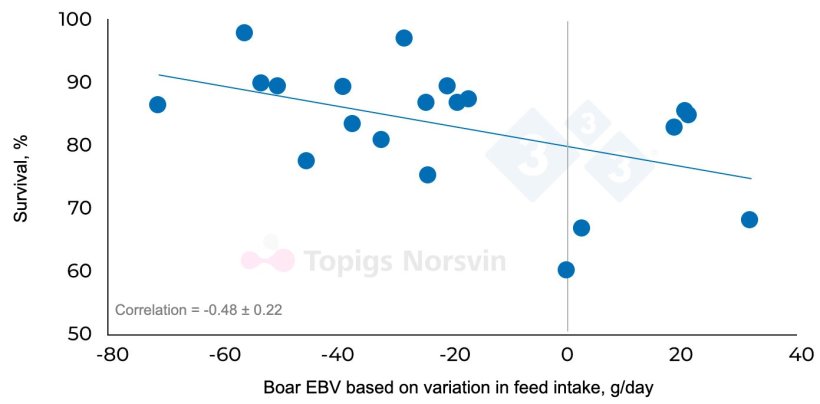
Figure 3. Relationship between estimated breeding values (EBVs) for variation in daily feed intake among different boars (n = 20) and the survival of their progeny (n = 1,356 pigs) in a challenge trial involving multiple pathogens, including PRRS.
These results suggest that genetic selection aimed at reducing variation in daily feed intake could be used to improve pig survival under health challenge conditions. It is, therefore, an indirect way to improve the robustness of all our lines.
Currently, variation in daily feed intake is a selection criterion for all Topigs Norsvin lines.