

























 0
0
Once again, the community of 333 users has participated in our annual survey on pig price expectations for the current year. This year, we collected over 550 responses from multiple countries. From these, we present the nine markets with the most responses, those that had enough to analyze.
The following chart compares the predictions for 2026, represented by the median and range of the responses, with two key reference points: the actual average price in 2025 and the historical average for the 2020-2025 period.

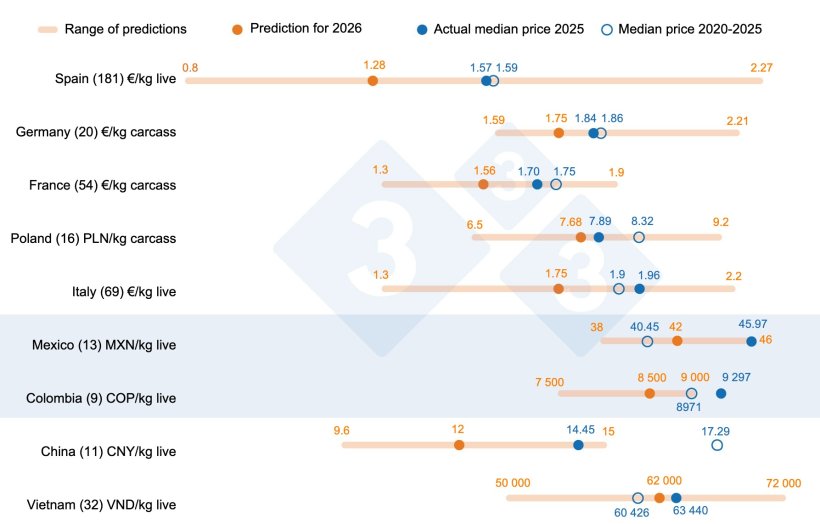
Figure 1. Pig price forecast for 2026: comparison between 333 user predictions and the actual average price in 2025 and during the 2020-2025 period. For each country, the range of responses is shown by the orange bar, where the maximum, minimum, and median values are represented. The actual average price in 2025 and 2020-2025 is indicated by blue dots. The number of data points analyzed for each country is shown in parentheses.
One common denominator: All markets expect lower prices than in 2025
The most striking finding from this edition is its unanimity. In the nine markets analyzed—five European, two American, and two Asian—the median prediction for 2026 is below the actual price recorded in 2025. This is unusual in this historical series, where there have always been markets with upward expectations that offset the pessimism of others.
Europe: Declines expected in all markets
The five European markets paint a clear bearish picture, albeit with some nuances. This European outlook cannot be separated from the situation in Spain, the EU's largest producer, a country that confirmed the presence of African swine fever (ASF) in wild boar in the province of Barcelona at the end of 2025, 30 years after having eradicated the disease. This confirmation triggered a chain reaction: several third countries automatically suspended their import certificates, cutting off exports to a significant portion of Spanish production, which is now being absorbed by the European internal market, intensifying pressure on prices across the continent.
In this context, the unanimous pessimism of the surveyed European markets can also be interpreted as a reflection of this interdependence: when the bloc's largest producer faces a crisis of this nature, the ripples spread throughout the entire European market.
Let's see, then, how our European users believe prices will evolve this year.
In the case of respondents from Spain, the market with the highest participation (181 responses), the prediction is the furthest removed from recent reality: the forecast is €1.28/kg live weight, compared to an actual price of €1.57/kg in 2025 and a historical average of €1.59/kg for 2020-2025. Spanish respondents expect prices in 2026 to be approximately 19% lower than last year's, and also below the industry average of the last six years. The range of responses is also the widest (from €0.80 to €2.27/kg), reflecting a significant disparity in opinions.
Italy shows a similar pattern: the predicted price of €1.75/kg live weight represents an 11% drop compared to the actual price in 2025 (€1.96/kg), also falling below the historical average (€1.91/kg). In France, the median price of €1.56/kg carcass weight reflects an 8% decrease compared to 2025 (€1.70/kg) and is also further from the 2020-2025 average (€1.75/kg).
Germany and Poland show somewhat more moderate bearish expectations. German users predict a €1.75/kg carcass price, 5% lower than in 2025 (€1.84/kg). In Poland, the median of PLN 7.68/kg carcass price is slightly below the actual 2025 price (PLN 7.89/kg).
The Americas: Also bearish, breaking the trend of previous years
One of the most significant changes compared to previous editions is the shift in the Americas. In previous years, Mexico and Colombia tended to stand out for their upward expectations, offsetting European pessimism. In 2026, that counterweight has disappeared.
In Mexico, the median forecast price is 42 MXN/kg live weight, below the actual 2025 price, which was around 46 MXN/kg (-9%). In Colombia, the forecast price of 8,500 COP/kg live weight is also below the actual 2025 price (9,297 COP/kg) and the historical average for 2020-2025 (9,000 COP/kg). Participation of both markets remains limited, requiring caution in interpreting these data, but the direction of expectations is clear.
Asia: China very bearish, Vietnam almost stable
In Asia, the differences between markets are most pronounced. China had one of the most pessimistic predictions in relative terms: the median price of 12 CNY/kg live weight represents a 17% drop compared to the actual price in 2025 (14.45 CNY/kg), and is also further from the historical average for 2020-2025, which is around 15 CNY/kg. Chinese users anticipate significantly lower prices than in recent years, in line with the structural difficulties the industry is experiencing in the country.
Vietnam is the only market where expectations are close to stable: the median prediction (62,000 VND/kg live weight) is very close to the actual price in 2025 (63,440 VND/kg), with a 2% difference. It is the least pessimistic market of all those analyzed.
Rational correction or excessive caution?
We'll know the real figures at the end of the year, and as always, we'll be able to assess who was most accurate at year-end. In the meantime, the chart serves as a snapshot of collective prudence, an unusual moment in this survey's history.
333 Staff.