

























 0
0
The swine industry in Latin America has evolved beyond on-farm efficiency. Today, business success depends on market-oriented strategic decisions: knowing and understanding different types of customers is largely what defines the sustainable competitiveness of an operation.
The key tool for achieving this is the buyer persona: a detailed profile of the ideal customer that allows you to align marketing, sales, and service processes with the real needs of distribution channels and end consumers. This alignment directly impacts profit margins and the long-term viability of the business.

Evolution of the pork market
Pork consumption in Latin America shows a sustained upward trend. In 2023, the regional average was estimated at 15 kg per capita per year, with projections indicating it will exceed 18 kg per capita by 2030.
At the same time, buyers (both institutional and end consumers) are becoming increasingly demanding: quality, safety, traceability, on-time deliveries, and after-sales service are variables that now carry as much weight as price. This forces retailers to design differentiated strategies based on each client's profile.
What is a buyer persona, and why use it in the pork market?
The buyer persona is a detailed description of the ideal customer a company wants to attract. It is built from market research and environmental analysis (PESTEL) and integrates four fundamental dimensions:
- Type of buyer: Traditional channel, modern channel, HORECA, and processing industries.
- Needs and expectations: What the customer is really looking for when buying.
- Pain points: Difficulties or challenges you want to avoid.
- Decision factors: Price, service level, and on-time delivery.
The main buyer profiles in the pork sector
Each region has its own particularities, but the following profiles are frequently seen in Latin American markets:
The traditional butcher: Their decision revolves around price. They seek rapid turnover and immediate profit margins. The relationship is transactional and highly sensitive to competition.
The wholesale distributor: Prioritizes reliable logistics and consistent supply. Negotiations are typically closed with volume discounts and purchase incentives.
The modern channel (supermarkets and chains): It rigorously evaluates standardization, certifications, and regulatory compliance. It strictly penalizes non-compliance in quality or delivery times.
HORECA (hotels, restaurants, and catering): It requires specific cuts and presentations for its operation. Although it handles smaller volumes, it is the channel with the greatest margin potential for the marketer.
Let's look at an example of what the buyer persona of an end consumer of pork might look like:
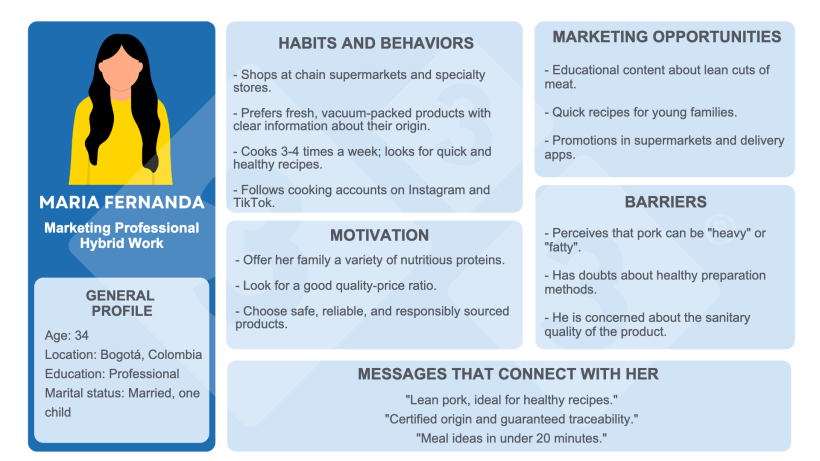
Figure 1. Example of a buyer persona.
By clearly defining the buyer persona, we will understand the different criteria the customer considers when making purchasing decisions, which will generate differentiated strategies with a better probability of obtaining the results expected by the producer.
Steps to define the buyer persona
1. Analyze customer characteristics
The starting point is to identify the main customers: that 20% who account for approximately 80% of revenue. For each one, it's recommended to answer the following:
- What are their purchase volumes per product or SKU?
- How often do they purchase?
- What factors determine their purchase decision?
2. Identify real needs
Beyond the price, it is key to understand:
- What inconveniences does the customer want to avoid?
- What are their short, medium, and long-term plans with their supplier?
3. Map actors and decision-making processes
Every purchase involves several roles: the influencer, the decision-maker, the one who executes the purchase, and the consumer. Identifying this internal chain (and the factors that each actor values) is essential for designing an effective sales proposal.
4. Give life to the profile
Assigning a name and specific characteristics to the persona helps you to visualize a real customer. This exercise facilitates the design of more concrete and applicable loyalty strategies.
What does the organization gain by using this methodology?
Working with well-defined buyer personas allows the pork marketer to:
- Focus sales efforts where there is real return.
- Improve customer selection and reduce churn.
- Rely less on discounts and aggressive promotions.
- Increase profitability and build longer-lasting business relationships.
Ultimately, a deep understanding of the ideal customer allows for the design of highly personalized value propositions. When the proposal aligns with the real expectations of each profile, the chances of closing the sale (that coveted "yes, I'll buy") increase significantly.