

























 1
1
Introduction
The highest piglet mortality rate occurs during the first few days of life. During this phase, colostrum is the primary factor influencing survival, growth, and immune development.
Although it has long been known that the amount ingested is a determining factor, there is growing evidence that the quality of colostrum also plays a key role.

A recent study analyzed the composition of colostrum in detail using a multi-omic approach, revealing direct relationships with mortality, growth, and the development of the piglets’ gut microbiota (Luise et al., 2026).
The study
The study included 20 sows (Large White × Landrace) grouped by parity:
- Gilts
- Second parity sows
- Multiparous sows
All the animals were raised under the same conditions and on the same diet to ensure a reliable comparison.
Immediately after farrowing, colostrum samples were collected and analyzed to determine:
- Nutritional composition
- Immunoglobulin content
- Fatty acids (more than 70)
- Metabolites (approximately 950)
These analyses provided a very detailed picture of this essential first source of nutrition.
At the same time, the gut microbiota of the piglets was studied at 6 and 24 days of age. The piglets—all from the same litters—were weighed and monitored to assess their growth and mortality.
Thanks to advanced statistical analyses, it was possible to correlate colostrum quality with microbiota development and piglet performance, providing a more comprehensive picture of the link between maternal nutrition and offspring health.
This approach not only made it possible to identify individual nutrients but also to highlight the functional relationships between maternal metabolism, colostrum, and piglet development, providing a more comprehensive picture than traditional analyses. The objective was to identify which components of colostrum—whether or not they depend on the sow’s parity—are most closely associated with the survival and growth of the litter.
Effect of parity on litter performance and the multi-omic characterization of colostrum
One of the main findings regards the role of parity. Second parity sows had the highest mortality rate, while gilts produced piglets with lower birth weights (Table 1). These results are consistent with the literature, which indicates that young sows face greater challenges related to nutritional requirements and physiological status.
Table 1. Effect of parity on piglet performance
| Parameter | Gilts | 2nd parity | Multiparous | P-value |
|---|---|---|---|---|
| At farrowing (d0) | ||||
| Total born (n) | 16.0 | 16.6 | 16.5 | 0.95 |
| Born alive (n) | 14.3 | 15.6 | 14.2 | 0.43 |
| Stillborn (n) | 1.00 | 0.57 | 1.50 | 0.23 |
| Mummies (n) | 0.85 | 0.42 | 0.83 | 0.50 |
| Birth weight (g) | 1.347ᵇ | 1.571ᵃ | 1.548ᵃᵇ | 0.036 |
| Lightweight piglets (%) | 34.0 | 21.0 | 25.5 | 0.21 |
| Normal piglets (%) | 49.7 | 47.1 | 57.5 | 0.64 |
| Heavy piglets (%) | 10.6ᴮ | 28.7ᴬ | 12.3ᴮ | <0.001 |
| Litter variability (%) | 21.1 | 14.0 | 19.4 | 0.39 |
| At 6 days (d6) | ||||
| Litter size (n)1 | 11.2 | 11.7 | 10.6 | 0.77 |
| Mortality (%)2 | 9.99ᴮ | 23.2ᴬ | 12.01ᴮ | <0.001 |
| Lightweight piglet mortality (%) | 34.1 | 54.3 | 61.8 | 0.47 |
| Weight (g) | 2.573 | 2.476 | 2.604 | 0.68 |
| Litter variability (%) | 16.1ᴬ | 25.8ᴮ | 20.2ᴬᴮ | 0.025 |
| Growth d0–d6 (g/day) | 176 | 154 | 177 | 0.56 |
| At 24 days (d24) | ||||
| Litter size (n)1 | 10.9 | 8.57 | 9.11 | 0.17 |
| Mortality (%)2 | 18.8ᴮ | 39.4ᴬ | 34.3ᴮ | <0.001 |
| Lightweight piglet mortality (%) | 42.4 | 60.1 | 64.3 | 0.63 |
| Weight (g) | 6.090 | 7.140 | 6.976 | 0.07 |
| Growth d0–d24 (g/day) | 195 | 237 | 231 | 0.08 |
1 The reduction in litter size on d6 and d24 is due both to piglet mortality and to the transfer of some piglets to other litters due to insufficient growth.
2 Mortality is cumulative and was calculated between d0 and d6, and between d0 and d24.
The different letters (a, b; A, B, C) indicate significant differences between groups; uppercase letters indicate the most pronounced difference (P < 0.05).
Contrary to what is often assumed in practice, traditional colostrum parameters—such as protein, lactose, and immunoglobulins—do not, on their own, explain the differences observed in piglet performance. In fact, no significant differences were detected for these parameters between the different parities.
The most significant differences are related to the fatty acid and metabolomic profiles of colostrum, as shown in Figures 1 and 2.
Regarding the fatty acid profile:
- Gilts present a lower ratio of polyunsaturated fatty acids to saturated fatty acids (PUFA/SFA).
- Gilts present a higher proportion of diet-derived PUFAs.
This suggests greater mobilization of body reserves in gilts, linked to higher energy requirements. Differences in branched-chain fatty acids (BCFAs) may also reflect the combined effects of diet and the microbiota.
The metabolomic profile reveals even more pronounced differences between parities. The main variations involve amino acid and peptide metabolites, which are more abundant in gilts (FruLeuIle, lysine, N-acetyltryptophan), indicating greater protein mobilization, likely related to suboptimal protein intake during the final stage of gestation. Gilts also show signs of greater oxidative stress (N-acetyltryptophan, S-lactoylglutathione), while multiparous sows exhibit a higher presence of metabolites of microbial origin (L-beta-homotyrosine), suggesting a more stable and mature microbiota.
In general, the effect of parity on colostrum composition is primarily related to the sow’s metabolic status: it is more critical in gilts and more stable in multiparous sows.
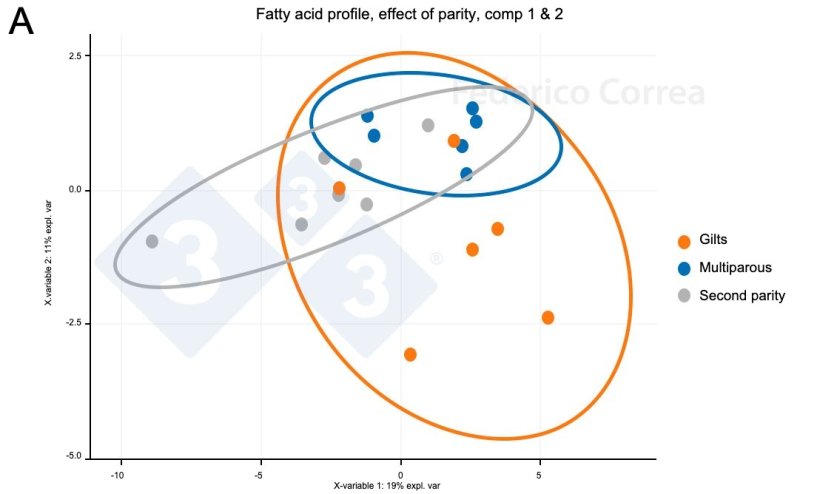
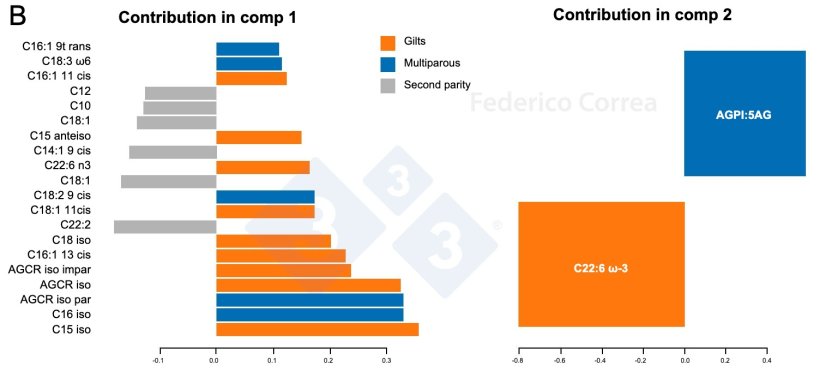
Figure 1. Effect of parity on the lipid and metabolomic profile of porcine colostrum. Analysis of the fatty acid profile (A-B) shows a partial separation between gitls, second parity sows, and multiparous sows (A), with specific fatty acids contributing to the differentiation between parity groups (B).
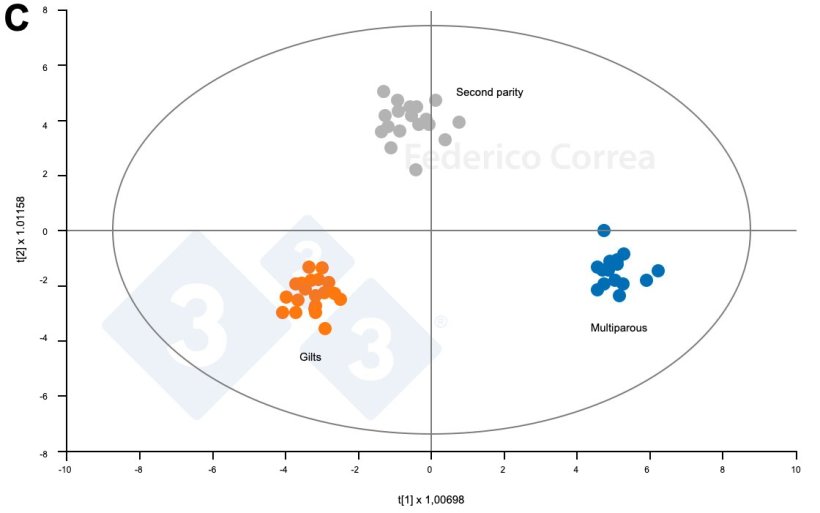
Figure 2. In contrast, the metabolomic profile (C-D) shows a clear separation among the three parity groups (C). The most discriminatory metabolites are primarily amino acids, peptides, and lipid derivatives (D). The VIP (Variable Importance for Projection) values indicate the importance of each metabolite in discriminating between the experimental groups; higher values correspond to greater discriminatory power. Positive Log2FC values indicate a higher concentration in the first comparison group, while negative values indicate a higher concentration in the reference group.
D |
Chemical Classification | VIP | Log2FC (gilts vs. multiparous) | Log2FC (gitls vs. 2nd parity) | Log2FC (2nd parity vs multiparous) |
|---|---|---|---|---|---|
| Metabolite | |||||
| FruLeulle | Peptide | 2.79 | 2.64 | 0.48 | 2.16 |
| Leu-Gly-Gly | Peptide | 2.77 | 0.83 | -1.34 | 2.17 |
| Lysine | Amino acid | 2.52 | 1.53 | 2.45 | -0.92 |
| N-acetyltryptophan | Tryptophan derivative | 2.08 | 2.33 | 1.45 | 0.88 |
| L-beta-homotyrosine | Amino acid derivative | 1.94 | -2.60 | -1.81 | -0.80 |
| Histidine | Amino acid | 1.71 | -1.11 | -1.12 | 0.01 |
| Kynurenine | Tryptophan derivative | 1.50 | -0.55 | 0.75 | -1.30 |
| Arginine ethyl ester | Arginine derivative | 1.46 | 0.08 | 0.96 | -0.89 |
| Lipoic acid | Lipid derivative | 1.44 | 0.63 | 1.29 | -0.65 |
| S-lactoylglutathione | Oligopeptide | 1.33 | 0.77 | 0.30 | 0.47 |
| L-carnitine | Carnitine | 1.30 | 0.28 | -0.53 | 0.81 |
| Guanosine monophosphate (GMP) | Nucleotide | 1.23 | 0.76 | 0.35 | 0.41 |
Log2FC: positive values → higher concentration in the first group; negative values → higher concentration in the comparison group
Practical implications
- The results indicate that colostrum should be evaluated not only in terms of quantity and immunoglobulins, but also in terms of its bioactive composition.
- Parity has a significant influence: the differences between gilts, second parity sows, and multiparous sows are primarily related to the sow’s metabolic status and impact piglet growth and mortality.
- In particular, gilts show signs of greater metabolic stress, suggesting the need for more specific nutritional management during the last stage of gestation.
Acknowledgments
This research was funded by the BOOSTcolostrum project (P2022ZTYLS—CUP J53D23018670001) – NextGenerationEU – National Recovery and Resilience Plan (PNRR) – Director's Decree No. 1409 of September 14, 2022. https://site.unibo.it/boostcolostrum/it