






















 Azienda
Boehringer Ingelheim Vetmedica GmbH
Germania
165
Pubblicazioni
1108
Followers
Azienda
Boehringer Ingelheim Vetmedica GmbH
Germania
165
Pubblicazioni
1108
Followers
Content Compass Conference edition ESPHM 2026–Florence


V. Rodriguez-Vega, Manuel Toledo, Emilio José Ruíz, Andrea Martínez, Anabel Fernández, Juan Ignacio Arias, Elena Goyena, Simón García Legaz
Material presented at ESPHM 2026
Background and objectives
Porcine Proliferative Enteropathy (PPE), caused by Lawsonia intracellularis (L.i.), is one of the most prevalent enteric diseases in European countries (1) with a major impact on pig performance. Pigs are usually infected subclinically and therefore it is often difficult for producers to assess the impact of the disease and the economic return of control programs. Sampling at slaughterhouses for qPCR testing has been proposed as a good method for diagnosing the disease, so the aim of this study is to investigate whether there are different results in slaughterhouse sampling in animals vaccinated with different vaccination schedules.
Material and Methods
This study was conducted in a 3,000-place fattening unit housing two consecutive groups of pigs raised under the same conditions. Pigs at fattening were suffering from clinical Ileitis confirmed by qPCR in fecal samples. The first group (group A) was intramuscularly vaccinated at 3 weeks of age with an inactivated intramuscular L.i. vaccine, Porcilis Lawsonia and the second group (group B) was vaccinated with a modified live L.i. vaccine, Enterisol® Ileitis by drinking water at 8 weeks of age,. In both cases, following the manufacturer's instructions. A total of 50 ilea were collected per group, 20 per group were sent to laboratory A and 30 per group to laboratory B to run qPCR. Fisher’s exact test was used to compare the results.
Results 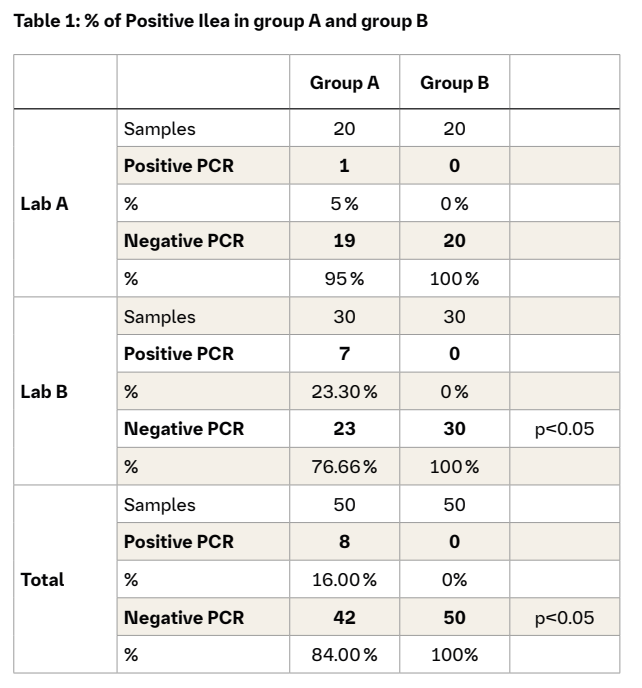
Results are summarized in Table 1. None of the ileums from pigs in group B were positive, while 16 % (p < 0.05) (5 % in laboratory A and 23.30 % in laboratory B p < 0.05) of the ileums from pigs in group A were positive with ct values between 26.05 and 38.22.
Discussions and Conclusions
Slaughterhouse sampling for Lausonia intracellularis qPCR testing of ilea appears to be a good method for comparing different control programmes for porcine proliferative enteropathy. Under the conditions of this study, oral vaccination is a more effective method of controlling Lawsonia intracellularis excretion until the final stages of pig growth. Under the conditions of this study, the group of animals vaccinated orally performed better than the animals vaccinated intramuscularly.
References
1. Arnold M, et al 2019. Prevalence of Lawsonia intracellularis in pig herds in different European countries. Porcine Health Management 2019;5:3 2. Jansen et al (2028) Proc 25th IPVS Congress II- 63
Have access to Content Compass Conference edition ESPHM 2026–Florence
Contatto:
Contattaci con questo modulo