






















 Company
Kemin
Belgium
6
products
48
Publications
423
Followers
Company
Kemin
Belgium
6
products
48
Publications
423
Followers
CLOSTAT® in Action: Rebuilding the Microbiome, Proven Stability, and a Practical Summer Protocol



CLOSTAT® in Action: Rebuilding the Microbiome, Proven Stability, and a Practical Summer Protocol
Throughout this series, we've review several points that shows Red Gut is a preventable syndrome driven by primarily heat stress, microbial dysbiosis, and Clostridium perfringens overgrowth. In Article 3, we showed that PB6 inhibits Clostridium. But PB6 does far more than just kill pathogens — it rebuilds the gut ecosystem that heat stress destroys.
Triple Mechanism of Action
CLOSTAT® (Bacillus velezensis PB6) works through three complementary mechanisms:
1. Competitive Exclusion
Probiotics will occupy a space in the microbiome which was used by other species. This will be the first step in improving microbial diversity
2. Direct Anti-Clostridial Activity (Surfactins)
As demonstrated in the antibiograms (Article 3), PB6 produces surfactins — cyclic lipopeptides that create pores in pathogenic bacterial membranes. These have broad-spectrum activity but show their strongest effect against C. perfringens (17.79 mm inhibition zone). The most effective compounds have MIC data of 6–20 ppm.
3. Quorum Quenching (Fengycin)
PB6 produces fengycin, a quorum-quenching molecule. C. perfringens uses quorum sensing (QS) to coordinate virulence — when cell density reaches pathogenic levels, QS messengers trigger toxin production (including NetB toxins). Fengycin inhibits this QS signalling, so even when some Clostridium cells are present, they cannot "talk" to each other and therefore cannot initiate disease.
Proven Stability in Wet Feed Systems
A common concern in European pig production - particularly in countries using liquid feeding with fermented byproducts - is whether a probiotic can survive in such an acidic, biologically active environment.
Research by Kemin team, tested the survivability of PB6 in a liquid compound feed containing fermented byproducts (whey, sugar beet pulp, barley and wheat bran):
 All variation well below the 0.5 log acceptable threshold. In practice, wet feed rarely stays in the feeder for more than 1 hour, meaning PB6 delivers its full dose at every feeding.
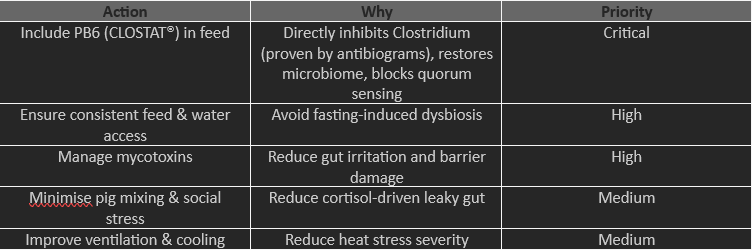
A Practical Summer Protocol
Based on the science covered in this series, here's a comprehensive approach to Red Gut prevention in finisher barns:
The Bottom Line
Red Gut costs European producers thousands of euros per barn every summer — and it kills the best pigs at the worst possible time. Antibiotics are increasingly restricted, and management alone cannot fully control the microbial imbalance that heat stress creates.
CLOSTAT® PB6 offers a targeted, antibiotic-free, scientifically proven solution backed by:
- Antibiogram data showing inhibition of C. perfringens, C. septicum, C. sordellii, and C. difficile
- MIC data of 6–20 ppm for the most effective surfactin compounds
- Electron microscopy proving cell lysis of C. perfringens within hours
- Wet feed stability - full spore survival even in fermented byproduct systems
Don't wait for the first dead pig this summer. Act now — protect your herd and your
Contact:
Contact us using the following form.