























 Company
Boehringer Ingelheim Vetmedica GmbH
Germany
181
Publications
1177
Followers
Company
Boehringer Ingelheim Vetmedica GmbH
Germany
181
Publications
1177
Followers
ESPHM 2026- Does a booster vaccination at the start of the fattening period improve control of Mycoplasma hyopneumoniae infection in pigs?


Garcia-Morante, B, Aguilar-Vega, C, Abella, G, Moradell L, Llorens, A, Pérez, D, López, R, Alonso, C, Segalés J., Sibila, M.
INTRODUCTION
- Mycoplasma hyopneumoniae remains a major health concern in swine despite widespread vaccination.
- Most protocols involve vaccination between one and three weeks of age to protect pigs throughout the wean-to-finish phase.
- Disease may still occur during the fattening period in some herds, highlighting the need to assess whether a booster vaccination can extend protection until slaughter.
OBJECTIVE
This study aimed to evaluate the effect of a booster dose of the M. hyopneumoniae vaccine at the start of the finishing pe riod in pigs exposed to natural infection.
MATERIALS & METHODS
Three hundred pigs from the same batch of a M. hyopneumoniae-positive farm were allocated to two groups:
- booster group (n = 150), vaccinated with Ingelvac MycoFLEX® at weaning and again at the start of fattening
- one-dose group (n = 150), vaccinated with the same vaccine only at weaning
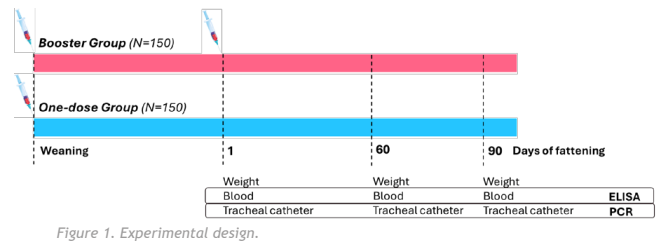
- Tracheal catheter and blood samples were collected at entry into fattening, and at 60 and 90 days afterwards.
- Tracheal catheter samples were analysed by real-time PCR, while serum samples were tested by ELISA.
- Body weight was recorded at the same sampling time points.
RESULTS
 At 60 days of fattening, the number of seropositive animals was significantly higher in the Booster group compared with the One-dose group (p < 0.0001; Fig. 2).
- At 90 days of fattening, the number of M. hyopneumoniae PCR-positive animals was significantly higher in the One-dose group than in the Booster group (p < 0.0001; Fig. 3).
- At 90 days of fattening, pigs in the Booster group (ݔҧ= 89.22 Kg) were significantly heavier than One-dose pigs (ݔҧ= 85.16 Kg;
- p < 0.05).
- Average daily weight gain (ADWG) was significantly higher in the Booster group than in the One-dose group (p < 0.05; Fig. 4).
Carcass weight was also higher in the Booster group, with a mean difference of +4.9 kg compared with the One-dose group (p < 0.0001).
 DISCUSSION & CONCLUSIONS
A boost vaccination against M. hyopneumoniae reduced infection pressure, as evidenced by fewer PCR-positive animals towards the end of the fattening period.
Seropositivity increased significantly after booster vaccination, although absence of seroconversion does not necessarily indicate lack of protection.
Pigs that were boost vaccinated showed improved productive performance, with higher ADWG, greater live weight, and carcass weight.
Contact:
Contact us using the following form.