






















 Company
Boehringer Ingelheim Vetmedica GmbH
Germany
180
Publications
1175
Followers
Company
Boehringer Ingelheim Vetmedica GmbH
Germany
180
Publications
1175
Followers
ESPHM 2026 - Comparative evaluation of two vaccination protocols for Mesomycoplasma hyopneumoniae under field conditions


J. Aibar, C. Fanlo, L. Olivia, D. Martí , S. Gaviria, G.Abella, C. Alonso, F. Gonzalvo
Introduction and Objectives
Despite the availability of vaccines and the knowledge in the industry for the control of Mesomycoplasma hyopneumoniae (M. hyo), this pathogen remains key in the porcine respiratory complex (CRP). SoundTalks® (ST) is a sound-based monitoring tool that provides the ReHS (Respiratory Health Status) metric that has shown to detect disease early (up to 5 days before the start of an outbreak)1 and correlate with very sensitive sampling techniques (tracheobronchial scrapings). The objective of this study was to evaluate two vaccination strategies against M. hyo in fattening pigs by comparing mortality rate and respiratory clinical signs provided by STs - ReHS.
Materials and Methods
The study included 8160 PRRSV and M. hyo positive pigs (distributed in 8 lots of 1020 animals) corresponding to 16 weeks of production from a single sow farm. Pigs were housed in 4 parallel barns sound-monitored with 12 ST devices (3 monitors/barn) and followed for 2 consecutive batches. All pigs were vaccinated for M. hyo at weaning (21 days) with a commercial M. hyo vaccine and 50% booster vaccinated at the beginning of fattening (63 days), while the others remained as a negative control. Allocation to treatment was at a barn level and alternated between batches. Batch mortality was recorded, and respiratory health was analyzed based on ReHS and % of green days. ReHS is a value between 0 and 100 that is associated with a color scale:
- green (100–61)
- yellow (60–41)
- red (40–0)
When the graph leaves the green stripe (ReHS<60)itis considered a respiratory alarm. The statistical analysis was performed with Minitab®21.
Results and Discussion
Results from this study demonstrated a significant improvement in both the respiratory health index (ReHS) (Figure 1) and the total percentage of days in alarm (ReHS<60) between the boosted-vaccinated animals (b) (average ReHS 58 and 55% of days in alarm) and the control group not revaccinated (a) (average ReHS 31 and 96% of days in alarm). The effect of the booster dose of M. hyo resulted in a 35% reduction in mortality (6.6% in control groups vs 4.3% in revaccinated pigs) (Table 1).
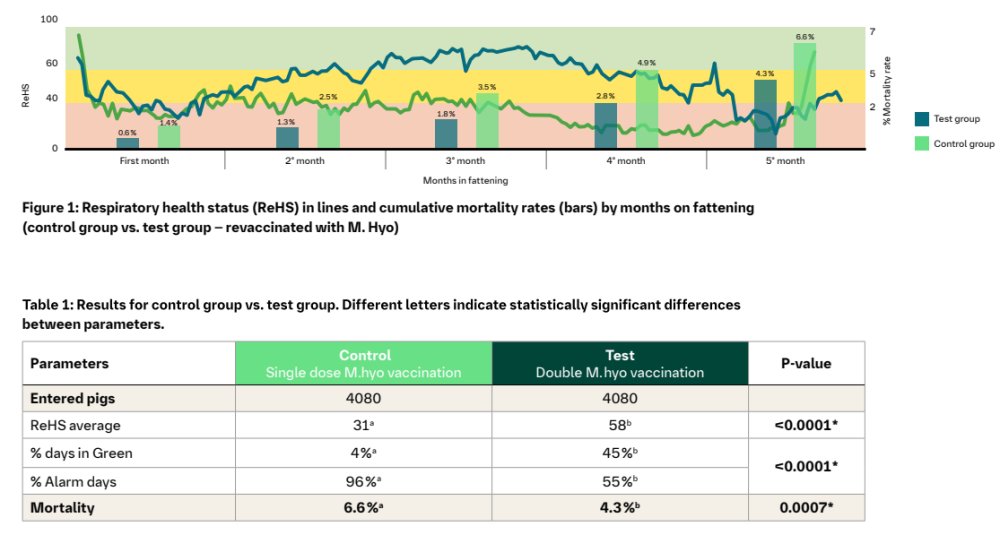
The differences in mortality were consistent throughout the months, which was directly related to an improvementin overall respiratory health demonstrated by the dynamics of ST. ReHS graph of revaccinated batches was above (healthier) controls on 70% of days (105/150).
Conclusions
These results demonstrate not only the impact of a booster vaccination dosis for Mhyo to control respiratory clinical signs and production parameters technologies as objective tool. Under the conditions of the present study, the investment of a M.hyo. boost dose translated to a return on investment (ROI) of 1:10 only considering the reduction of mortality that it made possible.
References
1. D. Polson, et al. 2018. AASV Conference.
2. E. De Conti, et al. 2024. IPVS&ESPHM
Contact:
Contact us using the following form.