























 Company
Tonisity
Ireland
3
products
106
Publications
552
Followers
Company
Tonisity
Ireland
3
products
106
Publications
552
Followers
Liquid Support, Solid Results


Tonisity research confirms that supplementing young piglet diets during the difficult transition period, with nutrients that are precisely targeted to optimise gut integrity and protect cellular function, offers the potential to improve health and performance across the entire production phase. These findings are consistent and suggest that all piglets, not just small, lightweight littermates, would benefit from specific nutritional support at this critical stage.
Figure 1 – Effect of Tonisity Px on pre-weaning mortality (PWM).
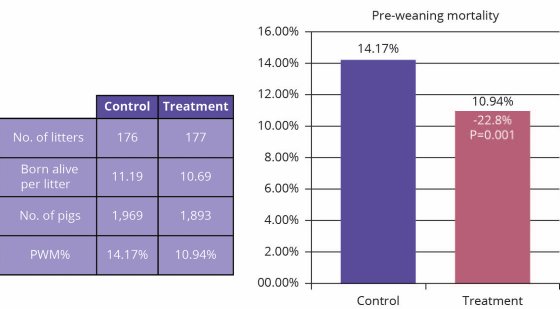
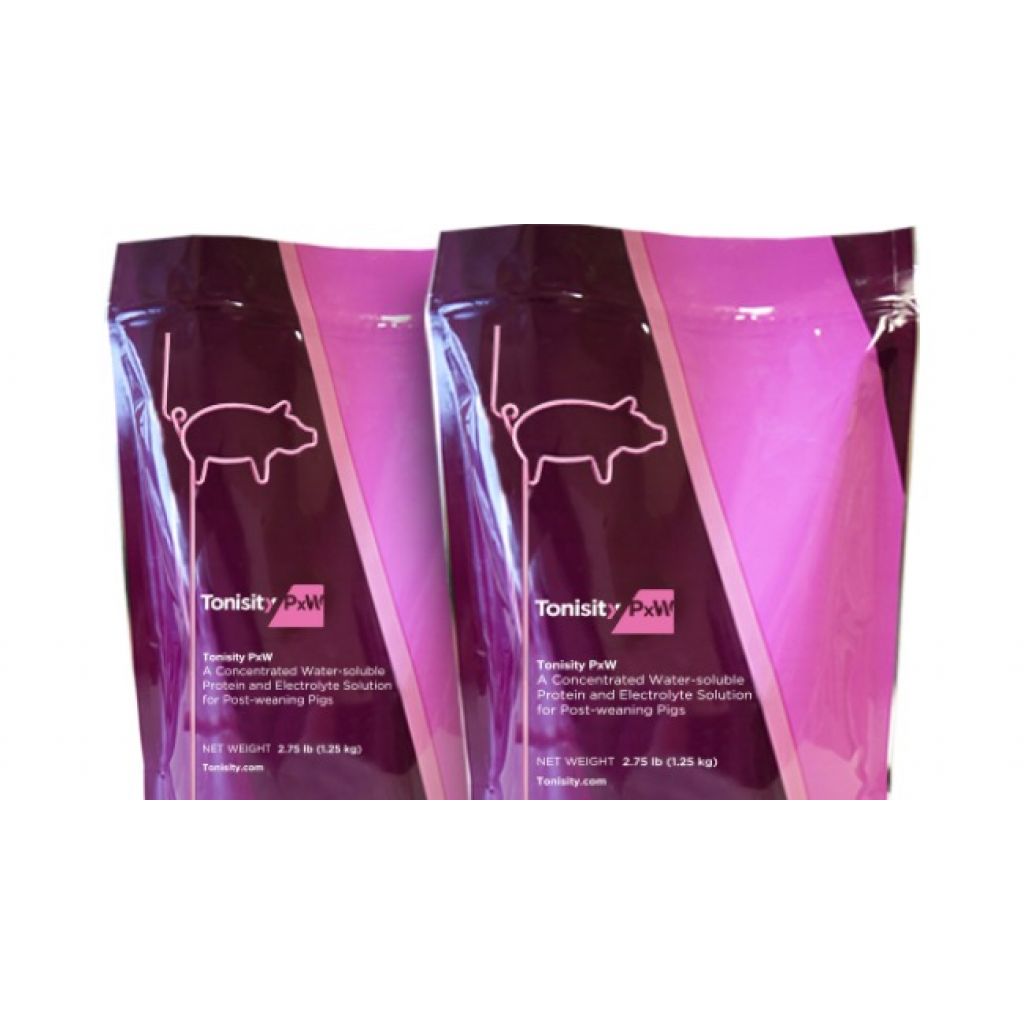
The trial, carried out on a 3,200-sow breeding farm in Indiana, US and follow-on finishing sites in the Mid-West, demonstrated how this isotonic supplement, can optimise performance during the critical transition period – when piglets are first introduced to dry creep feed and then subsequently weaned onto nursery diets. The overall results of this investigation, which analysed data collected from 3,862 piglets, demonstrated how feeding the isotonic drink alongside a creep diet from days 2 to 8 of life and around weaning helped to reduce pre-weaning mortality by more than 22% (Figure 1) and improve productivity in the nursery stage and beyond. The findings were in line with 36 other trials across Europe, Asia and the US, involving 64,148 piglets in total, and showing an average reduction of 23.6% (P<0.0001), in pre-weaning mortality vs. controls (10.6% vs. 13.9%). This equates to +0.5 pigs per litter or +1.2 piglets per sow per year.>
Weighty response
However, what’s more interesting is how the Tonisity Px (TPX) transition programme influenced productivity in the growing and finishing phase. The piglets given TPX pre- and post- weaning achieved heavier end weights – more than 3.03 kg heavier on average at finishing than pigs in the control group. But further analysis, evaluating how low (below 1 kg), medium (1 to 1.6 kg) and high (above 1.6kg) birthweight pigs, responded to the TPX programme, demonstrated that weight gain was far more pronounced in pigs that were classed as heavy or light at birth. Heavy piglets given TPX in the transition period were found to be 4.1kg heavier at slaughter than control pigs, while lightweight piglets showed a 3.5kg advantage over their control group equivalents. Piglets classed as medium sized at birth, showed a 2.6kg improvement in finished weight compared with their control group peers.
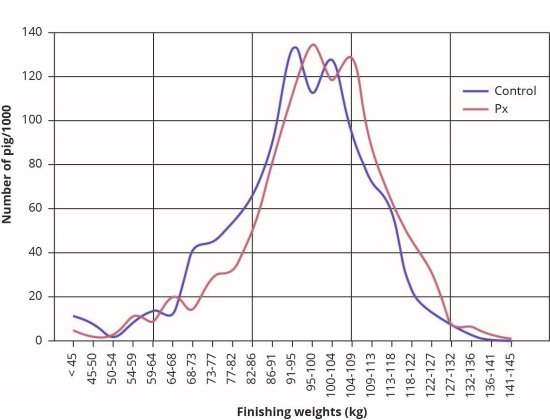
The trial results also revealed how a higher percentage of pigs in the TPX treatment group finished at heavier weights, above 103.4 kg lwt. What’s more, all small birthweight piglets in the TPX group that completed the trial actually caught up with their heavier cohorts. This general ‘shift up’ in performance produced a more compact finished weight profile overall, with fewer underweight pigs (below 92kg) produced in the TPX group – an outcome which is economically significant (Figures 2 and 3).
Figure 2 - Effect of Tonisity Px on distribution of pre-harvest weights,per class of weight at birth.
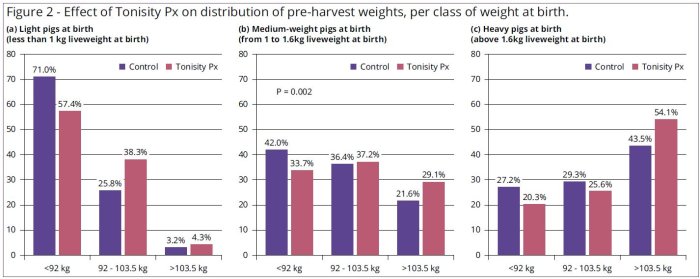
What’s interesting is that this study does not concur with the commonly-accepted paradigm that low birthweight pigs rarely advance up the ladder. The results here show that they do; and that when the isotonic supplement was administered during stressful periods in early life, the benefits were more distinct. A higher proportion of pigs finished at heavier weights, while fewer moved down to lower weight bands.
Figure 3 – Finishing weight population shift with Tonisity Px.
Nurturing balance in the gut
The key reason for using an isotonic supplement at this stage in a pig’s life is to support gut integrity and the cellular tissues that line the intestines during a critical period of change. As piglets’ move from a purely liquid milk diet to consuming drier feeds with a higher nutrient content the physiology of naive intestines change and cell structures can be challenged. Enterocytes, cells in the gut lining which are at the forefront of the absorption process, are particularly vulnerable. If they are compromised, they are less able to metabolise essential nutrients and that will have an impact on pig health and productivity. The isotonic nutrients in Tonisity Px are specifically developed to nourish these enterocytes, and the balanced formulation supports optimal cell function, which in turn sustains intestinal integrity, and promotes nutrient uptake.
This US study demonstrates how the return on investment (ROI) when using a pre-weaning nutritional supplement should not be gauged on the outcomes purely achieved at weaning and/or by the performance improvements seen in small/underweight piglets. In this case, the ROI was above 3:1 when considering pre-weaning mortality reduction only, and 5.9:1 when taking into account both mortality reduction and increased final weights. The financial implications discovered in this trial reach further than the farrowing house and nursery, as greater value was realised in the finishing stages. The TPX programme produced notable improvements to pig performance overall, but by far the biggest benefit was the considerable increase in finished weights achieved by pigs with the heaviest birthweights. This confirms that all piglets, not just small and lightweight at birth, benefit from the specific nutritional support provided by the isotonic protein drink.
More information can be found at www.tonisity.com.
Author: Mathieu Cortyl, Managing Director, Europe and Asia Pacific, Tonisity

Contact:
Contact us using the following form.