























 Company
Tonisity
Ireland
3
products
112
Publications
570
Followers
Understand the effects of early-life nutrition and its impact on post-weaning performance


Weaning weight is a useful indicator of future performance. Heavier piglets generally grow faster after weaning and reach market weight sooner, so it makes sense that producers, veterinarians and nutritionists pay close attention to it.
But not every strategy that increases weaning weight delivers the same long-term benefits. What matters is also how prepared the piglet is for weaning and how it grows afterwards.
Extra weight may come from greater milk or creep feed intake, or from improvements in intestinal development and nutrient utilisation. These differences matter, because an early weight advantage does not always last.
Weaning weight is just one part of the picture
A 2024 Teagasc study compared pre-weaning feeding strategies. At day 27, piglets averaged 7.87 kg in the control group, 8.10 kg with dry starter feed and 8.27 kg with liquid milk replacer.
Although the feeding strategies increased weaning weight, no additional treatment effect on subsequent body weight was detected. However, because piglets were regrouped by weight after weaning, the study cannot establish whether the original weight advantage would have persisted.
A 2023 systematic review and meta-analysis also found variable responses to creep feeding: 46% of publications reported better pre-weaning performance, while 58% reported better nursery performance.
Weaning weight still matters, but extra weight at weaning does not always mean better growth afterwards.
Beyond weaning weight: what is happening inside the piglet at the time of weaning?
One of the key factors behind healthy, consistent growth is what happens inside a piglet’s intestine: how well it can digest what the piglet consumes and absorb the nutrients. Increased nutrient intake can contribute to higher weaning weight, but weight alone does not indicate how well the intestine has developed or how effectively the piglet will cope with the transition to solid feed.
This is where micro-enteral nutrition comes in. By delivering small amounts of specific nutrients to the gastrointestinal tract, it aims to support intestinal function and help prepare piglets for the challenges they face during critical early-life periods.
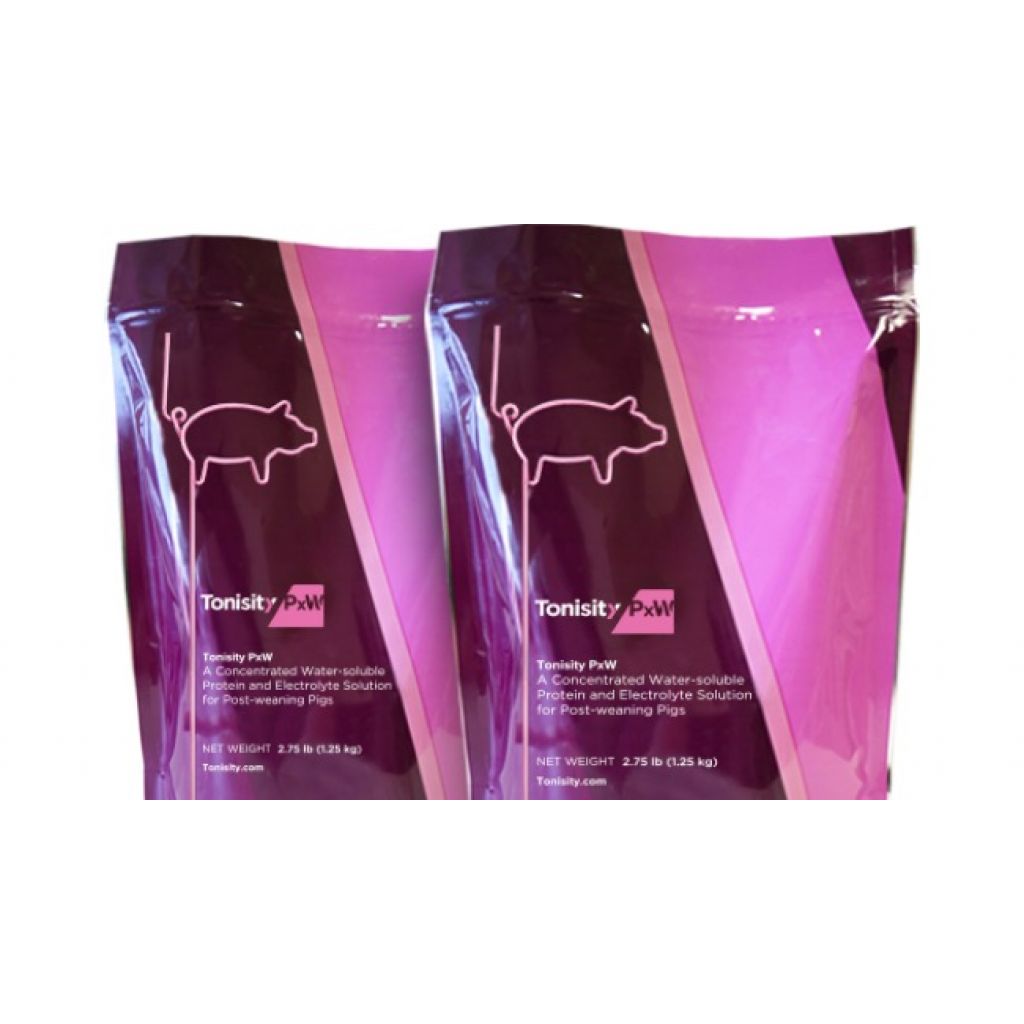
In a 2025 peer-reviewed study involving 160 piglets, Gong and colleagues evaluated an isotonic protein solution, Tonisity Px, given from days 2 to 8 and during the three days before weaning. At day 24, treated piglets were 250 g heavier than controls: 7.20 versus 6.95 kg. The solution supplied only about 2.4 kcal per piglet per day, too little energy on its own to plausibly explain the weight difference.
The researchers also observed approximately 8% greater jejunal villus height and a 31% higher villus-to-crypt ratio. GLP-2 expression was 3.35 times higher, while expression of the tight-junction markers ZO-1 and Claudin-1 increased by 64% and 56%, respectively. These findings suggest that the response involved measurable changes in intestinal morphology and selected markers of intestinal function, alongside the improvement in body weight.
What Happens Immediately After Weaning?
A commercial-farm study led by Vinícius de Souza Cantarelli at the Federal University of Lavras in Brazil examined early nutritional support, intestinal morphology and post-weaning growth.
The study involved 120 litters and four treatment strategies, including a full programme combining supplementation on days 2–8 with peri-weaning administration.
Piglets receiving the full programme weighed 7.45 kg at weaning, compared with 7.03 kg in controls, although this difference was not statistically significant. After weaning, the gap widened:
- Day 7: 8.10 versus 7.44 kg — a 0.66 kg advantage (P=0.009).
- Day 14: 10.17 versus 9.31 kg — a 0.86 kg advantage (P=0.020).
- Average daily gain over these 14 days: 196 versus 161 g/day.
The same study found differences in intestinal morphology. Villus length was 256 micrometres in the full-programme group versus 189 in controls, while the villus-to-crypt ratio was 1.02 versus 0.76.
These measurements do not prove that longer villi alone caused the additional growth. They do, however, show that better post-weaning performance occurred alongside measurable differences in intestinal structure during the same transition period.
Do the Benefits Continue Through to Finishing?
Two commercial trials provide examples of performance beyond the nursery.
US study 18-014-P-P
This trial enrolled 3,862 piglets from 353 litters, with 2,193 pigs followed through to the end of finishing.
There was no weight advantage at weaning: 6.13 kg in the Tonisity Px group versus 6.18 kg in controls (P=0.52). At the end of nursery, treated pigs were numerically 0.41 kg heavier, although the difference was not statistically significant (P=0.10).
By 168 days of age, however, the advantage had reached 3.04 kg (P=0.002). This later difference could not simply reflect extra weight carried forward from weaning, because there had been no initial weight advantage.
Polish study 17-031-P-R
Piglets receiving Tonisity Px before weaning were 0.31 kg heavier at weaning and 1.70 kg heavier at the end of nursery. They also reached the target market weight of approximately 120 kg around seven days earlier than controls.
Feed conversion during fattening and finishing improved from 2.79 to 2.74 — a 1.8% reduction in feed required per unit of weight gain (P=0.0187).
The study did not investigate the physiological reasons behind these results. However, the widening weight gap and earlier achievement of market weight suggest that the response extended beyond maintaining the initial weaning weight advantage.
What Does the Wider Tonisity Dataset Show?
Individual trials describe results under specific farm conditions. Tonisity’s 2026 weight meta-analysis brings together results from different farms and production systems:
| Stage | Studies | Pigs | Avarage weight advantage |
| Weaning | 46 | 41,983 | +300 g |
| End of nursery | 12 | 15,242 | +1.14 kg |
| Finishing, at the same age | 4 | 4,080 | +2.50 kg |
The nursery and finishing figures come from smaller subsets of the studies. They should therefore not be read as the same population progressing from a 300 g advantage to a 2.50 kg advantage. They show that weight benefits were observed at each of these production stages.
Looking Beyond Weaning Weight
Weaning weight remains an important indicator, but it is not the full measure of success. To assess the value of early-life nutrition, we also need to understand the piglet’s condition at weaning and follow its performance through subsequent production stages.
See the full content with more details on the Tonisity website, in the blog post titled: "What Happens After Weaning? A Closer Look at Piglet Growth."
www.tonisity.com
References:
Arnaud EA et al., Translational Animal Science (2024); Muro BBD et al., Animals (2023); Gong C et al., Veterinary Sciences 12:715 (2025); Cantarelli VS et al., UFLA study 18-126-P-R (2018); Tonisity studies 18-014-P-P and 17-031-P-R; Tonisity 2026.03 Weight Meta-Analysis.

Contact:
Contact us using the following form.