























 Company
Tonisity
Ireland
3
products
111
Publications
570
Followers
Company
Tonisity
Ireland
3
products
111
Publications
570
Followers
How to Increase Creep Feed Intake in Piglets: New Study Finds 24% Higher Intake


Increasing creep feed intake in piglets requires more than simply placing solid feed in the farrowing pen. Early exposure, palatable feed presentation and nutritional continuity around weaning can all influence consumption.
In a commercial Spanish study, a structured Tonisity Px programme was associated with 24% higher creep feed intake and 1.42 kg more body weight three weeks after weaning.
For producers asking how to increase creep feed intake in piglets, the study provides a practical example of how early voluntary intake, wet-feed presentation and support across the weaning transition can be combined within one feeding programme.
Study at a glance
Study element
Study reference
Tonisity Study 23-016-P-P
Location
Commercial farm in Spain
Study population
405 Iberian-cross piglets from 54 litters
Farm profile
500 sows; approximately 7.7 piglets born alive per litter
Average weaning age
Approximately 26 days
Intervention
Structured Tonisity Px pre- and peri-weaning programme
Weaning weight
7.55 kg vs 7.34 kg; P=0.75
Nursery weight
13.71 kg vs 12.29 kg three weeks after weaning; P=0.03
Why is creep feed intake important before weaning?
Weaning exposes piglets to several changes at the same time: separation from the sow, a different environment, new social groups and the transition from milk to solid feed. Familiarity with solid feed before weaning can therefore form part of a broader strategy to prepare piglets for this transition.
Simply making creep feed available, however, does not guarantee consistent consumption. An effective strategy should encourage early feeding behaviour, maintain feed freshness and connect the pre-weaning experience with the first days after weaning.
How can producers increase creep feed intake in piglets?
Based on the management principles evaluated in this study, producers can encourage creep feed intake by introducing voluntary feeding early, offering small quantities of fresh feed, using a palatable wet presentation, maintaining easy feeder access and continuing nutritional support across the weaning transition.
1. Introduce voluntary liquid intake early in life.
2. Begin creep-feed exposure before weaning.
3. Use a fresh and palatable feed presentation.
4. Offer manageable quantities and replace them regularly.
5. Keep feeders clean and easily accessible to piglets.
6. Maintain a consistent routine before and around weaning.
7. Measure feed intake and piglet weight to evaluate the response under farm conditions.
What did the Tonisity commercial study evaluate?
Study 23-016-P-P was conducted on a 500-sow commercial farm in Spain. It evaluated whether administering Tonisity Px as part of a structured pre- and peri-weaning programme influenced creep feed intake, weaning weight and nursery weight three weeks after weaning.
The study included 405 piglets from 54 litters, using Iberica × Duroc PIC Iberica × Gepork genetics. Litters averaged approximately 7.7 piglets born alive, and piglets were weaned at approximately 26 days of age.
Litters were randomly allocated to either a Tonisity Px group or an unsupplemented control group. Both groups were housed in the same farrowing rooms during the same period, and cross-fostering was performed within each treatment group. Piglets were weighed by pen at weaning and again three weeks after weaning.
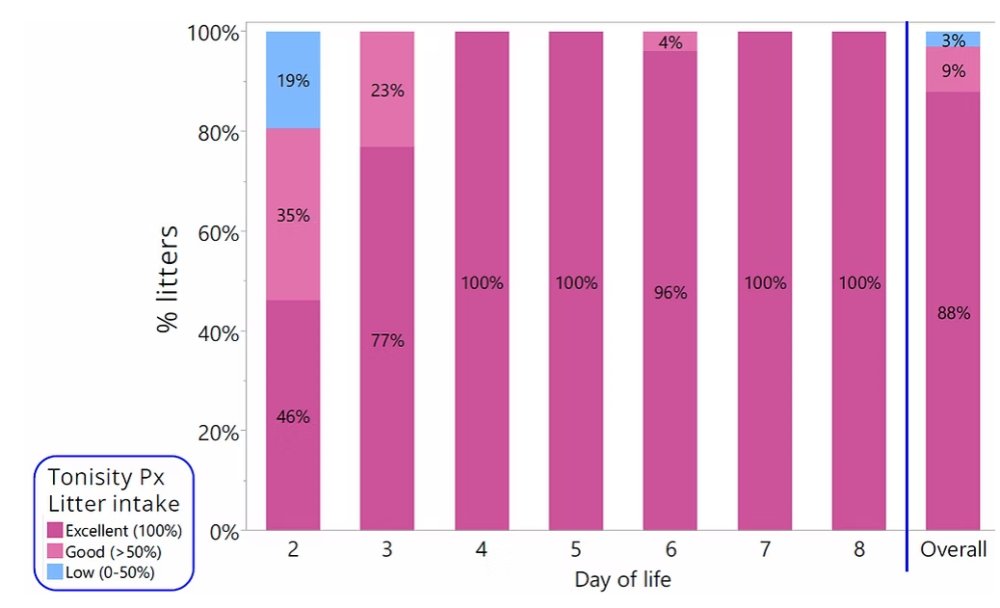
The study recorded good voluntary intake from day 2. Across the complete day 2-8 period, 88% of litters were classified as having excellent intake, while a further 9% demonstrated good intake.
This early acceptance is particularly relevant because nutritional interventions must be voluntarily consumed if they are to integrate successfully into everyday farm management.
What Tonisity Px protocol was used?
The Tonisity Px group followed a programme covering early life, creep-feed introduction and the peri-weaning period.
Early-life administration
From day 2 to day 8 of life, litters received 400 ml of Tonisity Px solution per day. The study recorded good voluntary acceptance from day 2. Across the day 2–8 period, 88% of litters were classified as having excellent intake, while a further 9% demonstrated good intake.
Creep-feeding period
From day 8 to day 10, 400 ml of Tonisity Px solution was combined with 65 g of creep feed. This provided a wet feed presentation designed to introduce piglets to creep feed and encourage consumption during the farrowing period.
Peri-weaning support
During the three days before weaning, 400 ml of Tonisity Px solution per litter per day was applied to dry feed. During the first three days after weaning, piglets received 100 ml of Tonisity Px solution per pig per day.
Extending the programme across the transition connected the piglets’ pre-weaning feeding experience with their new post-weaning environment.

How much more creep feed did the piglets consume?
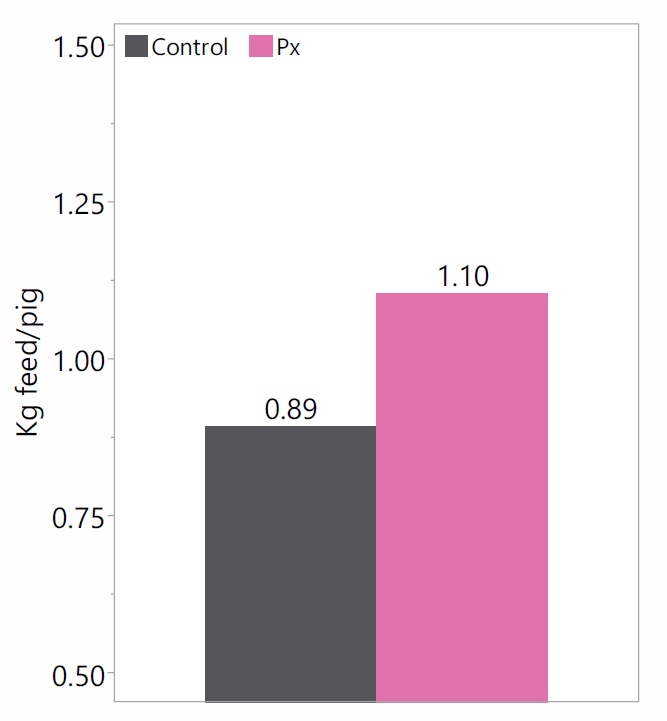
Piglets receiving Tonisity Px consumed an average of 1.10 kg of creep feed per pig during the farrowing period, compared with 0.89 kg per pig in the control group.
CREEP FEED RESULT
Tonisity Px group: +210 g of creep feed consumed per pig, equivalent to a descriptive increase of 24% compared with control.
Did the programme influence weaning and nursery weight?
At weaning, piglets in the Tonisity Px group averaged 7.55 kg, compared with 7.34 kg in the control group. This represented a numerical difference of 210 g per pig, or 3%.
Three weeks after weaning, piglets in the Tonisity Px group averaged 13.71 kg, compared with 12.29 kg in the control group. This represented 1.42 kg, or 12%, more body weight.
NURSERY RESULT
Piglets receiving Tonisity Px were 1.42 kg heavier three weeks after weaning in this study (P=0.03).

What do the results mean for commercial farms?
The findings show how creep feeding can be integrated into a connected transition programme rather than treated as an isolated activity. The protocol linked early voluntary intake, wet creep-feed presentation and support immediately before and after weaning.
Under the conditions evaluated, the Tonisity Px group recorded higher creep feed intake and a statistically significant weight advantage three weeks after weaning. This does not demonstrate that creep feed intake alone caused the later weight difference, but it supports further consideration of nutritional continuity across the weaning transition.
A practical approach to creep feeding and weaning
Tonisity Px is an isotonic protein drink designed to deliver key nutrients to intestinal cells. It can be incorporated into structured pre- and peri-weaning protocols without individual piglet handling or specialised equipment.
For farms seeking to improve creep-feed consumption, the study highlights three practical priorities: encourage voluntary intake early, provide an attractive and fresh feed presentation, and maintain continuity around weaning.
Contact Tonisity to learn more about Tonisity Px: info@tonisity.com
Frequently asked questions
- When should creep feed be introduced to piglets?
The appropriate timing depends on the farm’s management system and weaning age. Early introduction gives piglets more time to explore and become familiar with solid feed before weaning. In this study, the wet creep-feed presentation was offered from day 8 to day 10 as one stage of a broader programme.
- Why are my piglets not eating creep feed?
Low intake may be associated with feed freshness, presentation, palatability, feeder position, access or limited previous feeding experience. Offering manageable quantities, keeping feeders clean and introducing feed consistently can help encourage exploration.
- Does wet creep feeding increase intake?
A wet presentation may help make feed more attractive and accessible. In this study, piglets following a programme that included Tonisity Px combined with creep feed consumed 24% more creep feed than control piglets. Because the report does not provide statistical significance for this comparison, it should be treated as a descriptive study result.
- Did the piglets have higher weaning weights?
The Tonisity Px group was numerically 210 g heavier at weaning, but the difference was not statistically significant (P=0.75).
- Were the piglets heavier after weaning?
Yes. Three weeks after weaning, piglets in the Tonisity Px group were 1.42 kg heavier than control piglets, and this difference was statistically significant (P=0.03).
- Discuss the protocol with the Tonisity team
Would you like to understand how the Tonisity Px programme could be introduced under your customers’ farm conditions? Speak with the Tonisity team to review the protocol, discuss the study findings and identify an appropriate approach for different production systems.
Study reference: Tonisity Study 23-016-P-P. Tonisity Px – Better Creep Feed Intake And Higher Weights in Iberian Pigs
Written by: Tonisity Technical Team | Study by: Stefan Buzoianu, Technical Director – Livestock and Applied Research

Contact:
Contact us using the following form.