























 Company
Kemin
Belgium
6
products
50
Publications
429
Followers
Company
Kemin
Belgium
6
products
50
Publications
429
Followers
Can Gut Health Support Help Pigs Cope with Heat Stress?



In our previous article, we focused on how heat stress affects the pig gastrointestinal tract: reduced blood flow to the intestine, weaker barrier function, changes in microbiota, and increased inflammatory pressure.
The heat waves experienced across Europe in June 2026 remind us that heat stress is not merely a theoretical risk for pig production. In western France, for example, the heat wave had a major impact on production, with more than 1,000 farms reported to be affected and sow losses estimated at 3–5% of the Brittany sow herd. The consequences go beyond immediate sow mortality: reduced growth, future production gaps, and pressure on farm logistics all underline how heat stress has become a strategic challenge for the industry. As heat stress strongly affects the gut, one promising approach is to support gut resilience through microbiome management.
Heat stress does not only make pigs eat less. It activates physiological stress responses and can compromise intestinal integrity. Two useful indicators to better understand these effects are cortisol and D-lactate dehydrogenase (D-LDH).
Cortisol is commonly described as a stress hormone. When pigs are exposed to challenging conditions, including heat, cortisol can increase as part of the animal’s endocrine response. While this response is useful in the short term, prolonged or excessive stress can divert energy away from growth, immunity, and recovery. D-LDH is also relevant in the context of heat stress because it is linked to D-lactate metabolism and was used in a recent study as an indicator associated with intestinal barrier disturbance. In scientific studies, D-lactate has been reported to increase during heat stress and is often discussed as a blood marker related to intestinal permeability.
A recent field study conducted in a commercial farm in Greece evaluated Bacillus velezensis PB6 (CLOSAT®, Kemin Europa NV) supplementation in grower pigs under elevated temperatures. The probiotic is available for both feed and drinking water application and was applied through the feed in this study. The study included 700 pigs at 13 weeks of age, divided into a control group and a probiotic group. The probiotic group received feed supplemented with PB6, and animals were monitored from 13 to 18 weeks under warm field conditions, around 29°C and 40–44% relative humidity. Blood samples were collected from 60 pigs per group to assess physiological stress indicators.
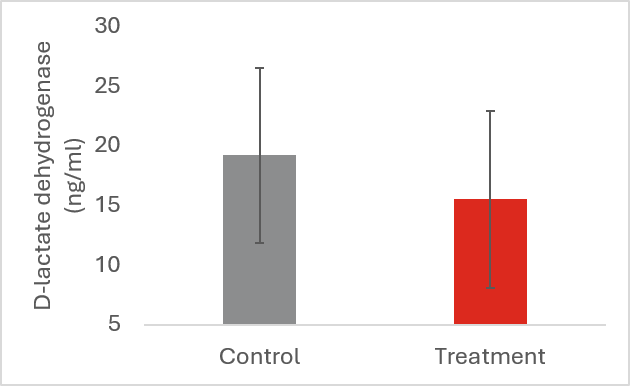
Figure 1: Serum D- Lactate Dehydrogenase (D-LDH) concentrations in the control and treatment groups at 18 weeks of age
At 18 weeks of age, pigs receiving PB6 showed lower serum cortisol than the control group: 154.60 ± 75.7 ng/mL versus 220.70 ± 104.9 ng/mL. At the same age, D-LDH was also lower in the supplemented group: 15.54 ± 7.41 ng/mL versus 19.22 ± 7.35 ng/mL in the control group. These results suggest that PB6 supplementation was associated with a lower physiological stress response and a more favourable marker profile related to intestinal integrity during the heat-stress period.
For the industry, the message is practical: cooling, ventilation, water access, and feeding management remain essential, but they may not be enough. During heat stress, the gut becomes a central point of vulnerability. Supporting the microbiota with a documented probiotic strain such as B. velezensis PB6 may help pigs maintain better physiological balance and gut resilience when environmental conditions become challenging.

Contact:
Contact us using the following form.