






















 Company
Kemin
Belgium
6
products
50
Publications
429
Followers
Company
Kemin
Belgium
6
products
50
Publications
429
Followers
Heat Stress and the Pig Gut: Why Gut Should Be a Summer Priority



In previous articles, we discussed why summer heat increases the risk of Red Gut and sudden mortality. This article takes a closer look at what heat stress does specifically to the pig intestine, and why protecting the gut should be a priority during hot periods.
Heat stress is often first noticed through changes in behaviour: pigs reduce feed intake, drink more, breathe faster, and spend more time lying down. These visible signs are important, but they only tell part of the story. Behind them, one of the organs most affected by heat stress is the gastrointestinal tract. The intestine is not simply an organ of digestion. It is also a barrier, an immune interface, and a key regulator of nutrient use. Because heat stress directly affects the gut, protecting it should be a summer management priority.
Heat stress changes the priorities of the body
When ambient temperature rises above the pig’s thermal comfort zone, heat Dissipation is prioritized. Blood flow is redirected away from internal organs toward peripheral tissues. This physiological response helps the pig lose heat, but it can reduce visceral blood flow and oxygen delivery to the intestine. The scientific literature describes reductions in visceral blood flow of 30–50% under heat stress, contributing to intestinal ischemia and hypoxia.
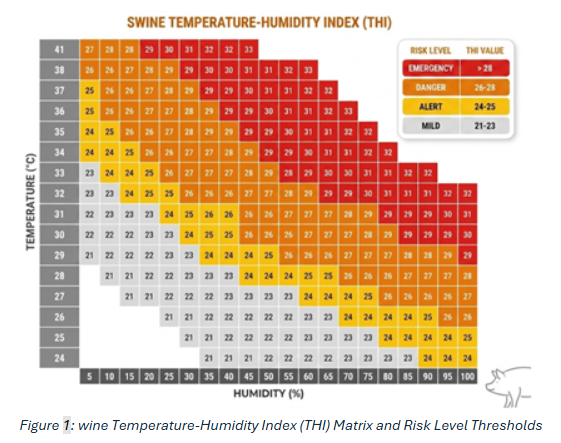
At the same time, lower feed intake is not only a behavioral response. It is also a metabolic strategy to reduce heat production from digestion and nutrient metabolism. Heat stress can affect feed intake, digestion, absorption, metabolism, oxidative balance, and microbial diversity.
The intestinal barrier becomes more vulnerable
The gut barrier is made of several protective layers. The first is the epithelial barrier, where tight-junction proteins such as occludin and claudins help regulate what can pass between intestinal cells. Heat stress can alter the expression and function of these proteins, making the barrier more permeable. Studies reported higher serum diamine oxidase and D-lactate, both indicators of increased intestinal permeability, together with changes in tight-junction markers in heat-stressed pigs.
The second layer is the physical structure of the intestine itself. Heat stress has been associated with shorter villi and changes in crypt morphology, reducing the absorptive surface available for nutrients. Reports show that heat stress may reduce intestinal villus height by 20–40%, which can compromise absorptive capacity. This helps explain why performance losses during hot periods may go beyond the reduction in feed intake alone.
Mucus and microbiota: two connected defences
The mucus layer is another important defence. It protects the epithelial surface and helps structure the microbial ecosystem. During heat stress, mucin-related gene expression may be reduced, weakening this protective layer. Once this happens, the microbiota can also be affected. Beneficial bacterial groups such as Lactobacillus and Bifidobacterium may decrease, while opportunistic bacteria may find more favourable conditions to expand.
Short-term heat stress can modify the mucosal microbiota in the ileum and cecum and was associated with changes in oxidative stress, cytokine profiles, intestinal morphology, and short-chain fatty acids. These findings suggest that heat stress affects the gut as an ecosystem, not only as a digestive tube.
From gut leakage to systemic pressure
When barrier function is weakened, bacterial components such as endotoxins can pass more easily from the intestinal lumen into circulation. This can contribute to systemic inflammatory pressure and may increase disease susceptibility. Short-term cyclic heat stress can impair intestinal barrier function and increase circulating endotoxin.
Key takeaways
Heat stress does not only reduce feed intake. It changes blood-flow priorities, weakens intestinal barrier function, modifies the mucus–microbiota ecosystem, and increases inflammatory pressure. In summer, supporting the gut support not secondary, it is one of the foundations of pig health and performance.
References:
Fan, X., Tian, X., & Li, M. (2025). Challenges of heat stress on intestinal health in pig husbandry. Fundamental Research, 5, 2607–2611. https://doi.org/10.1016/j.fmre.2025.06.006
Liu, F., Zhao, W., Le, H. H., Cottrell, J. J., Green, M. P., Leury, B. J., Dunshea, F. R., & Bell, A. W. (2022). What have we learned about the effects of heat stress on the pig industry? Animal, 16, 100349. https://doi.org/10.1016/j.animal.2021.100349
Xia, B., Wu, W., Fang, W., Wen, X., Xie, J., & Zhang, H. (2022). Heat stress-induced mucosal barrier dysfunction is potentially associated with gut microbiota dysbiosis in pigs. Animal Nutrition, 8, 289–299. https://doi.org/10.1016/j.aninu.2021.05.012
Contact:
Contact us using the following form.