






















 Company
Kemin
Belgium
6
products
45
Publications
413
Followers
Company
Kemin
Belgium
6
products
45
Publications
413
Followers
Clostridium perfringens: The Opportunist Behind Red Gut — And the In-Vitro Evidence for Fighting Back



In the first two articles of this series, we explored what Red Gut is and how heat stress destroys the gut's natural defences. Now, let's focus on the pathogen that capitalises on that destruction — Clostridium perfringens — and examine the in-vitro evidence that a specific probiotic strain can inhibit it.
A Normal Resident Turned Deadly
Clostridium perfringens is not an exotic invader - it's a normal inhabitant of the pig's intestine in healthy animals. It's a Gram-positive, anaerobic, spore-forming bacterium capable of producing potent toxins that damage the intestinal lining.
What makes C. perfringens dangerous is not its mere presence, but its ability to proliferate explosively when conditions shift in its favour - exactly what happens during summer heat stress. When it does, the ascending infection into the small intestine produces the characteristic "red gut."
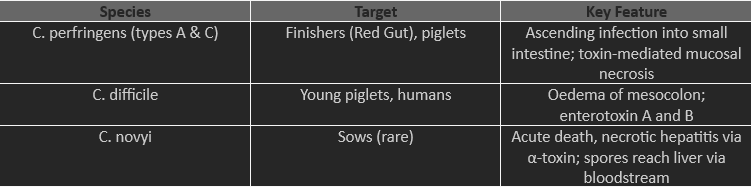
The Clostridial Family: Key Players in Pig Disease
The Antibiogram Evidence: A Probiotic that Inhibits Clostridium
The critical question for any antibiotic-free strategy is: does it actually work against the pathogen? For CLOSTAT®'s active strain, Bacillus velezensis (PB6), the answer is supported by extensive in-vitro data.
Disk Diffusion Test - Broad-Spectrum Activity
In standardised disk diffusion assays, PB6 was tested vs C. perfringens with a positive and negative control. The inhibition of all groups can be seen in Figure 1- confirming that PB6 has a particular affinity for inhibiting Clostridial growth:
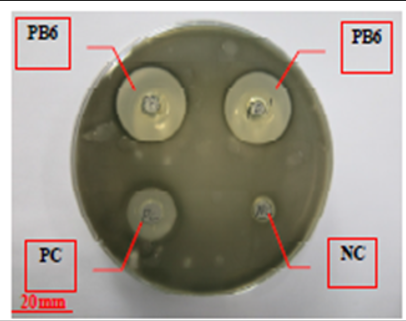
Figure 1: Kemin Internal Document WP-14-00076 – PB6: Bacillus Velezensis CLOSTAT®, NC Negative Control. PC Positive Control
Well Diffusion Assay — Field Isolates from Diagnostic Labs
Going beyond reference strains, researchers at the Universities of Georgia (UGA), Minnesota (UMN), and Arkansas (UARK) tested PB6 against 7 Clostridial field isolates from pigs obtained from actual clinical outbreaks and 8 from poultry and 6 from Ruminants. The results were remarkable:
Key findings:
- PB6 inhibited 100% of field isolates tested — including C. perfringens, C. septicum, C. sordellii, and C. difficile
- Several isolates showed PB6 inhibition equal to or exceeding chloramphenicol (the antibiotic positive control)
- Swine-specific C. difficile isolates (691 and 688) showed inhibition zones of 20 mm and 16 mm respectively
- The most effective surfactin compounds produced by PB6 have MIC values of 6–20 ppm against C. perfringens
Source: Kemin Documents WP-08-00049, WP-08-00140
How PB6 Kills Clostridium: Electron Microscopy Evidence
Transmission electron micrographs at 29,500× magnification show the physical mechanism of destruction. The lipopeptides (surfactins) produced by PB6 create pores in the C. perfringens cell membrane:
- After 1 hour - disruption of the cell wall and loss of cytoplasmic contents into the exterior
- After 4 hours - complete rupture and death of the cell
This is a lytic mechanism — PB6 literally punches holes in Clostridium until it bursts.
The Antibiotic Dilemma
Historically, some producers have turned to in-feed antimicrobials to control HBS outbreaks. However, evaluating their effectiveness is difficult since HBS tends to be transient and seasonal. With increasing regulatory pressure across Europe, producers need effective alternatives.
The antibiogram data above provides that evidence: PB6 achieves good inhibition levels against the exact Clostridial species involved in Red Gut - without contributing to antimicrobial resistance.
🔑 Key Takeaway: PB6 isn't just a probiotic - it's a proven anti-Clostridial agent with MIC data, disk diffusion evidence, and electron microscopy proof of its lytic mechanism. It inhibits every Clostridial species tested, including swine-specific C. perfringens isolates
Contact:
Contact us using the following form.