

















 0
0
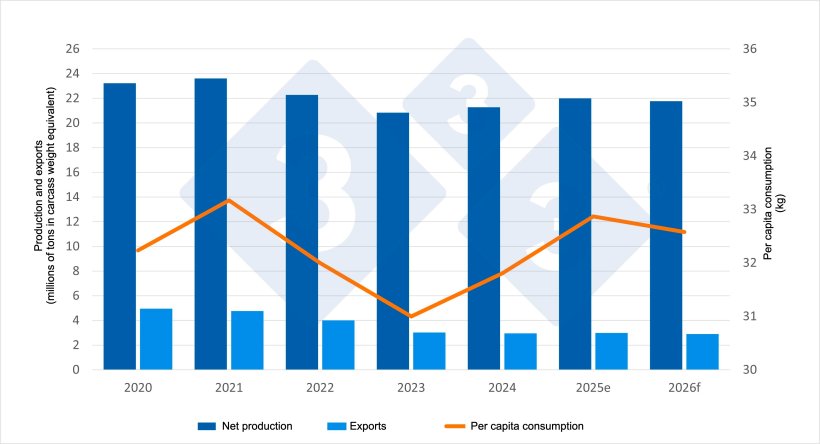
The European Commission has published an update to its Short-Term Outlook for EU agricultural markets for 2026. This adjustment comes in the context of a macroeconomic environment weakened by prolonged geopolitical instability in the Middle East, which is driving up the costs of energy, transportation, and fertilizers—and consequently the price of feed—with a corresponding impact on production costs.
Table 1. Selected indicators for the EU swine industry.

| Net production (thousand t) | Exports (thousand t) | Per capita consumption (kg) | Self-sufficiency (%) | |
|---|---|---|---|---|
| 2020 | 23,218.6 | 4,943.5 | 32.2 | 126.1 |
| 2021 | 23,614.7 | 4,751.7 | 33.2 | 124.8 |
| 2022 | 22,277.1 | 3,993.8 | 32.0 | 121.3 |
| 2023 | 20,829.1 | 3,016.6 | 31.0 | 116.5 |
| 2024 | 21,279.0 | 2,940.3 | 31.8 | 115.7 |
| 2025e | 21,983.8 | 2,982.6 | 32.9 | 115.4 |
| 2026f | 21,764.0 | 2,893.1 | 32.6 | 115.1 |
| Dif. 26/25 | -1.00% | -3.00% | -0.89% | -0.30% |
Production: Another downward revision
According to forecasts, net pork production is expected to decline by approximately 1% from the previous year, falling from the 21.98 million metric tons (Mt) estimated for 2025 to the 21.76 Mt projected for 2026.
Historical data on the EU supply-demand balance confirm that the sector has been seeking a new equilibrium for several years. Following the peak in gross production in 2021, when net production exceeded 23.6 Mt, the sector suffered a double blow from falling Chinese demand and the herd reduction cycle, bottoming out in 2023 at 20.8 Mt. The recovery in 2024 and 2025 (21.3 and 22.0 Mt gross, respectively) is now cut short in 2026 by a new downward revision.
Exports: New reduction on the horizon
The outlook for trade is the bleakest. Pork exports, which exceeded 4.9 million metric tons in 2020, driven by demand from China, continue to undergo structural adjustment. After closing 2024 at 2.94 Mt and recovering slightly in 2025 to an estimated 2.98 Mt, the forecast for 2026 points to a further decline of 3% to 2.89 Mt. The Commission warns that high prices and a weakening economic environment could reduce the competitiveness of European pork in international markets, although the sector would maintain its positive trade balance.
Per capita consumption: Stability despite high prices
The Commission's update highlights that per capita meat consumption in the EU will remain stable in 2026, with robust demand despite high prices in virtually all markets. For pork, the figure is expected to be around 32.6 kg per capita, slightly below the 32.9 kg estimated for 2025, representing a stabilization following the lows of 2023 (31.0 kg).
Sustained self-sufficiency, but on the decline
The EU maintains a self-sufficiency rate of over 115% in the forecasted period, confirming that the bloc consistently produces more than it consumes. However, the trend is clearly downward: from 126% in 2020, it has fallen to 115.7% in 2024, and a further decline to 115.1% is projected for 2026.
May 27, 2026/ 333 Staff with data from DG Agri.