














 Firma
Kemin
Belgia
6
Produkty
48
Publikacje
426
Obserwujący
Firma
Kemin
Belgia
6
Produkty
48
Publikacje
426
Obserwujący
Why sudden death in sows matters: SOW MORTALITY AND ITS ECONOMICAL IMPACT



Sow mortality rates have been increasing, and this has been a growing concern for the swine industry. From an economic perspective (focused on profitability) sows represent the third largest production cost after feed and labour (Palomo, 2025). The mortality rate increases indirect costs due to partial losses of genetic value, retaining a female that should normally be removed/culled, and an increased number of gilts with lower adaptation for the farm health challenges (Schwertz et al, 2021). But it is not only the economic losses, it can also affect employee morale negatively and raise concerns about animal welfare and sustainability (Bergman et al, 2018).
In Spain, recent data show mortality rates of over 15% (SIP Consultors, 2023), much over the ones registered in other European countries like France with only 5,2% in 2022 (IFIP). The mortality in sows has risen by approximately 0.3% annually. Sow´s mortality data combined from herds in the USA, Canada, Australia and the Philippines were estimated at 13,56% in 2021, with an average increase from 7.32 % to 11.78% between 2012 and 2018 (Eckberg, 2022). A Brazilian study from 2022, reported on an annual herd mortality rate of around 12,5%.
Figure 1. Main reasons for mortality in Midwestern US
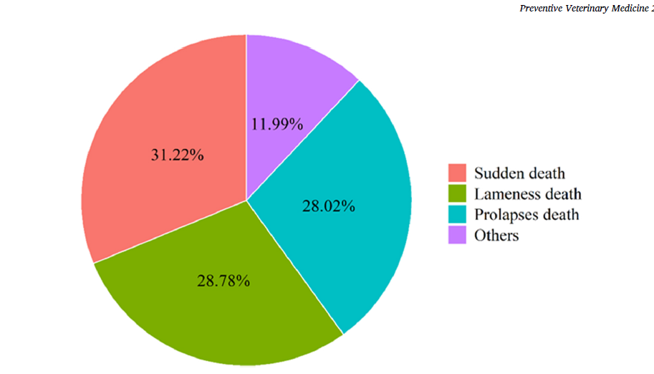
The study by Paiva et al, 2023, includes this graph presenting the main causes of sow mortality, with sudden death being the most prominent one. The study also identified key risk factors associated with sudden death in sows, including year (with an increase observed from 2019 to 2021), season (higher incidence during summer), PRRS status (higher in farms experiencing epidemic outbreaks), PED status (higher in positive farms), feed medication (higher in non-medicated groups), Mycoplasma status (higher in positive farms), as well as interactions between these factors.
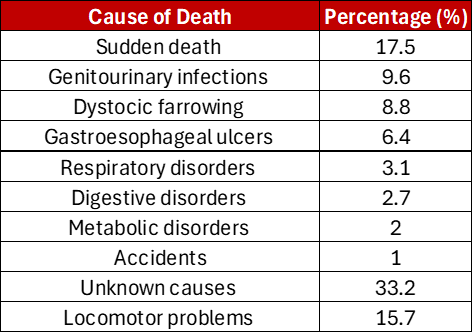
Palomo, 2025 also described an etiological table from the different causes of mortality in sows:
Table 1. Etiological causes of mortality in sows
Related to metabolic disorders, there are two critical factors described by Bortolozzo, 2024, which are: environmental stress from high temperatures and the peripartum period, which accounts for nearly half of all deaths.
Another study from Laura Solis, Chris Rademacher and Marcelo Almeida from Iowa State University, shows that 61% percent of death happen during the peripartum period as shown in the figure 2.
Figure 2. Sow mortality peaks across the production based on 213 necropsies (adapted by Kemin).
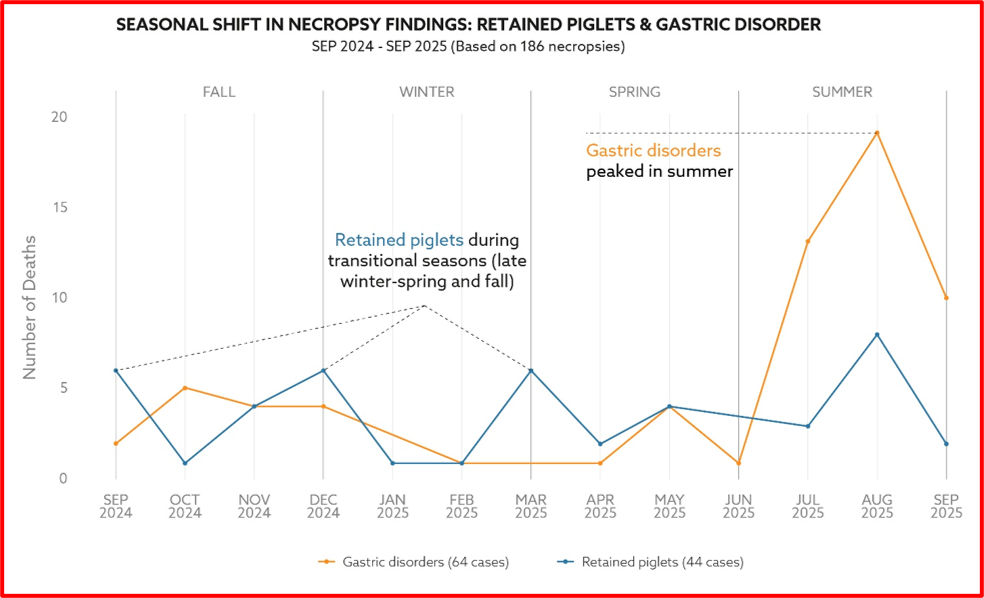
While diving deeper into the causes, these were the findings described by the same article.
Figure 3. Sow mortality by parity (adapted by Kemin).
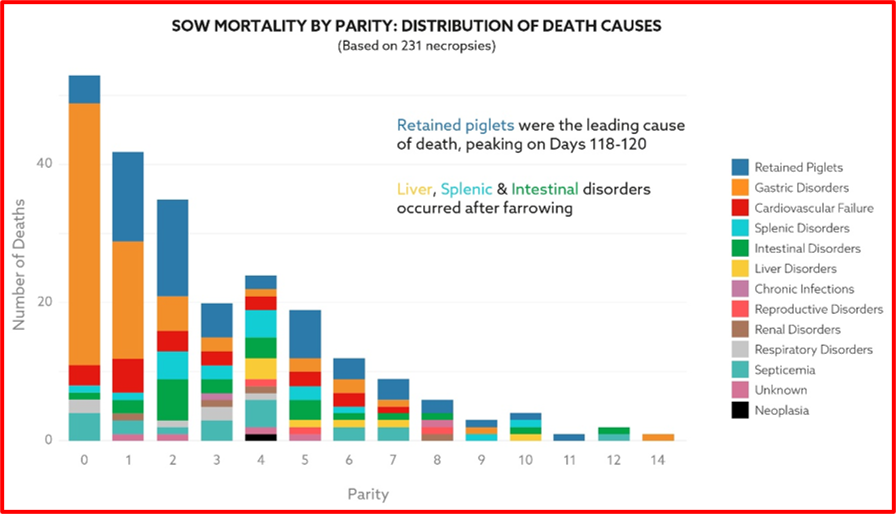
Intestinal torsion and hemorrhagic bowel syndrome (HBS) can be part of the causes of these sudden deaths in sows, and it is described that heat stress and the overgrowth of some commensal bacteria like Clostridium spp. may be part of the explanation to this syndrome.
Heat stress elevates circulating levels of stress hormones, particularly cortisol, and disrupts the tight junctions between intestinal epithelial cells. This disruption increases intestinal permeability, a condition commonly referred to as “leaky gut”. This damage to the intestinal barrier includes multiple components: weakening of the mechanical barrier, thinning of the chemical layer, disturbance of the microbial community, and dysregulation of immune defenses. This has resulted in a reduction of villus between? 20-40% , also the deepness of crypts, detiriorating the ratio villi/crypt.
The intestinal mucus (riched in mucins) plays a critical role in the chemical barrier. Heat stress reduces the genic expression of mucins, reducing the mucus layer which directly affects the microbiota. The changes produced in the microbiota are a reduction of diversity and a trigger of inflammation. This affects especially Lactobacillus and Bifidobacterium, and opens the door to other opportunistic bacteria as E. coli, Salmonella and Clostridum perfringens. Heat stress also increases oxidative stress caused by the increase of the activity of some enzymes like superoxide dismutase and gluthation peroxidase.
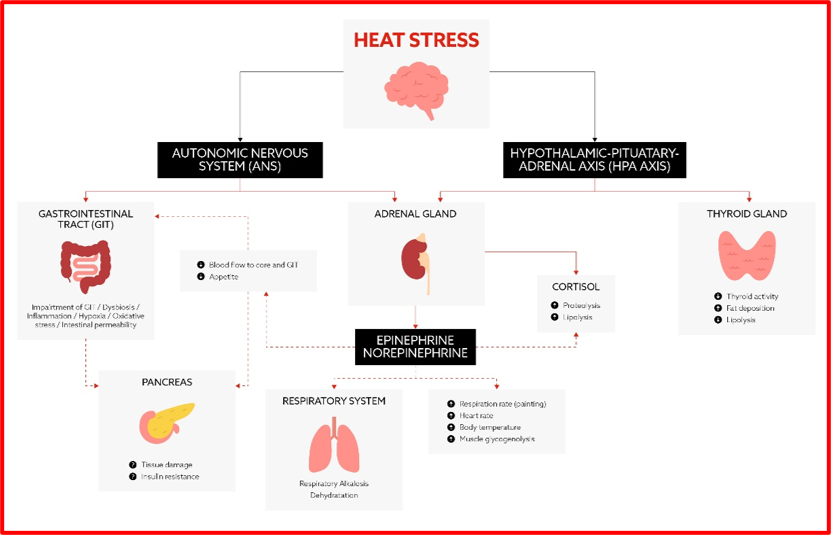
With high temperatures, as we explained before, blood is directed towards organs implicated in heat dissipation such as the skin, ears, diaphragm and lungs, but really far from the core and intestinal tissues (Collin et al, 2001). This can lead to a cascade of reactions explained in figure 4, created by Silva, 2025.
Figure 4. Thermoregulation and thermal acclimation responses due to heat stress on the autonomic nervous system and the hypothalamic-pituitary-adrenal (Adapted from Gonzalez-Rivas et al., 2020 by Kemin)
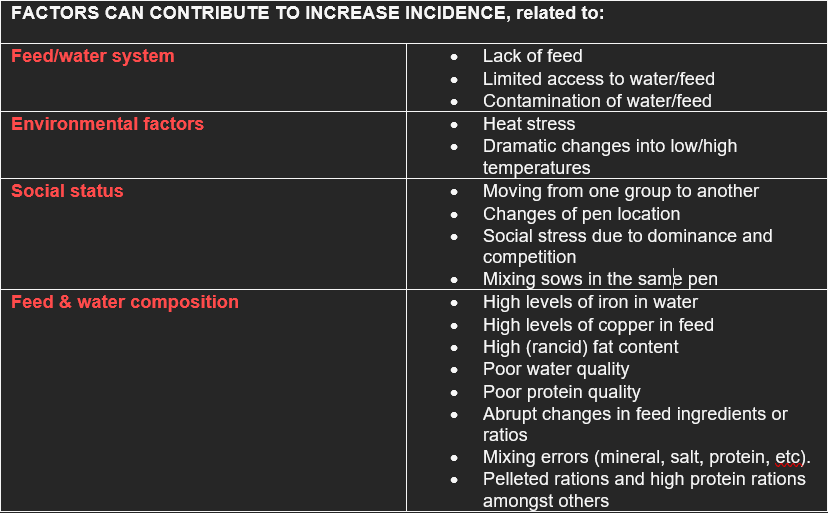
RISK FACTORS IN HBS
For a herd afflicted by HBS, the risk factors most frequently mentioned involve disruptions of feed intake, issues with feed or water quality, or change in social status.
Controlling all these risk factors is key to managing HBS syndrome. There are also several nutritional strategies that can be used, such as the use of CLOSTAT®, a proprietary probiotic containing Bacillus velezensis PB6 (ATCC PTA-6737) (Kemin Europa NV), which acts against Clostridium spp. through three different mechanisms:
- CLOSTAT® produces different functional lipopeptides. Lipopeptides are molecules that consist of lipids and amino acids, with biological properties; some of them are called surfactins with broad-spectrum antibacterial activity, specially against C. perfringens.
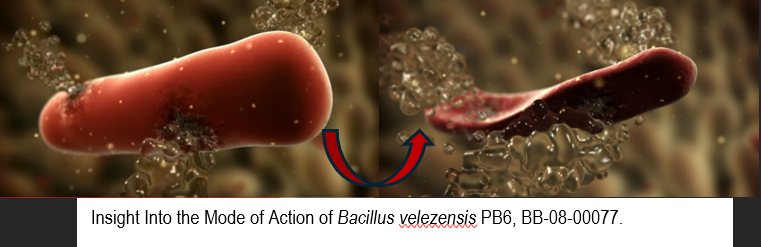
- CLOSTAT® also produces fengycin, a quorum quenching molecule; which inhibits communication between bacteria, to prevent high cell densities and reduce pathogenicity of Clostridium spp.
- CLOSTAT® competes for space within the microbiome against other bacteria and increases microbial diversity, which contributes to improved gut health.
Overall, CLOSTAT® is a preventive tool to avoid HBS and prevent sudden deaths in a sow’s herd, especially in summer season it can serve as a reinforcement of the general health status specifically in the intestine; thanks to the direct effect it has against Clostridium spp.
THE ECONOMICAL COSTS
Sow mortality increases the cost because of higher rates of replacement, higher nonproductive days (3,5€/sow/day, SIP,2025), treatment expenses, and also indirect costs we referred to before. The economic value of a dead sow is estimated at €950-1050, including effective costs and lost income (Bortolozzo, 2024, Magalhaes, 2024). Every additional percentage point in mortality increases the production costs by €10 (Palomo, 2025).
REFERENCES
- Kikuti, M., Deen, J., Pinilla, J.C., Corzo, C.A., 2021. Understanding Sow Mortality: Part College of Veterinary Medicine, University of Minnesota.
- Kikuti, M., Preis, G.M., Deen, J., Pinilla, J.C., Corzo, C.A., 2022. Sow mortality in a pig production system in the midwestern USA: Reasons for removal and factors associated with increased mortality. Vet. Rec., e2539 https://doi.org/10.1002/ vetr.2539.
- Palomo, 2025. Chapter 11. Sow mortality: a practical point of view. From the Novus book “Nutrition and production strategies for today´s sows”.
- https://www.nationalhogfarmer.com/livestock-management/why-does-it-matter-how-we-code-sudden-deaths-in-sows
- Rodrigo C. Paiva, et al, 2022. Risk factors associated with sow mortality in breeding herds under one production system in the Midwestern United States. https://doi.org/10.1016/j.prevetmed.2023.105883
- Matheus Saliba Monteiro et al, 2023. Causes of Sow Mortality and Risks to Post-Mortem Findings in a Brazilian Intensive Swine Production System https://doi.org/10.3390/ani12141804
- INF-26-23257. Heat stress Hemorragic bowel syndrome Clostridium spp How can we fight against it
- F.P. Bortolozzo, M.B. Menegat, A.P.G. Mellagi, M.L. Bernardi, I. Wentz. New artificial insemination technologies for swine. Reprod. Domest. Anim., 50 (2015), pp. 80-84, 10.1111/RDA.12544
- Will, K.J.; Magalhaes, E.S.; Moura, C.A.A.; Trevisan, G.; Silva, G.S.; Mellagi, A.P.G.; Ulguim, R.R.; Bortolozzo, F.P.; Linhares, D.C.L. Risk Factors Associated with Piglet Pre-Weaning Mortality in a Midwestern U.S. Swine Production System from 2020 to 2022. Prev. Vet. Med. 2024, 232, 106316.
- Collin,A., Y. Lebreton, M. Fillaut, A. Vincent, F. Thomas, and P. Herpin. 2001. Effects of exposure to high tempeature and feeding level on regional blood flow and oxidative capacity of tissues in piglets.Exp. Physiol. 86:83–91.
- Silva, 025. Chapter 7: Sow nutrition during heat stress. From the Novus book “Nutrition and production strategies for today´s sows”.
Kontakt:
Skontaktuj się z nami za pomocą poniższego formularza.