















 Company
Cargill Animal Nutrition and Health
United States
3
products
6
Publications
187
Followers
Company
Cargill Animal Nutrition and Health
United States
3
products
6
Publications
187
Followers
Phytogenics can help support post-weaning challenges in pigs


An increasing body of evidence and farm trial data is demonstrating that phytogenic feed solutions can be an effective tool to address post-weaning challenges in piglets, especially during the vulnerable early weeks after weaning.
The transition at weaning exposes piglets to significant physical and social stressors, which, combined with an immature gastrointestinal tract, frequently result in digestive disturbances such as post-weaning diarrhea (PWD). These challenges often lead to reduced growth performance and economic losses. Intestinal dysfunction is typically associated with a combination of undigested dietary protein which can result in the proliferation of undesirable bacteria, primarily Escherichia coli, in the hindgut. Clinically, PWD is characterized by diarrhea, dehydration, growth retardation in surviving piglets, and, in severe cases, sudden death [1,2].
More knowledge on nutrients and feeding strategies
Reducing PWD in piglets has become a key priority for sustainable pig production, driven by environmental, health, and safety considerations. Considerable progress has been made in understanding how the composition and nutritional characteristics of dietary ingredients influence the development of PWD. One notable advancement is the strategy of lowering dietary crude protein levels for example or using ingredients that are better digestible by the animals, this ultimately leads to less substrate for the proliferation of undesirable bacteria. At the same time, accumulating evidence has deepened our understanding of the role of specialties, particularly phytogenics, in supporting the resilience of animals during post-weaning challenges notably by stimulating feed intake and supporting gut microbiota balance.
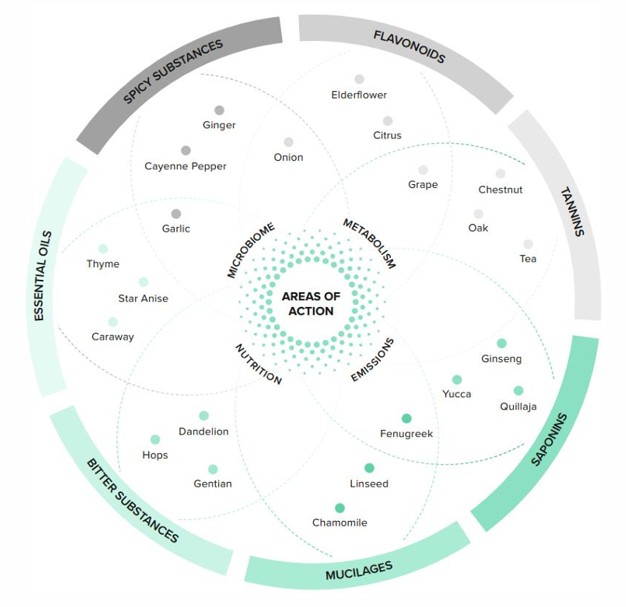
Phytogenics are bioactive compounds derived from plants, including essential oils, herbs, spices, and other botanical extracts. They encompass a wide variety of plant-based ingredients and active substances with multiple modes of action (Figure 1). For instances, phytogenics stimulate early feed intake supporting digestion, help towards modulation of a balanced gut microbiota, and have antioxidant properties [3,4]. The specific modes of actions and potential of phytogenics for weaned piglets is also nicely outlined in this pig333 article.
Figure 1 - Phytogenics comprise a diverse range of bioactive compounds with multiple modes of actions.
Phytogenic feed solution tested in practice
Growing evidence and a deeper understanding of phytogenics are enhancing our ability to tackle post-weaning challenges, particularly during the critical first 14 days after weaning. Cargill Animal Nutrition & Health (‘Cargill’) has been researching phytogenics for years. Refining formulations and testing them extensively under practical, farm conditions led to the development of a phytogenic feed solution (PFS).
An important trial by Cargill in Spain (2022) demonstrated the significant benefits of using the PFS during the weaning period. A total of 276 weaned piglets of both sexes (Danbred sows X Pietrain male) with intact tails and weaned at 22 days were allocated to treatments according to gender, body weight and sow parity. The trial was conducted for 42 days. Pigs were assigned to two treatments (11 replicates for control treatment and 12 replicates for PFS treatment; 12 pigs/replicate – see Table 1). Two-phase diets (phase 1 for 18 days and phase 2 for 24 days) were offered in pellet form and ad libitum. Water was also available ad libitum. Basal diets (control) contained a blend of feed additives (PFS) aiming to promote piglet gut resilience and performance but did not have pharmacological levels of zinc oxide. Measurements taken included ADG, ADFI, FCR and faecal scores (1: firm and shaped; 2: soft and shaped; 3: loose; 4: watery).
Table 1 - Description of experimental treatments.

Better growth, low fecal scores in phytogenic group
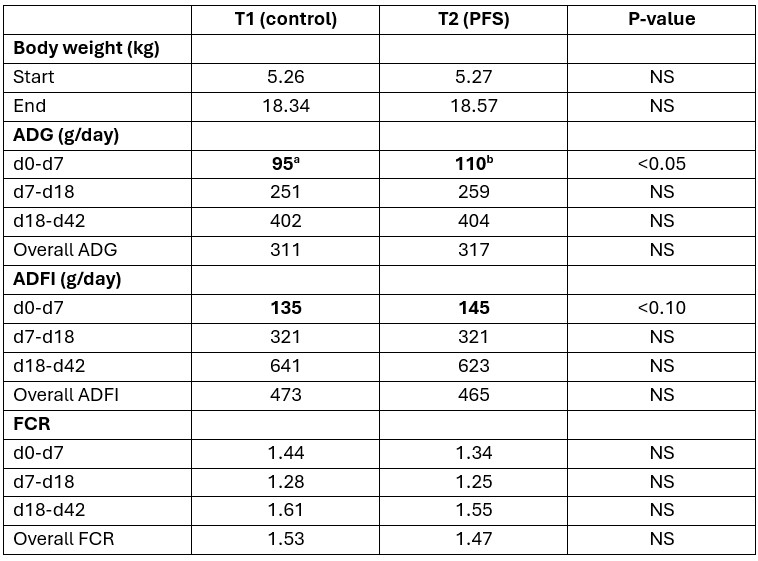
During the first 7 days post-weaning, the PFS group showed a trend for improved feed intake and a significant improvement in ADG by 15.1% (110 vs 95 g/day, p-value, see Table 2).
Table 2 – Growth performance results.
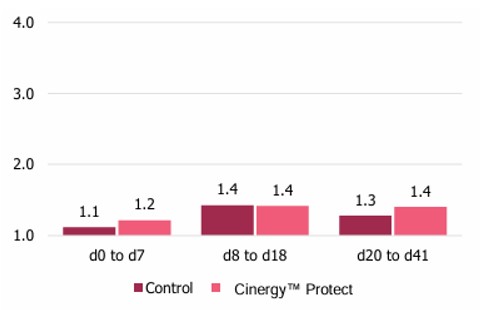
The faecal score was below score 2 during the experimental period (Figure 2) which indicated the absence of watery feces or diarrhea during the experiment.
Figure 2 – Fecal scoring between the two treatment groups.
An effective nutritional tool to control PWD is here
Increasing regulatory and consumer pressures are steering pig producers towards innovative alternatives to support piglets during post-weaning challenges. Growing scientific evidence and a deeper understanding of phytogenic compounds are driving the development of advanced, commercially viable solutions such as CinergyTM Protect from Cargill.
Its efficacy has been demonstrated in numerous trials. In the study referenced in this article, supplementation with Cinergy Protect improved piglet growth performance during the first seven days post-weaning, with average average daily feed intake (ADFI) increasing by 7.8% and daily gain (ADG) increasing by 15.1% . These results indicate that Cinergy Protect has the potential to support growth performance during the critical post-weaning phase.
References:
- Amezcua R, Friendship RM, Dewey CE, Gyles C, Fairbrother JM. Presentation of postweaning Escherichia coli diarrhea in southern Ontario, prevalence of hemolytic E. coli serogroups involved, and their antimicrobial resistance patterns. Can J Vet Res. 2002;66:73–8.
- Fairbrother JM, Nadeau E, Gyles CL. Escherichia coli in postweaning diarrhea in pigs: an update on bacterial types, pathogenesis, and prevention strategies. Anim Health Res Rev. 2005;6:17–39.
- Liu, Y.; Song, M.; Che, T.M.; Almeida, J.A.S.; Lee, J.J.; Bravo, D.; Maddox, C.W.; Pettigrew, J.E. Dietary plant extracts alleviate diarrhea and alter immune responses of weaned pigs experimentally infected with a pathogenic Escherichia coli. J. Anim. Sci. 2013, 91, 5294–5306.
- Blavi, L.; Solà-Oriol, D.; Mallo, J.J.; Pérez, J.F. Anethol, cinnamaldehyde, and eugenol inclusion in feed affects postweaning performance and feeding behavior of piglets. J. Anim. Sci. 2016, 94, 5262–5271.

Contact:
Contact us using the following form.