



 Entreprise
Virbac | Building the future of animal health
France
3
Produits
10
Publications
142
Suiveurs
Don't start the house with the roof: what comes before hormonal intervention in swine reproduction


Reproductive hormones have been on the market for years and, used properly, they work. When the expected result doesn't come, the fault rarely lies with the product. It usually lies earlier: a sow out of condition, an eyeballed diagnosis, a poorly stored product or a dose given at the wrong time. That idea underpins the Virbac Swine Bio-Academy capsule series on hormones in swine reproduction, which this article summarizes.
Synchronizing gilts: selection comes first
The progestagen temporarily suppresses the hypothalamic-pituitary axis and, once it is withdrawn, the females resume cycling at the same time. For that to happen, there has to be a cycle to resume: a prepubertal or anestrous gilt will not respond. That is why selection comes before the protocol (growth, age, backfat, boar stimulation), and ultrasound helps identify prepubertal gilts.
With altrenogest for 18 days, the target is for at least 95% of females to come into heat, generally 5 to 6 days after the last dose. The more tightly grouped those heats are, the better the fertility and the easier it is to meet each batch's service target. The most common failures relate to timing (always at the same time of day, within a one-hour margin), incomplete doses and product storage. As for duration, treatments shorter than 5 days or longer than 15 work well; intermediate durations perform worse.
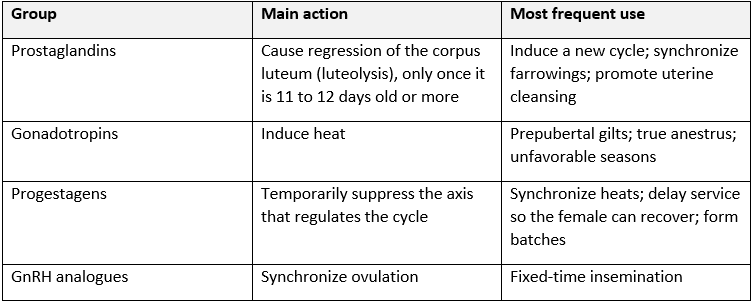
Table 1 summarizes what each hormone group does and when it is used.
Table 1. Hormone groups: main action and most frequent use.
Gonadotropins given around 24 hours after weaning bring forward both heat and ovulation. In a program of three inseminations at fixed times, the third may arrive after the fertility window has already closed (Figure 1).
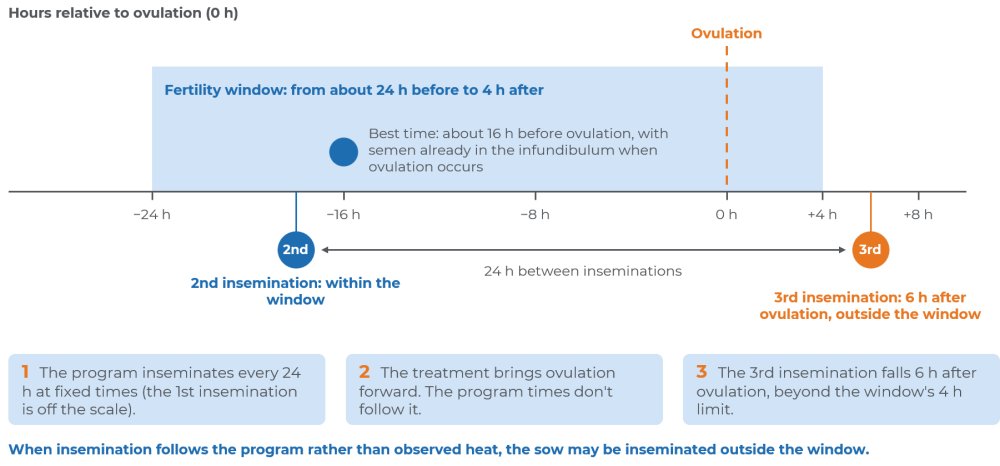
Figure 1. Fertility window around ovulation and the effect of earlier ovulation on the program's 3rd insemination. The position of the 2nd insemination is estimated from the 24 h interval between inseminations.
Diagnosis: treating blindly is costly
In reproduction, many diagnoses remain presumptive and ultrasound is underused. The typical case begins with retained placenta or endometritis that keeps the corpus luteum active and progesterone high. The sow does not come into heat, is treated as if she were anestrous and receives a gonadotropin which, with progesterone present, ends in follicular cysts (Figure 2).
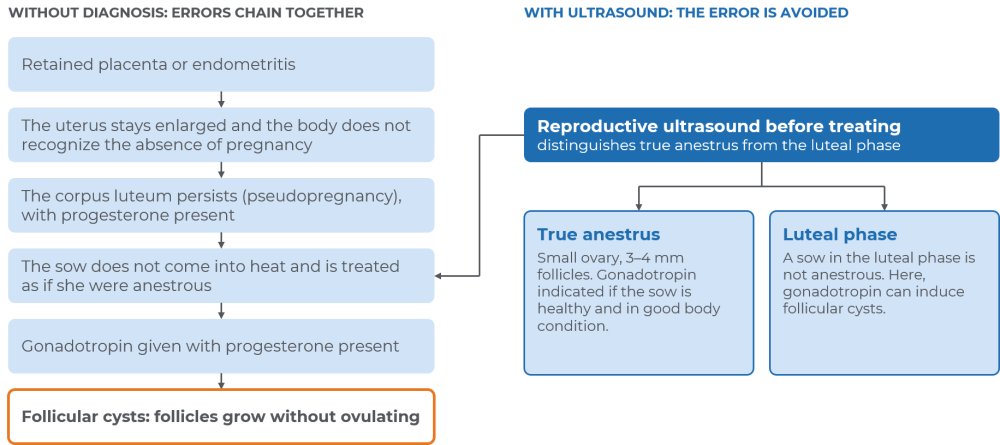
Figure 2. How a presumptive diagnosis sets off a chain of errors: a sow in the luteal phase, treated as if she were anestrous, may receive gonadotropin and develop follicular cysts. Reproductive ultrasound helps distinguish true anestrus from the luteal phase.
Ultrasound settles the question. In true anestrus, with a small ovary and 3–4 mm follicles, gonadotropin is indicated if the sow is healthy and in good body condition. In the luteal phase, it is not.
As a reference, 90% of sows should be in heat within 7 days after weaning and 97% within 10 days.
Management: as important as the product
The product is sensitive to light and heat, is degraded by dirty applicators, and must be stored and dosed according to the product label.
The sow only allocates resources to reproduction once everything else is covered, so nutrition must be planned in every phase. Flushing helps in the post-weaning period and in thin females, but adds little for those that already arrive in good condition. The environment also plays a role: environmental and social stress alters LH secretion and compromises maintenance of the corpora lutea.
In heat detection, those who stimulate the sow heavily tend to detect heat earlier, while those who wait for the standing reflex detect it closer to ovulation. Both approaches work as long as the timing of insemination is adjusted to the detection method. The teaser boar remains essential.
Each protoco's target is set before starting: 95% of females in heat for synchronization, and good-quality heat 4 to 7 days later for induction with gonadotropin.
Fixed-time insemination: effective, but demanding
In fixed-time insemination, a GnRH analogue is usually given at a set time and females are inseminated at a fixed time, without waiting for heat. It reduces the subjectivity of heat detection, saves labor and doses, and groups farrowings. On the other hand, protocols are strict, every female must be treated and the products are expensive. Fertility and number born are very similar to those of conventional insemination, so the decision depends on whether the farm can sustain those demands.
Combined protocols, with altrenogest followed by gonadotropin, give good results in gilts during unfavorable seasons and in primiparous sows that need to regain condition. Once again, the risk lies in giving gonadotropin without a diagnosis.
The capsules sum it up in one sentence: “let's not start the house with the roof.” Each topic in this article is covered in one of them at the Virbac Swine Bio-Academy
Content developed in collaboration with Virbac.
Contact :
Contactez-nous en utilisant le formulaire suivant.