













 Entreprise
Adisseo
France
4
Publications
80
Suiveurs
Entreprise
Adisseo
France
4
Publications
80
Suiveurs
Feeding for performance: maximising intake and nutrient use in modern sows


Meeting the escalating demands requires a holistic approach that goes beyond formulation alone and addresses feed safety, voluntary feed intake, nutrient utilisation, health status, immune competence and overall management. Within this framework, two factors largely determine whether a sow can fully express her genetic potential: how much she eats, and how effectively nutrients are utilised. And this is where targeted nutrition can play a key role.
More than just kilograms per day
Sow nutrition is a key lever to optimise piglet performance. It involves providing adequate levels of essential nutrients, including amino acids, fatty acids, vitamins and minerals, as well as functional components such as antioxidants and immunomodulatory compounds. Even the most precisely balanced diet, however, cannot deliver its intended benefits if feed intake is insufficient – a situation that occurs more frequently in practice than is generally assumed.
During late gestation, energy and amino acid requirements rise sharply due to rapid foetal growth, mammary development and colostrum synthesis. At the same time, in the days around farrowing, voluntary feed intake is often depressed as a result of changes in diet composition and environment, parturition-related stress and hormonal fluctuations. Moreover, lactating sows in commercial farrowing facilities experience heat stress almost continuously, which can further suppress appetite. And from the second or third week of lactation, feed intake frequently fails to keep pace with the dramatic nutrient demands of large, fast-growing litters.
Negative energy balance
Disruptions in feeding behaviour, whether due to heat stress, parturition, diet composition or palatability issues, can quickly push sows into a negative energy balance. High-producing sows therefore often begin mobilising body fat and protein tissue already in late gestation, and body weight losses of up to 20–25 kg during lactation are not uncommon. Excessive mobilisation of body reserves is associated with reduced colostrum and milk yield, impaired litter growth and survival, and compromised reproductive performance in the subsequent cycle.
Feed intake in lactating sows is often discussed primarily in terms of daily intake targets. While daily intake is clearly important, it does not fully capture feeding behaviour. Other aspects such as meal size and frequency, day-to-day consistency of intake, and intake during critical periods like early lactation are also important determinants.
Supporting feed intake through palatability
Within strategies aimed at supporting lactational performance, palatability-enhancing solutions can be considered valuable complementary tools to increase voluntary feed intake. Improving palatability is not about stimulating intake at a single moment, but about supporting appetite, reducing meal interruptions and maintaining consistent feeding patterns over time, particularly under challenging conditions such as heat stress or high litter demands. In addition, palatability solutions can help mask subtle variations in raw material quality that may otherwise negatively affect feed acceptance.
Krave® AP supports consistent feed intake
Krave® AP has been formulated to influence sow feeding behaviour by activating oronasal sensory pathways, thereby enhancing the attractiveness of the diet. In a study by Silva et al. (2021), supplementation with Krave® AP significantly increased average daily feed intake during lactation, from 5.36 to 6.42 kg/day; an increase of approximately 22% (Figure 1).
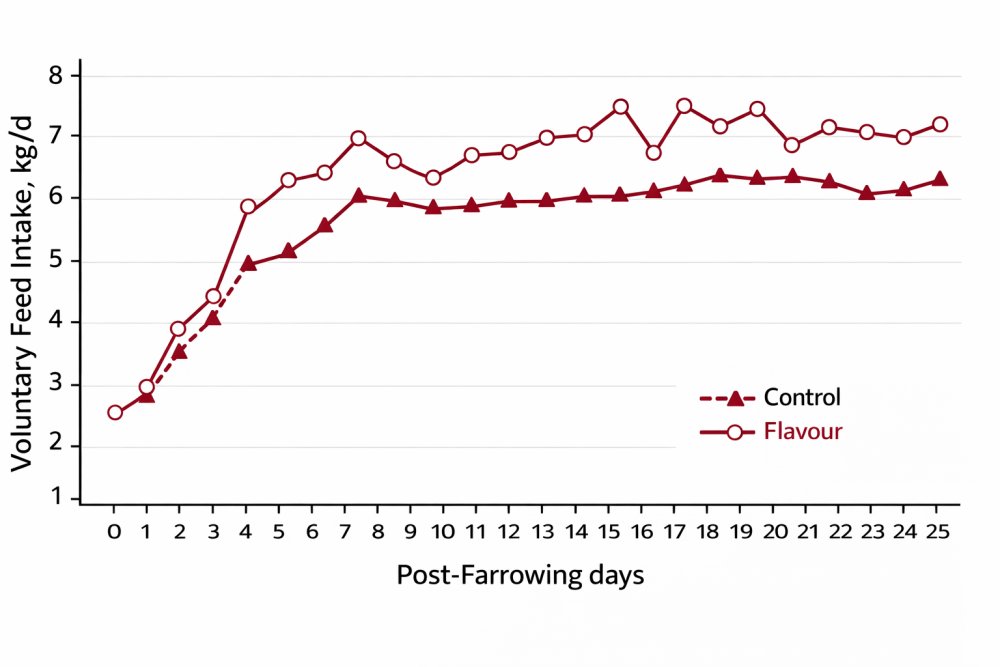
Figure 1. Adding flavour (Krave AP®) to the diet increased daily feed intake during lactation; feed intake differed between diets from d 3 to 24 (P < 0.05; Silva et al., 2021).
Beyond total daily intake, the study also demonstrated clear effects on feeding behaviour. Sows receiving Krave® AP consumed more feed per meal, particularly during the coolest periods of the day. This pattern is especially relevant under tropical or warm conditions, where heat load suppresses intake during daytime hours and shifts feeding activity toward the night. By increasing intake per feeding event during these favourable periods, Krave® AP supports a more stable energy supply throughout lactation (Figure 2).
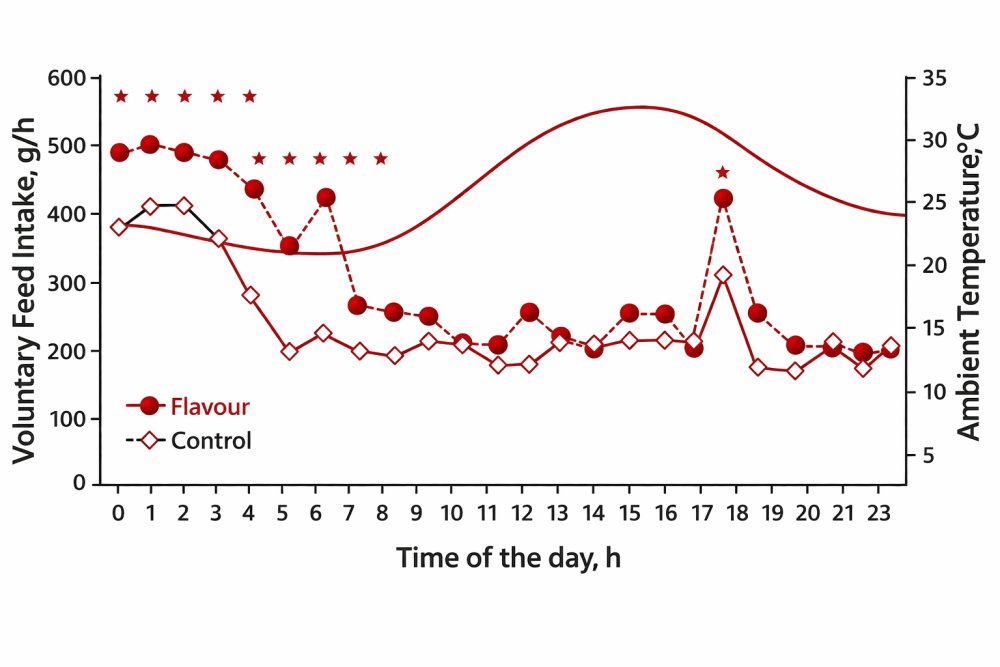
Figure 2. Adding flavour (Krave AP®) to the lactation diet increased feed intake during the coolest part of the day; feed intake differed between diets on hourly feed consumption from 00:00 to 0800 and 1800 (*; P < 0.05). The solid line represents the average daily ambient temperature (Silva et al., 2021).
By supporting consistent voluntary feed intake, Krave® AP helps create a more favourable metabolic state, allowing sows to better meet their nutritional requirements through feed rather than through excessive mobilisation of body reserves. This more balanced energy status provides a physiological basis for improved lactational output and, indirectly, for piglet growth, survival and reproductive performance in the subsequent cycle.
Why higher feed intake is not enough
Improving feed intake is a critical first step. However, even when palatability is optimised and sows eat more, performance may still remain limited by digestive constraints and dietary factors that reduce nutrient availability.
CTA: Read the full article to understand why feed intake alone is not enough, and how improving nutrient utilisation is essential to maximise sow and litter performance. Click here
Contact :
Contactez-nous en utilisant le formulaire suivant.