















 Company
ECO Animal Health Global
United Kingdom
23
Publications
400
Followers
Company
ECO Animal Health Global
United Kingdom
23
Publications
400
Followers
Evaluation of the antimicrobial susceptibility of Mycoplasma hyopneumoniae isolated from pigs in Brazil


Suzana S. Kuchiishi 1 ; Rafael Frandoloso 2 ; José A. Caon 3 ; Javier Uriarte 3 1Centro de Diagnóstico de Sanidade Animal (CEDISA), Concórdia, Brazil. 2 Laboratory of Microbiology and Advanced Immunology, University of Passo Fundo, Brazil. 3 ECO Animal Health, The Grange, 100 High Street, London, UK. suzana@cedisa.org.br
BACKGROUND AND OBJECTIVES
Mycoplasma hyopneumoniae (M. hyo) is one of the most prevalent respiratory pathogens in pig production causing enzootic pneumonia with significant production and economic losses. The objective of this study was to determine the Minimum Inhibitory Concentration (MIC) of several antibiotic active ingredients against eleven M. hyo strains isolated from pig farms in Brazil.
MATERIALS AND METHODS
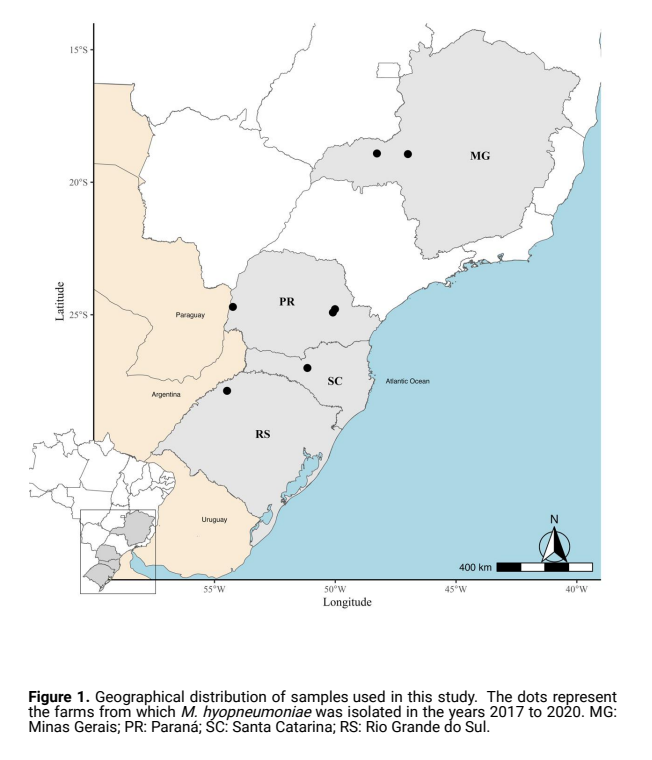
Eleven M. hyo isolates from farms with respiratory clinical signs compatible with enzootic pneumonia were tested in this study (Figure 1). The strains were isolated from diseased lungs submitted to CEDISA and AFK Imunotech.
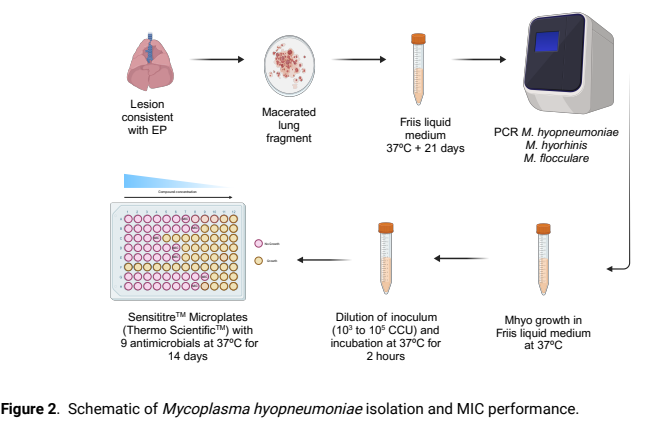
The microdilution method described by Hannan et al. was followed using Sensititre TM Microplates (Thermo Scientific TM). Each microplate contained nine active ingredients at different concentrations: tilmicosin, tiamulin, enrofloxacin, doxycycline, erythromycin, lincomycin, chlortetracycline, tylvalosin and tylosin tartrate. The MIC value was defined as the lowest drug concentration capable of inhibiting M. hyo growth (Figure 2).
DISCUSSION AND CONCLUSION
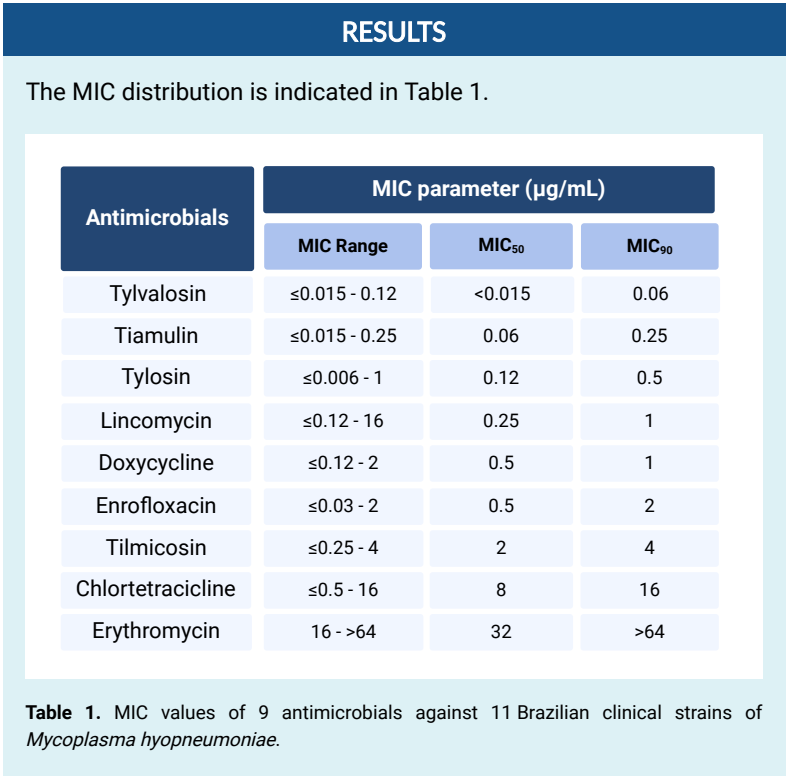
The M. hyo isolates had different sensitivity profiles to the tested antibiotics. Based on the results of MIC 50/MIC 90 , tylvalosin had the lowest MIC values followed by tiamulin, tylosin tartrate and tilmicosin in agreement with other researchers along with a narrow MIC range. These findings suggest that tylvalosin would be a highly effective antibiotic for the treatment of M. hyo and enzootic pneumonia in Brazil.
References
(1) Hannan, P.C.T. 2000. Guidelines and recommendations for antimicrobial minimum inhibitory concentration (MIC) testing against veterinary mycoplasmas species. Veterinary Research, v.31, p.373-395, 2000.
Contact:
Contact us using the following form.