















 Company
Boehringer Ingelheim Vetmedica GmbH
Germany
169
Publications
1112
Followers
Company
Boehringer Ingelheim Vetmedica GmbH
Germany
169
Publications
1112
Followers
ESPHM 2026 - Case Report: Impact of Mass Sow Vaccination Against Mycoplasma hyopneumoniae on Piglet Colonization at Weaning


E. Bénéteau, M. Lesueur, J.-B. Herin, G. Mabecque
Background
This study was conducted in a commercial herd of 1,500 sows that had previously experienced a Porcine Respiratory Disease Complex (PRDC) outbreak. The objective was to assess whether vaccinating sows,following specific veterinary advice could reduce the transmission of Mycoplasma hyopneumoniae (M. hyo) to piglets. Historically, the farm received gilts from a source infected with M. hyo. However, for the past 18 months, gilts have been sourced from a multiplication farm free of M. hyo, which also supplies other farms that routinely practice mass vaccination of breeding animals against this pathogen. During a veterinary visit, it was discovered that sow vaccination had been discontinuedon this farm, creating an opportunity to compare outcomes between vaccinated and unvaccinated systems.
Material and Methods
The vaccination program used Ingelvac MycoFLEX® for both sows and piglets. Deep tracheal swabs were collected from piglets at weaning after reintroducing sow vaccination and compared with samples from other vaccinated herds supplied by the same multiplier. PCR testing was performed to detect the presence of M. hyo.
Results
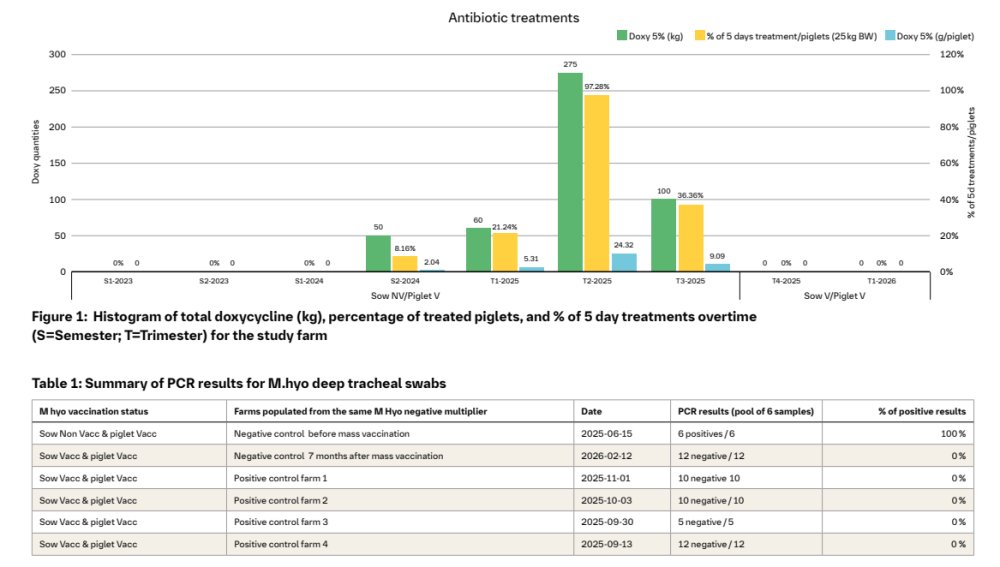
All piglet samples from the farm following mass sow vaccination tested negative for M. hyo, as did samples from other vaccinated herds (Table1). Additionally, respiratory issues during the fattening phase were no longer observed. These findings confirm that sow vaccination efectively prevents piglet colonization at weaning, reducing the prevalence of PCR positive animals. As illustrated in Figure 1, the antibiotic treatments were also dramatically reduced after the arrival of the piglets born from revaccinated sows.
Conclusions
Mass vaccination of sows against M. hyo is a reliable strategy to limit pathogen transmission in modern swine production. By preventing early colonization,this approach improves respiratory health and lowers the risk of future outbreaks. The study also underscores the importance of compliance with veterinary recommendations and monitoring piglets at weaning to ensure disease control, even in the absence of clinical signs.
References
1. Arsenakis I., et al. Effects of pre-farrowing sow vaccination against Mycoplasma hyopneumoniae on offspring colonisation and lung lesions. Veterinary Record, January 2019.
2. Sibila M., Bernal R., Torrents D., et al. Effect of sow vaccination against Mycoplasma hyopneumoniae on sow and piglet colonization and seroconversion, and pig lung lesions at slaughter. Veterinary Microbiology, 2008;127:165–170.
3. Ruiz A., Utrera V., Pijoan C. Effect of Mycoplasma hyopneumoniae sow vaccination on piglet colonization at weaning. Journal of Swine Health and Production, 2003;11:131–135.
4. Díaz E., Chevez J.C., Lara J. Using 2 different Mycoplasma protocols for the control of Mycoplasma hyopneumoniae, considering in one of them sow vaccination. Proceedings of the 18th International Pig Veterinary Society Congress, Hamburg, Germany, 2004:411.
5. Klingenberg M., et al. Vaccination of gestating sows against M. hyopneumoniae – a useful adjustment to piglet “only” vaccination. Proceedings of the 22nd International Pig Veterinary Society Congress, Rio de Janeiro, 2020:275.
Contact:
Contact us using the following form.