
Weaning on Friday and using altrenogest to avoid weekend farrowings; is it possible?
10-Jan-2012 (14 years 9 months 3 days ago)
"Alternative" uses of altrenogest
Altrenogest is a synthetic hormone with an effect equivalent to that of natural progesterone in the sow. It is commonly used to group the mating of gilts, especially on farms operating in batches over one week.
However, altrenogest has a number of "alternative" uses which are also very interesting:
When supplied to weaned sows, altrenogest prevents estrus, allowing for:
- Grouping together the mating of sows weaned on different days.
- Modification of post weaning estrus, allowing us to avoid having to wean and mate on holidays during the week.
- Recuperation of some body condition before mating.
When supplied to lactating sows, it helps avoid estrus while still in the farrowing pens, which can happen under certain genetic lines under certain circumstances.
Delayed farrowings
"Alternative" uses described above have been known for some time and apply as usual. However, altrenogest has another very interesting, but still quite unknown, potential for use: blocking farrowing.
Interestingly, if we read an altrenogest prospect, we can see the first contraindication is in administering it to pregnant sows. However, we have recently seen a survey published by C Vanderhaeghe et al. (2011),which successfully used altrenogest treatment for 3 days (starting on day 110 or 111) to prevent premature birth, and a clinical case study, with similar results.
On some of the farms I manage I have been using similar altrenogest treatments to maintain the gestation of specific sows which were to enter the farrowing pen with almost no margin. The idea was not to delay farrowing, but simply to avoid an early farrowing in pregnant sows. Following the success I even dared to administer it to sows with an anticipated farrowing on Saturday and Sunday, postponing it until Monday. So far, the result has been a success. The sows do not farrow on weekends and do not show any problems during farrowing.
The Revolution: Weaning on Fridays + matings and farrowings at the beginning of the week
From these concepts, I’ve come up with an idea that could be revolutionary. I say "could be" because I have not yet carried them out and they may, to some extent, be quite risky.
It seems that the trend is to extend hyperprolific sow gestation. Some of the current genetics have gestations that last up to116 days for most of the sows. These are animals that, when weaned on Thursday, most tend to give birth on Friday.
What if we were to wean on Friday? We would have the bulk of farrowings on Saturday. What if we were able to block these farrowings for 2 days? Most of the farrowings would be concentrated on Monday. This situation would generate multiple benefits:
- Weaning on Friday, we can clean the farrowing pens that same day and have 2 days of sanitary depopulation (during the weekend), entering sows on Monday comfortably without much risk of any farrowings in gestation. (Weaning on Thursday is a little riskier because we have a margin of one day less).
- Majority of matings on Tuesday. During the weekend there will be virtually no matings.
- Bulk of farrowing at the beginning of the week. We have the whole work week for the most important farm work: monitoring farrowings and piglets up to 3-4 days of life.
- This is still a farrowing scheduling system, but in this case delaying farrowing instead of advancing it (as when we use prostaglandins).
- This generates a higher piglet birth weight. Each day of gestation represents between 100-200 grams extra per piglet, something to consider now, since hyperprolific sows give birth to small piglets.
Aspects to keep in mind:
- We need sows with long gestations (116 days or more).
Example: Gestation distribution of PIC Camborough sows on a farm between on 01-01-2011 and 27-05-2011
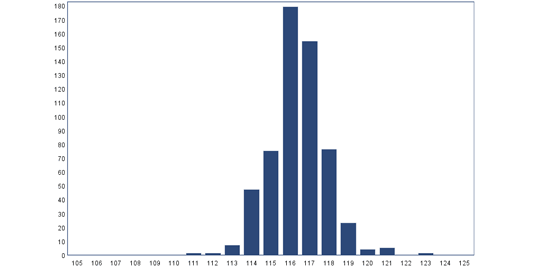
- Sows with 116 day gestations will delay farrowing by 2 days; will this generate more difficult farrowings?
- Even genetics with 116 day gestations, certain sows have shorter duration (e.g. 114 days or less). This type of sow will be delayed by more than 3 days. Will this longer delay lead to problems?
- Farms that usually wean at 21 days, could do it at 18 days with this system (farrowings on Monday’s and weaning on Friday’s). The weight of weaned piglets is likely to be the same or even better, but uterine involution time may be insufficient. On farms that wean at 28 days, there will be no problem.
- Farrowing days will coincide largely with mating days.
Conclusion
This method opens the door to a situation that has always seemed impossible to solve. Weaning only once per week, until now we had only two options:
- If we wanted to avoid weekend matings, farrowings and the care of piglets were moved to the weekend (farms to wean on Wednesdays or Thursdays).
- If we wanted to avoid the birth and care of piglets on a weekend, matings were carried out over the entire weekend (farms weaning on Mondays).
Now it seems we could carry out most of the work within the workday.
However, delaying farrowing by 2 days is risky with most sows, stillbirths and the need for supervision is likely to increase.
Another option would be to delay farrowing one more day, weaning the next day (Saturday). It may sound crazy, but if you just remove the sows and leave the room to wash with the piglets inside until Monday, the Saturday workload is not excessive. In fact, Victor Poza Moreno told me recently that they are doing this on a farm with sows with gestations that stretch up to 117 days.
In the case of "our" sows with 116 days of gestation, weaning on Saturday would result in farrowing on Sunday and then if we could delay farrowing by just one more day it will be met with plenty of success.
Another possibility would be to wean on Wednesday, Thursday or Friday and delay estrus by 3, 2 and 1 days using altrenogest at weaning. The drawback of this approach is that it increases the post-weaning non-productive days as well as the expense of hormones.
In short, it opens a world of new possibilities, who will dare to try it?