
Colostrum and piglet viability: Beyond quantity and immunoglobulins (Part II)
21-Sep-2026 (27 days ago)
The study shows how the bioactive composition of colostrum, which is influenced by the sow's parity, can affect piglet survival, growth, and intestinal development.
After analyzing the composition of colostrum (Part I), in this second part we'll examine its effects on the survival and growth of these piglets.
Piglet survival
Mortality in the first few days and during the lactation period was closely associated with the presence of specific compounds in colostrum and certain microbial taxa.
Metabolites and fatty acids in colostrum
Arginine and certain essential fatty acids were identified as key beneficial factors.
Arginine is known for its role in intestinal and immune function in piglets: studies in suckling and weaned piglets have shown that supplementation with arginine:
- improves intestinal integrity
- reduces epithelial damage
- positively modulates the immune response
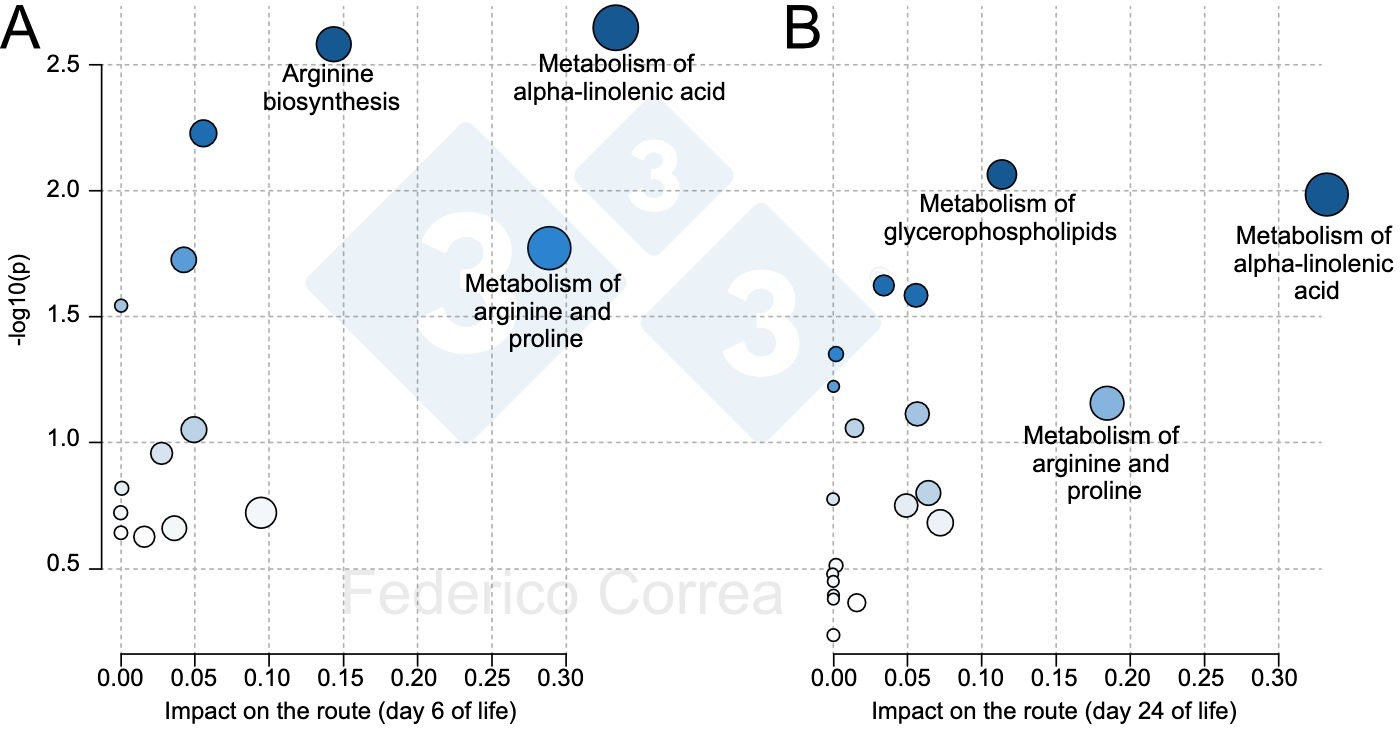
Analysis of metabolic pathways (Figure 1) also revealed an enrichment of the arginine biosynthesis and α-linolenic acid metabolism pathways in the groups with higher survival rates. This finding supports the hypothesis that colostrum most favorable for piglet viability is characterized not only by individual compounds but also by an overall metabolic profile more geared toward supporting intestinal and immune function.
As for the lipid component, n-3 polyunsaturated fatty acids (PUFAs) appear to play an important role. In particular, α-linolenic acid, EPA, and DHA are associated with:
- Anti-inflammatory effects
- Support for the intestinal barrier
- Neurological development of newborn piglets
The proper balance between n-6 and n-3 fatty acids is also crucial: a suboptimal ratio can compromise the piglet’s utilization of PUFAs and reduce their beneficial effects. In this context, the increase in certain n-6 fatty acids in the groups with higher mortality rates could reflect an unfavorable lipid imbalance.
Intestinal microbiota
Colostrum directly influences the piglets' microbiota. Piglets with higher survival rates had a greater abundance of beneficial bacteria that produce short-chain fatty acids, such as Roseburia and Lachnospiraceae.
Piglet growth
It was also shown that piglet growth is related to the composition of colostrum and its interaction with the gut microbiota.
Metabolites and fatty acids in colostrum
The fastest-growing piglets were associated with colostrum that was richer in metabolites involved in energy metabolism and protection against oxidative stress. Among the most important compounds is vitamin E, which is essential for newborn piglets because it helps reduce oxidative stress and control inflammatory processes, along with histidine, branched-chain amino acids, and carnitine, all of which are involved in energy metabolism and protein synthesis.
In contrast, the presence of metabolites such as kynurenine and γ-aminobutyric acid (GABA) was associated with reduced growth. Kynurenine is a marker of tryptophan metabolism activation under conditions of stress or inflammation, while GABA plays a role in the regulation of neuroendocrine and intestinal processes.
The increased levels of kynurenine and GABA in colostrum may reflect a less favorable physiological state in the sow, with potential implications for piglet growth.
Intestinal microbiota
In faster-growing piglets, a higher abundance of taxa associated with improved intestinal function and digestive efficiency was observed, including Lachnospiraceae, Akkermansia, Eubacterium, and Rikenellaceae. These microorganisms are also involved in fatty acid metabolism, suggesting an interaction between colostrum, the microbiota, and growth capacity.
Practical implications
The results highlight that the quality of colostrum—in terms of its metabolic and lipid composition—has a direct impact on piglet survival and growth.
In particular, the study emphasizes the importance of:
- Supporting the sow’s metabolic status during the final stages of gestation
- Ensuring adequate intake of key amino acids and a proper balance between n-6 and n-3 fatty acids
- Considering colostrum as an early modulator of the gut microbiota
In short, improving the quality of colostrum is a key tool for increasing piglet vitality and optimizing litter performance.
Acknowledgments
The research was funded by the BOOSTcolostrum project (P2022ZTYLS—CUP J53D23018670001) – NextGenerationEU – National Recovery and Resilience Plan (PNRR) – Decree No. 1409 of September 14, 2022. https://site.unibo.it/boostcolostrum/it