
Vaccines and PCV2 evolution
21-Nov-2014 (11 years 10 months 16 days ago)
Porcine circovirus 2 (PCV2) is economically one of the most important viruses infecting pigs. It results in several diseases, collectively called Porcine circovirus diseases (PCVD). First vaccine against PCV2 was launched in 2004 and nowadays most of the pigs receive a PCV2 vaccine. In Spain, which is the second most important pig producer within EU countries, up to 80% of the 24 million pigs are vaccinated. In North America vaccine coverage is even higher.
Lately, our research group has been interested in how the vaccine induced immunity may affect PCV2 evolution. Indeed, recently published results showed that distinct PCV2 variants are currently circulating in commercial pig farms (Kekarainen et al., 2014). Some of the variability was found in different frequencies and genomic positions of PCV2 in vaccinating and non-vaccinating farms. Furthermore, many amino acid changes were located in epitope regions important in immune system activation and previously identified by experimental methods. In this study next generation sequencing (NGS) was applied on PCV2 which allowed low frequency variants to be identified. Such low frequency variants are not detected with traditional sequencing methods but can play an important role in the infection, transmission of the virus and most importantly in the evolution. The power of NGS technique is the large amount of data obtained. Subsequent bioinformatics analysis then allows detailed studies on viral populations on whole genome level. These technologies have been already applied to better understand viral evolution in response to immunity and drug resistance (Grad et al., 2014; Ortega-Prieto et al., 2013; Tsibris et al., 2009).
What then makes PCV2 an interesting target to be studied for possible vaccine driven evolution? The characteristics making PCV2 suitable are:
- PCV2 gains genetic diversity by accumulating point mutations and through recombination. Indeed, evolutionary rates for PCV2 are higher than expected for a DNA virus (1.2x10⁻³ substitution/site/year), resembling the one from RNA viruses (Firth et al., 2009).
- Historic data shows that PCV2 genotype dominance is fluctuating. Based on genetic variation in its capsid gene, PCV2s are divided into three major groups designated PCV2 genotypes a, b and c (Segalés et al., 2008). A world-wide shift on genotype prevalence from PCV2a to b coinciding with the advent of very severe outbreaks of disease has been described in all parts of the world (Carman et al., 2006; Cortey et al., 2011; Cheung et al., 2007). Although such epidemiological data do not demonstrate that the appearance of epidemic outbreaks are caused by PCV2b strains, such coincidence in time and space points out that the genotype prevalence shift is part of the puzzle of the disease evolution (Segalés et al., 2013). It is not clear why such a shift occurred since a difference in pathogenicity between PCV2a and b is not evident (Opriessnig et al., 2008).
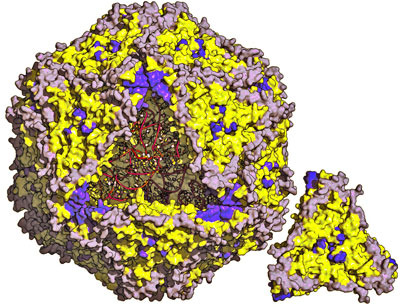
Structure of the PCV2 virus particle. Surface representation of the full capsid structure of PCV2 projected along the icosahedral threefold axis. The triangular cut-away correspond to a trimeric capsomer of coat proteins (lower right) to illustrate the actual biological context of the virion. Protein Data Bank ID: 3R0R.
- Recently, novel genetic variants of PCV2 have been identified, increasing the interest to closely monitor the possibility of emergence of variant PCV2 strains (Opriessnig et al., 2013). Indeed, in China, a variant of PCV2b was demonstrated to be apparently more virulent in pigs (Guo et al., 2012). Indeed, it is not even known if other, yet unknown, genotypes are circulating in the field.
- PCV2 vaccines are now widely used in all main pig producing countries. However, none of the current vaccines leads to sterilizing immunity. Therefore, animals are protected from the disease but still get infection with PCV2 in most of the farms. This type of vaccines, and the molecular characteristics of PCV2, creates a favourable situation for selection of viral variants in vivo. In the most notorious cases, some mutants may spread and escape immune recognition primed by vaccination.
- Our previous results point out that PCV2 populations circulating in farms are variable and this diversity differs in viral populations infecting animals in vaccinating and non-vaccinating farms (Kekarainen et al., 2014).
Despite of PCV2 vaccines displaying high levels of efficacy and excellent return on investment (Beach and Meng, 2012), the variability and evolution of the virus should not be forgotten as long as the virus persists in the vaccinated pig population.