
Marking foster sows on the back with the number of piglets to adopt
01-Sep-2014 (12 years 1 months 22 days ago)
Although it is a resource that we should not abuse, obtaining foster sows helps us to wean more piglets per farrowing, especially when prolificacy is very high.
In order for the process of obtaining foster sows to cause as least problems as possible (problems do appear sometimes) and provide us with as most benefits as possible, we should follow certain steps carefully:
- Knowing how many extra teats we need, whether they are for the excess piglets born or for the slow-growing piglets.
- Carrying it out with the sufficient regularity to ensure that we arrive on time to save the piglets that do not have access to a teat. As a general rule, it must be carried out at least three times per week.
- Select the sows that are suitable for being nurse sows and mark them on the back with the maximum number of piglets that they can take care of.
Something that is so simple gives us lots of benefits:
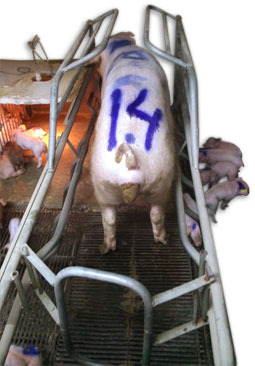
- When we arrive with the piglets it is easier to find the chosen sows.
- It avoids errors such as giving too many or too few piglets to the sow.
- It facilitates management procedures, such as leaving the sow for 2 hours without piglets so she accepts the adopted piglets more easily.
- It makes all the staff know, without having to read it in a card, that the sow is a foster sow, so we can pay more attention to her:
- Does she eat what she has to eat? We must lower the foster sows' ration at the beginning and we must remember to increase it later on.
- How well does she accept the piglets?
- Does she come into oestrus again?
- When the moment for weaning arrives, we will assess if we made the foster sows correctly, because we know how many piglets we gave to the foster sow and how many we have weaned: if we see too many losses we can change the process of obtaining foster sows.
- It will help us to assess if we obtain too many or too few foster sows, because it is easy to see how many foster sows we have per farrowing room.
- When the sow is pregnant again, the staff will know that the animal has been a nurse sow, and will be keeping an eye on possible irregular returns to oestrus.
If on the farm the working system on the gestation quarters is based on three colours, it is convenient to use the colour of the week on which we wish to wean the adopted piglets, and in this way we will avoid premature weanings.
Figure 1. Foster sow for slow-growing piglets.
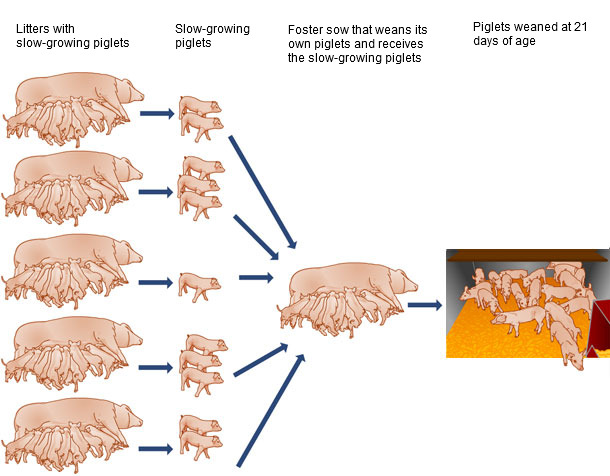
In some cases, the piglets that are left without a teat may be given directly to a newly weaned sow. In other cases it is convenient to carry out intermediate steps by giving the piglets to sows that have farrowed less days ago.
Figure 2. Foster sow for the excess piglets born.
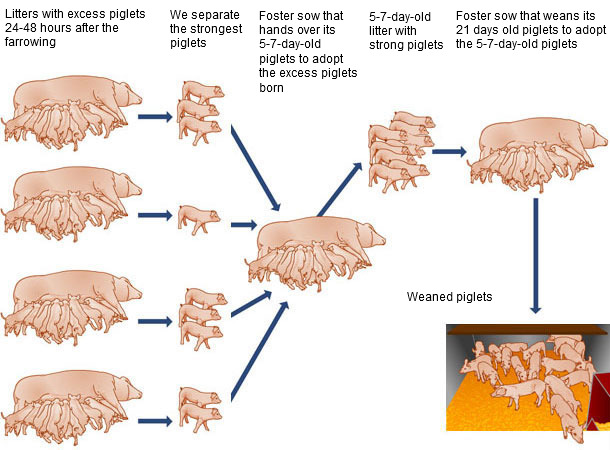
When foster sows are obtained for the excess piglets born, it is convenient to perform an intermediate step at least, as we can see in the example, and sometimes two, giving the 24-48-hour-old piglets to a sow that has farrowed 3 days ago, the piglets of this sow to another one that farrowed 10 days ago, and the 10-day-old piglets to a sow that farrowed 21 days ago.