
Plasma prevents and reduces E. coli diarrhoea in piglets
Albert van Dijk
11-Nov-2008 (17 years 10 months 22 days ago)
11-Nov-2008 (17 years 10 months 22 days ago)
In the EU animal plasma has been re-allowed as a feed ingredient for pigs and poultry since September 2005. It has been very good documented that plasma improves piglets growth performance (27%!), (Van Dijk et al. 2001). In a recently published experiment it was found that plasma has more effect on growth and feed intake in feed without AMGB than it has in feed with AMGB included (Fig. 1) (Bikker et al. 2004). So, in the AMGB-free situation that the EU is in from the beginning of 2006, more effect from plasma can be expected than before. Beside the growth promoting potency of plasma, more recently evidence comes from many research groups, that plasma improves piglet’s health.
Higher feed intake improves intestinal health
One of the main properties of dietary plasma is a substantial stimulation of feed intake after weaning (25%!). Many experiments demonstrated that a high feed intake after weaning prevents intestinal damage (villus atrophy) (fig 2). More recent research (Verdonk, 2006) shows that a high feed intake after weaning improves intestinal integrity, demonstrated by less leakage of undesired substances like toxins or pathogens through the intestinal wall. From this research there are also indications, that a high feed intake reduces intestinal inflammation.
Plasma prevents post-weaning diarrhoea
In the recent years, several research groups have performed challenge experiments, in which the effect of dietary plasma on post weaning diarrhoea was studied. In most experiments it was found that plasma reduces diarrhoea (Table 1). In some cases, also the faecal excretion of E. coli was reduced.
Table 1. Summary of E.coli challenge experiments in piglets studying the effects of plasma against diarrhoea.
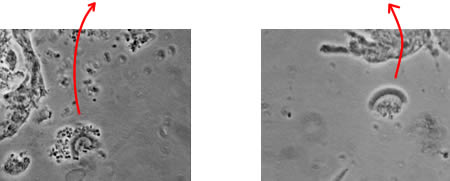
Research in the Netherlands demonstrated that the prevention of diarrhoea is mediated by blocking the adherence of E. coli bacteria to the intestinal wall (Fig 3) (van Dijk et al. 2002b). This prevents the bacteria to colonise, grow and produce their toxins. The active component from plasma that causes this effect is the immunoglobulin fraction.
There is a patented process to produce ‘hyper immune plasma’. In this process slaughter pigs are vaccinated against E. coli. At slaughter, blood from these pigs is gathered and subsequently spray dried. When used in a challenge experiment, this plasma prevents diarrhoea and reduces faecal E. coli excretion substantially.
From these recent experiments it can be concluded that plasma, especially hyper immune plasma, can play a major role in preventing post-weaning diarrhoea in piglets. In the EU situation, this finding comes right on time, because the ban of AMGB’s makes piglets more susceptible to E. coli problems.
Mode of action
Now that it becomes more and more clear that plasma works via lowering the infection of pathogens like E. coli, ideas are being put forward about the mode of action of plasma.
Generally, it is assumed that plasma works as follows:
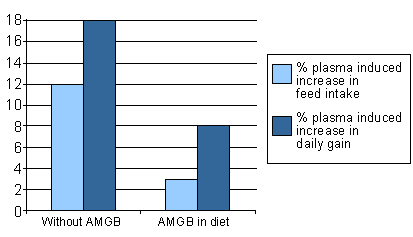 |
| Fig. 1 Experiment in which the effect of plasma on piglet growth performance was studied in feed with or without AMGB (Bikker et al. 2004). |
Higher feed intake improves intestinal health
One of the main properties of dietary plasma is a substantial stimulation of feed intake after weaning (25%!). Many experiments demonstrated that a high feed intake after weaning prevents intestinal damage (villus atrophy) (fig 2). More recent research (Verdonk, 2006) shows that a high feed intake after weaning improves intestinal integrity, demonstrated by less leakage of undesired substances like toxins or pathogens through the intestinal wall. From this research there are also indications, that a high feed intake reduces intestinal inflammation.
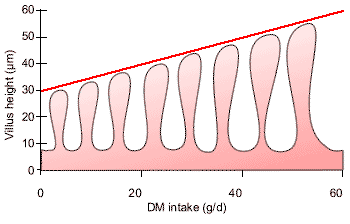 |
| Fig. 2. Effects of dry matter intake over villus height. |
Plasma prevents post-weaning diarrhoea
In the recent years, several research groups have performed challenge experiments, in which the effect of dietary plasma on post weaning diarrhoea was studied. In most experiments it was found that plasma reduces diarrhoea (Table 1). In some cases, also the faecal excretion of E. coli was reduced.
Table 1. Summary of E.coli challenge experiments in piglets studying the effects of plasma against diarrhoea.
|
||
|
Research in the Netherlands demonstrated that the prevention of diarrhoea is mediated by blocking the adherence of E. coli bacteria to the intestinal wall (Fig 3) (van Dijk et al. 2002b). This prevents the bacteria to colonise, grow and produce their toxins. The active component from plasma that causes this effect is the immunoglobulin fraction.
| Brush border from intestinal cell loaded E. coli bacteria |
Brush border from intestinal cell "empty" |
 |
|
| Fig. 3. In vitro adherence inhibition test with E. coli. In the picture on the left no plasma in the suspension, in the picture on the right plasma in the suspension (van Dijk et al. 2002b). | |
There is a patented process to produce ‘hyper immune plasma’. In this process slaughter pigs are vaccinated against E. coli. At slaughter, blood from these pigs is gathered and subsequently spray dried. When used in a challenge experiment, this plasma prevents diarrhoea and reduces faecal E. coli excretion substantially.
From these recent experiments it can be concluded that plasma, especially hyper immune plasma, can play a major role in preventing post-weaning diarrhoea in piglets. In the EU situation, this finding comes right on time, because the ban of AMGB’s makes piglets more susceptible to E. coli problems.
Mode of action
Now that it becomes more and more clear that plasma works via lowering the infection of pathogens like E. coli, ideas are being put forward about the mode of action of plasma.
Generally, it is assumed that plasma works as follows:
- The immunoglobulins in plasma provide ‘passive’ immunisation of piglets, e.g. as indicated in this article they prevent adhesion of E. coli to the intestinal wall. So, there will be less infection due to plasma. As a result, there will be less stimulation of the immune system. This has two effects:
- 1. The piglet will need less nutrients (energy, amino acids) for its immune system (production of immune cells and immunoglobulins). As a result, those nutrients will be available for growth, so the piglet wil grow faster.
- 2. Less cytokines will be produced. Cytokines are substances that are produced in case of infection and inflamation. Cytokines reduce feed intake. So, when cytokines are reduced, feed intake will be higher. As indicated in this article, a high feed intake results in a healthier intestine.