
Main problems with pregnant sows housed in groups (II)
14-Oct-2013 (13 years 4 days ago)
The first article summarised some of the main problems encountered in the pregnancies with group housing. In this article some solutions are suggested.
The first recommendation is to evaluate the parameters before and after the changes undergone by the group-housed pregnant sows. For this, it would be useful to compare a certain period with respect to the same period a year before the adaptation to fulfil the animal welfare regulations was carried out.
| 1st January-31st May 2012 | 1st January-31st May 2013 | Difference | Action level | |
| Total piglets born | 13 | 12.5 | 0.5 | 13 |
| Piglets born alive | 12 | 11,7 | 0.3 | 12 |
| Non-productive days / farrowing | 14 | 19 | 5 | 13 |
| Farrowing rate (%) | 88 | 84 | 4 | 88 |
| Kg of feed / sow / year | 1,135 | 1,185 | 50 | 1,150 |
| Sow mortality (%) | 7 | 8 | 1 | 9 |
| Preweaning mortality (%) | 14 | 14 | 0 | 12 |
Real data from a farm that carried out the adaptation during the summer of 2012
Once we have made this 'homework' we will be more conscious of the consequences of the changes carried out in order to adapt our farm, seeing exactly which parameters have worsened and in what proportion.
Although a change normally requires an adaptation process, and in this process normally some efficiency is lost, many farms have even improved their productivity. So, if we detect a decline we cannot accept it as something normal.
The next recommendation is to look for external help from experts in design and handling/management in order to prepare an action plan to improve the farm.
Some of the problems frequently encountered and the suggested solutions are listed below:
1. Competitiveness:
- We must choose the best moment of the day to mix the animals.
- Increase the intake during the first week after mixing the sows.
- Make enough groups in order to divide the sows according to their size.
- Give them access to toys and materials they can manipulate as, for instance, straw, without reaching an amount that may clog the slurry pits.
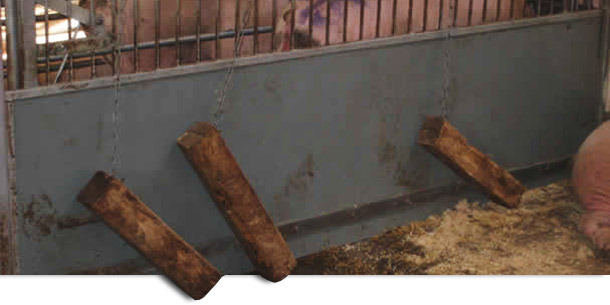
Photo 1. Toys in the pen.
2. Design problems. The ones most frequently seen are:
- The dirty and the feeding area (the area where there are more fights, which makes it more dangerous) are not correctly separated.
- Resting area in the middle of the transit areas.
- Lack of insulation. The buildings are cold in winter.
In all of these cases, the diagnosis is normally clear once the animals are observed. Then, corrections must be made on the design, although this will need some investment.
3. Unsatisfactory control of the body condition:
In the majority of the systems, from day 28 of pregnancy it is impossible to customise the sows' intake. The only periods during which the intake can be controlled are the lactation and in the breeding area (gestation control).
- Feeding during the lactation: It is very difficult that a sow farm has an optimal production without an appropriate feeding during this stage, and with group gestation system this is even more important. We should distinguish at least between the normal, thin and fat sows. The thin and normal sows should eat as much as possible, creating a curve for the sow or a curve that bears in mind the sow and the number of piglets. We should make the fat sows lose some body condition, because sometimes they keep their weight or even gain more because they do not produce much milk.
- Feeding during the gestation control (from weaning until 28 days after the mating): The goal during this period of time is that the sows attain the highest possible homogeneity when their pregnancy is confirmed. It is interesting to classify the sows according to their body condition when weaned in order to make the feeding according to their body condition easier.
- Confirmed pregnancy: The goal during this period is that the sow reaches an optimal body condition at farrowing. The normal sows should keep their body condition, but we should make the thin sows gain weight, and make the fat sows lose some body condition, although with caution.
We must classify the sows according to their size and body condition:
- The ideal situation would be to divide each batch in 7 groups:
- 1 group of nulliparous sows
- 3 groups of small sows: normal, thin and fat sows.
- 3 groups of large sows: normal, thin and fat sows.
- But at least, we should have 4 groups:
- 1 group of nulliparous sows.
- 1 group of small sows.
- 2 groups of large sows: the fattest and the thinnest ones.
Each of these groups needs a specific feeding curve appropriate for the different needs that they will have.
Independently of how well we do it, in the majority of the systems the sows will end up having uneven body conditions. We should have a place prepared to separate the sows from the group and feed them according to their needs.
Independently of the kind of curve that we choose to feed the sows, it is important to establish some control points that make us be conscious of the consequences on the animals according to the curves chosen.
Every week we shall assign one day for the control of the body condition and for making the necessary corrections in the following production stages:
- Post-mating.
- When reaching the confirmed pregnancy.
- At 8 weeks of pregnancy.
- 3 weeks before the farrowing.
- Farrowing.
During those three periods (lactation, pregnancy and confirmed pregnancy) and their subperiods, we can use different strategies that could give rise to another series of articles. This one has focused on the body condition of the sows, whose control is one of the biggest challenges in the case of the gestation sows housed in groups.