
Clinical case: Impact of clinical and subclinical forms of ileitis on the same fattening farm
09-Sep-2013 (13 years 1 months 14 days ago)
Anamnesis I. Description of the production structure
The clinical case that we will now describe appeared on a 2000-pig fattening farm. The piglets come from a production farm of 1,200 sows, with a nursery on the same farm. Approximately at 20kg of LW the piglets are taken to 8 different fattening farms that total a capacity of 11,800 pigs.
This production structure is in Aragon in the region of La Hoya de Huesca (northeast of Spain).
The sow farm is managed on a weekly flow. It receives external replacement stock and it works with a conventional LWxLD sows and Pietrain boar.
Anamnesis II. Health status on the farm
| Replacements | Farm | ||
| Positive | Negative | Positive | Negative |
| Enzootic pneumonia | Atrophic rhinitis | Enzootic pneumonia | Swine dysentery |
| PRRS | Swine dysentery | PRRS (stable*) | Aujeszky's disease |
| Mange | Atrophic rhinitis | ||
| Aujeszky's disease | Mange | ||
* The tests carried out with the sera of 30 three-week-old piglets gave a negative result with PCR for the PRRS virus at the time when the case appeared and during all the previous year. Also, the serology tests carried out on 9-week-old piglets with respect to PRRS gave a negative result.
The replacement sows enter the farm when 7 months old. There starts the vaccination programme that is based on the primary vaccination and the revaccination every 10 days against PRRS, Aujeszky's disease, Atrophic rhinitis and Parvovirus-Erysipelas.
For the rest of the sows, the vaccination programme is based on:
- Nulliparous sows:
- Vaccination and revaccination against E.coli and Clostridium at 75 and 90 days of gestation.
- Atrophic rhinitis at 75 days of pregnancy.
- Rest of the sows:
- E.coli and Clostridium at 90 days of gestation.
- Atrophic rhinitis at 75 days of gestation.
- Parvovirus-Erysipelas 10 days after farrowing.
- Blanket vaccination every 3 months with a MLV PRRSV vaccine.
In piglets:
- Vaccination against M. hyopneumoniae. Single dose at 7 days of age.
- Vaccination against PCV2 at 4 weeks of age.
Anamnesis III. Description and health situation before the appearance of the case on the fattening farm
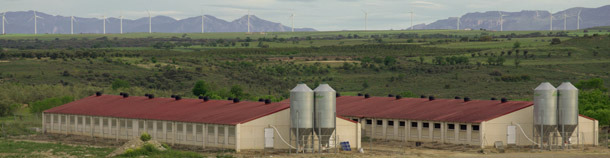
The fattening farm on which the case appeared has two recently built barns with room for 1,010 pigs each.
There is a strict all-in-all-out system in each building, although two batches can coincide. Sometimes, a building is almost empty while new piglets are entering the other one.
The buildings are 10 metres apart and they have natural air ventilation and automatic windows.
The water comes from the general water supply, and it goes directly to a 50 m3 tank where it is periodically disinfected with peroxides.
It has all the required biosecurity measures.
Type of feeding: drinker in the feeder and bowl drinker.
- Entry date:
- Building no. 1: 26th December 2012
- Building no. 2: 14th January 2013
- Weights at entry:
- Entry in building no. 1: Number of pigs = 1,003 ; Weight = 22,066 kg (average, 22 kg).
- Entry in building no. 2: Number of pigs = 1,020 ; Weight = 24,174 kg (average, 23.7 kg)
- Kinds of feeds:
- Feed no. 1: 10 kg/piglet (with 120 ppm colistin and 300 ppm amoxicillin)
- Feed no. 2: 40 kg/pig.
- Feed no. 3: 60 kg/pig.
- Feed no. 4: 100 kg/pig.
When the case appeared the mortality was 0.7%. These losses show, in the majority of cases, lesions that are compatible with Glässer's disease, and they appear after three weeks in the fattening building (in both buildings).
Both processes are controlled with a water treatment with amoxicillin: 0.4 g/10 kg LW/day for 4 days.
Appearance of the case
On March 18th 2013 the person in charge of the fattening pigs took five pigs from building no. 2 (the last ones entered, approximately 17 weeks old) to the hospital pens. One of them died and the other four were unable to stand up. He also sees sticky faeces in the rest of the building.
During the visit to the farm the following symptoms and lesions are seen:
Symptoms.
- 4 animals: acute symptoms:
- Age: 16-18 weeks.
- Paleness, anorexia.
- They refuse to eat.
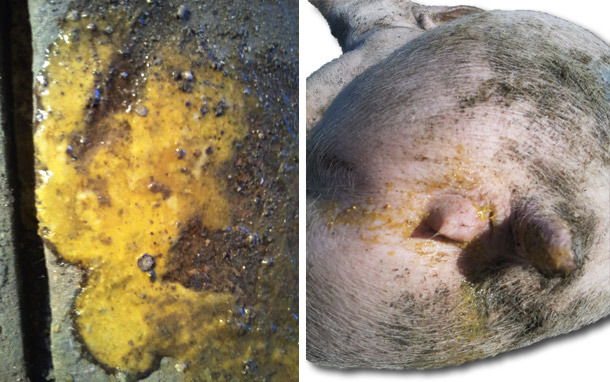
- Yellowish diarrhoeas with the presence of fibrin.
- One of them has coagulated blood in its faeces and shows jaundice.
- The rest of the animals: mild symptoms:
- In the 60% of the pens.
- Sticky and greenish faeces with undigested feed.
- In spite of the high percentage of affected pens, the clinical symptoms in these pens were mild and the pigs did not show any important symptoms.
Lesions. In those pigs with acute symptoms (necropsy performed on an affected pig euthanized with sodium thiopental).
- Macroscopic lesions.
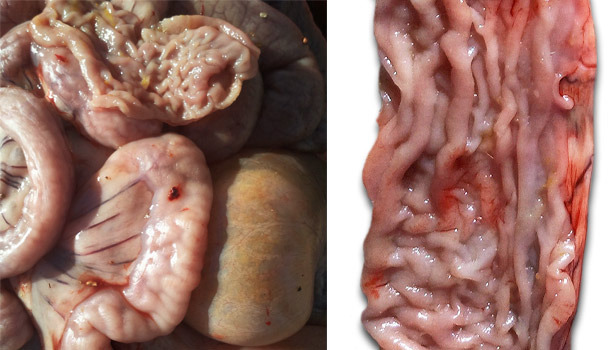
- Thickening of the mucosa in the distal part of the small intestine (terminal ileum). It is rigid and it can be seen through the serous membrane.
- Proliferative ileitis in the area near the ileocaecal valve. Wet mucosa with wrinkles and very thickened.
- Presence of slightly attached fringes.
- Swollen mesenteric lymph nodes.
Diagnosis
Differential diagnosis
- Proliferative enteropathy.
- Colitis due to Brachyspira spp.
- Salmonella typhimurium.
- PCV2.
- Mechanical diarrhoea with a nutritional origin.
Presumptive diagnosis
- Proliferative enteropathy.
Laboratory diagnosis
- The following samples are taken for their analysis:
- 15 sera evenly distributed taken from the different pens.
- Faeces samples. The samples were taken directly from the animals. From 6 animals with soft faeces distributed throughout the farm and mixed in two containers (three samples per container).
- A tissue sample taken from the terminal ileum of the euthanized animal and preserved in formaldehyde.
- Analysis requested:
- Serology of the sera against Lawsonia intracellularis.
- PCR against Lawsonia intracellularis in faeces.
- Histopathological analysis of an ileum sample from the area near to the ileocaecal valve.
Results
- Serology. Seroconversion by ELISA was detected in 35% of the sera. This does not establish the moment of the infection, but that at some point in the fattening stage there has been an infection.
- PCR. Positive in one of the three samples.
- Histopathological analysis:
- Atrophy of the intestinal villi. Hyperplasia of the cells in the crypts (immature enterocytes).
- Depletion of the number of caliciform cells.
Definitive diagnosis
Proliferative enteropathy.
Treatment and control measures
- Treatment with tylvalosin in the drinking water for five days (4.25 mg/kg LW/day).
- Injectable treatment given to all the animals in the affected pens with tiamulin (20%) for three consecutive days (10 mg/kg LW/day).
- Medicated feed with 100 ppm of tylosin for 14 days. After the treatment in the drinking water.
Results
As in any case, it is important to know the production parameters.
On the one hand, this information allows us to place the fattening farm with respect to other ones in the same production system, it allows us to compare between batches on the same fattening farm and, it will especially be of use as a measurement tool with respect to the success of the corrective measures applied after the appearance of the case.
| Historical average | Problematic fattening batch | |
| Stay (days) | 126 | 116 |
| Mortality | 3.22 | 1.8 |
| % of lightweight pigs | 2.16 | 0.73 |
| FCR | 2.55 | 2.59 |
| ADG | 679 | 699 |
| Treatment costs (€/pig) | 1.64 | 1.65 |
Surprisingly, the final results of the fattening batch were better than the historical ones for that production pyramid. This tells us, on the one hand, that the implemented measures were effective, and other hand it leads us to think about the hypothesis that on a regular basis Lawsonia intracellularis may be playing an important role in this production pyramid.
Under this hypothesis it was decided to determine the moment of infection and to establish a medication protocol around that moment.
For this kind of production system it is very common to find the time of infection around 14-17 weeks of age (Broonsvoort et al. 2001; Masterller et al. 2003).
Nevertheless, it was decided to perform a cross-sectional seroprofile in order to determine the infection dynamics for Lawsonia intracellularis in this production pyramid:
-6 sera were taken at 2-week intervals from week 12 to week 22.
The result of the ELISA test performed on 36 sera, and 7 of the sera turned out to be positive, all of them after week 16.
Seroprevalence
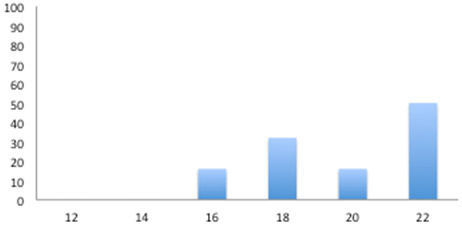
This is, the moment of the infection could be placed at around 14 weeks of age, fitting with the case previously described.
Treatment II
It was decided to use a macrolid (tylosin) at 100 ppm in feed during two periods. The first period at 14 weeks of age (in the feed) and lasting for two weeks (after the pigs had remained for about two weeks in the fattening building), and the second period three weeks later.
Results II
| Historical average | Problematic fattening batch | Rest of the fattening farms* | |
| Stay (days) | 126 | 116 | 123 |
| Mortality | 3.22 | 1.8 | 2.65 |
| % of pigs with a low weight | 2.16 | 0.73 | 1.47 |
| FCR | 2.55 | 2.59 | 2.56 |
| ADG | 679 | 699 | 683 |
| Treatment costs (€/pig) | 1.64 | 1.65 | 1.76 |
* The number of data is not big enough to be able to establish statistically significant differences between the groups "historical average" and "rest of the fattening farms". Although the results may not be conclusive the mortality rate and the % of low weight pigs at slaughter make us think our population is healthier and homogeneous.
Conclusions
Proliferative enteropathy (PE) or ileitis is a disease whose symptoms and lesions are known since 1930, but it is not until 1974 that Rowland & Lawson discover a bacterium with an abnormal proliferation inside cells. And it was not until 1993 when Lawsonia intracellularis' action as the etiologic agent of this disease was proven. Nowadays we know that 96% of the farms and 30% of the pigs are affected worldwide, at the nursery and fattening stages.
As we have been able to see in the case explained, PE can take different forms, even in the same fattening farm, and it is frequent for the subclinical and mild forms of the disease to coincide with a more acute and serious one, both forms having a direct negative impact on the main production parameters of the fattening farm clearly related to the financial profitability as, for instance, the FCR and the ADG, although others, like mortality, may not be very affected.
In this case we explain one of the multiple possibilities for the control and the treatment of this disease. Two macrolides (tylvalosin and tylosin) are the antibiotics of choice.
Other treatments with lincomycin and tiamulin have been equally effective in several published studies.
The important thing with the use of antibiotics for the control and the treatment of the disease is to decide the optimal moment for their application using the diagnostic tools described in this case for determining the moment of the infection and the disease. A good tool is serology: we can take samples every two weeks from week 8 to week 22 of age. In production systems like the one presented in the case we can carry out this control with a cross-sectional seroprofile.
Excessively early or prolonged treatments will prevent the development of a good active immunity in the pigs. On the other hand, if the treatment is carried out too late, a high number of pigs will have developed the disease and the intestinal lesions will be more severe.
The use of attenuated vaccines in piglets administered orally is also very widespread, and is also effective for controlling the disease, as it has been described in many published articles. It confers enough immunity for enduring the later challenge by Lawsonia intracellularis in the field.