
Main problems with pregnant sows housed in groups (I)
23-Sep-2013 (13 years 20 days ago)
There are different systems for housing pregnant sows, and they all have advantages and disadvantages. Although it is true that all the systems have some weak points, it is also true that with an appropriate design and handling/management most of them are able to provide optimal results.
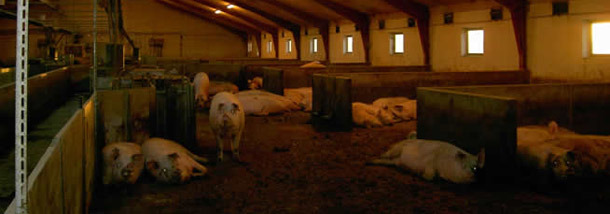
Since the adaptation of the sows' farms to the animal welfare regulations, we can distinguish three well differentiated realities:
- Farms that produce better (some of them significantly better) than before the adaptation to the animal welfare regulations.
- Farms that keep similar production levels.
- Farms in which the productivity has decreased (they will be the focus of this article).
Although there are other factors, as for instance changes in the health status, the two main factors that make that certain farms have not succeeded at adapting to the animal welfare regulations are the design and handling/management deficiencies.
The main effects (productive/financial) have been:
- Decrease in the number of born piglets.
- Increase of the non-productive days.
- Decrease of the farrowing rate.
- Increase in feed consumption.
- Increase in the number of sow losses and culled sows.
- Increase of the pre-weaning mortality and lower quality of the weaned piglets.
All these parameters have an important impant on the economy of a farm.
At a farm level, the most common problems that are seen and that affect from one up to all the previously mentioned parameters are as follows:
- Increase of embryo losses and abortions.
- Increase of the locomotor problems.
- Difficulties for the individual supervision of the sows.
- Differences in the body condition of the sows.
- Higher difficulties in keeping the temperature in the buildings in winter due to the lower number of sows per square/cubic metre.
The main differences with respect to the system previous to the implementation of the animal welfare regulations are:
- Increase of the fights between sows (intrinsic to the system).
The moment in which the new system forces to mix the sows affects their productivity negatively: 28 days after their mating (there are field data that confirm that when mixing the sows at least 35 days after their mating the prolificacy data is better). An alternative is to take them to the gestation pens before 4 days after their mating.
- Some designs and handling systems make the sows less comfortable than they were when housed in stalls (it should not be so):
- Designs with elements in the pen that may cause physical damages on the animals, sharp components, badly kept slats, slippery floors, etc. that already caused damages in the pregnancies in stalls, but as the sows can move freely, the damages increase.
- Lack of space where the animals can lay: they do not only lack the necessary square metres: the linear metres are also important, without obstacles like walls or crates.
- Not bearing in mind that, when decreasing the density in the buildings, they will be cooler in winter, and this will increase the feed intake and in some cases it will endanger the preservation of pregnancy.
- Impossibility of feeding all the sows individually and simultaneously (intrinsic to the system):
The only system that allows a completely individual feeding is the electronic feeding, but the sows cannot eat, all of them, at the same time, as their natural behaviour would be.
In the rest of the systems, the sows in the group eat the same amount of feed (and this implies that if they enter the gestation pens with different body conditions they will exit them with different body conditions), or there will be sows that eat more (and that get too fat) and sows that eat less (and lose too much body condition).
These are the general features of the systems for housing the pregnant sows in groups: each system (and the specific system on each specific farm) has peculiarities that must be borne in mind in order to solve the problems that they cause. In the two following tables these effects for the different systems are summarised.
Table 1. Evaluation of the feeding systems for swine
| System | Space | Floor | Intake | Handling |
| Ad libitum feeding | *** | *** | * | * |
| Feeding on the floor | ** | ** | ** | ** |
| Liquid feeding | ** | * | ** | ** |
| Slow-feeding system | ** | *** | *** | *** |
| Free access stall | *** | *** | **** | **** |
| Electronic sow feeding (static) (1) | **** | *** | **** | *** |
| Electronic sow feeding (dynamic) | **** | *** | **** | ** |
| Full-body length stall (non-lockable) (2) | *** | *** | *** | *** |
| Short length stall (non-lockable) (3) | *** | *** | *** | ** |
(*) = Poor, (**) = Moderate, (***) = Good, (****) = Very good.
Author: Bjarne Pedersen (Danish Farm Design)
(1) The original table does not distinguish between static and dynamic electronic group feeding.
(2) and (3) added by the author due to their popularity in Spain.
Table 2. Evaluation of the systems according to the precision of the feeding
| System | Individual | Group | No control |
| Ad libitum feeding | * | ||
| Feeding on the floor | ** | ||
| Liquid feeding | ** | ||
| Slow-feeding system | * | ||
| Free access stall (locked rear gate) | ** | ||
| Electronic sow feeding (static) (1) | ** | ||
| Electronic sow feeding (dynamic) | ** | ||
| Full-body length stall (non-lockable) (2) | * | ||
| Short length stall (non-lockable) (3) | * |
(*) Regarding the precision level, it is less efficient.
(**) Regarding the precision level, it is more efficient.