
PCV2 related diseases (PCVDs): risk factors analysis
14-Jun-2013 (13 years 4 months 10 days ago)
Importance of PCV2 dynamics of infection: age at PCV2 infection is determinant
There is accumulating evidence that the within-farm PCV2 dynamics of infection is strongly related to the probability of PCVD. The first case-control studies carried out in France (2000-2001) and Spain (2002-2003) showed higher within-herd prevalence of PCV2 seropositive pigs at 12-13 weeks of age in PCVD affected than in non affected farms. It suggested that on average PCV2 infection occurred earlier in PCVD farms. More detailed studies (longitudinal cohort study) carried out in PCVD-affected farms confirmed that the earlier PCV2 infection occurs, the higher the risk of pigs developing PCVD. The age at infection is strongly influenced by the uptake of PCV2 maternal antibodies through colostrum. Maternally-derived immunity against PCV2 can protect pigs against PCVD, and this protection was shown to be antibody titer-dependent. In addition, the maternal antibodies significantly reduce the transmission of the virus between pen-mates which decreases the probability of massive infection in the following weeks after weaning.
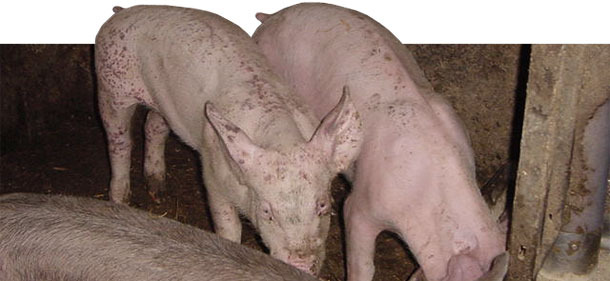
PMWS and PDNS affected piglets
Co-infections as main triggers of PCV2 pathogenicity
A wide spectrum of concomitant infections associated with PCVD was reported in the literature. However, PPV, PRRSV, and Mycoplasma hyopneumoniae are the main associated pathogens which were shown to enhance PCV2-associated lesions and increase the incidence of PCVD under experimental and field conditions. The mechanisms are not well known, but it seems possible that all these co-infections proceed from the same global mechanism of non specific immune enhancement favouring PCV2 replication in target cells. Hence, the role of immunostimulation, combined with PCV2 inoculation, in inducing clinical disease was demonstrated in the early 2000’s. Further investigations led to the suggestion that PCV2 replication was potentiated by immunostimulation, resulting from the massive activation of certain cells, such as macrophages in the lymphoid tissues. Due to the failure of a sole PCV2 infection to induce typical PCVDs such as PMWS, combined with the ubiquitous presence of the virus within the global pig population, it has been speculated that PCVD may be triggered by an unknown pathogen, often called ‘agent X’. However no identification of this so-called ‘agent X’ has been made to date. Therefore the pivotal role of PCV2 in PCVDs remains unchanged and ‘agent X’might be considered as an already known infectious agent which could not be systematically the same in the different geographical areas.
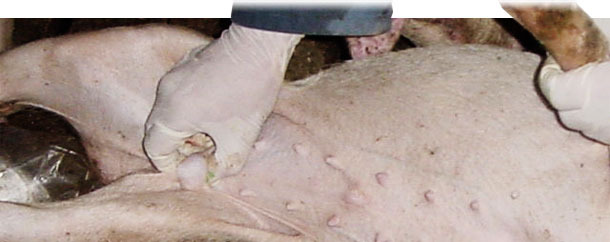
Enlargement of inguinal lymph nodes
Management and husbandry conditions significantly modify the PCV2 course of infection with direct implications in clinical outcome
Since the emergence of PMWS and other PCV2 related diseases, several epidemiological studies have verified that on-farm management, housing, and husbandry conditions were strongly related to the risk of developing PCVDs. These factors are related to the following domains:
- Housing: large pens in weaning facilities, absence of solid partitions between pens, or a common pit between different fattening rooms were found to be risk factors. All these characteristics suggest conditions increasing the probability of virus propagation within the population.
- Vaccination schedules: vaccination of gilts against porcine reproductive and respiratory syndrome virus (PRRSV) and the use of separate vaccines against Erysipelothrix rhusiopathiae and porcine parvovirus (PPV) on gilts were found to be risk factors whereas vaccination of sows against E. coli and atrophic rhinitis were found to be protective. It has not been determined to date, whether those associations between the risk of PCVD and some vaccination schedules were direct causal relations or if they were more likely an indicator of the occurrence of co-infections in these farms increasing the PCV2 pathogenicity.
- Hygiene and husbandry practices: short empty periods in nursery and farrowing sectors, intensity of pig mixing (e.g. cross-fostering and mixing groups of pigs while entering nursery), early weaning (<21 days), purchase of replacement gilts, use of farm-boars for semen collection, and sows in poor conditions (excess of neck abscesses due to poor injection techniques, rare treatments against ectoparasites) were found also to be risk factors.
- Biosecurity: shower facilities and visitors avoiding contact with pigs for several days before visiting farm were found to be protective whereas proximity to other pig farms were found to be risk factors.
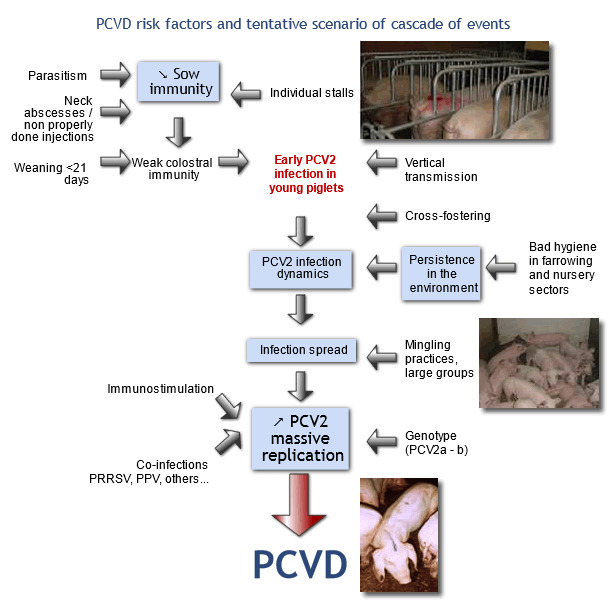
It is likely that these on-farm conditions could serve as triggers for massive PCV2 replication, both directly and indirectly. Indeed, a modelling approach showed recently that the dynamics of PCV2 in herds was strongly affected by herd management and husbandry practices.
Hence, despite the availability of several efficient vaccines in the field which have proven their efficacy towards PCV2 clinical consequences and PCV2 spread, the good husbandry practices should not been forgotten. It has been shown that their efficacy was dramatically decreased in the context of husbandry deviations such as excess of cross-fostering, mingling at weaning or very large groups in nursery. PCVDs were certainly for a large part some kind of man-made diseases because the virus was already present within the population some decades before the disease emergence. This should not be forgotten when vaccine efficacy often leads to a decrease of good farm practices observance.