
Salmonella: control during the transportation stage
15-May-2012 (14 years 5 months 3 days ago)
The transportation is an important stage with regard to the spreading of Salmonella in the food chain. In highly contaminated environments, an initial infection in the tonsils can spread via the lymph and reach the colon and the rectum in only 2 hours: this is, when exposed, the pigs get infected in less time than the length of the transportation and the waiting period (prior to the slaughter) in the abattoir. The infected pigs are carriers for a long time, and under stressful situations they can spread Salmonella via the faeces in any moment (see graph 1).
Graph 1. Increase in the positivity to Salmonella from the farm to the abattoir (%)
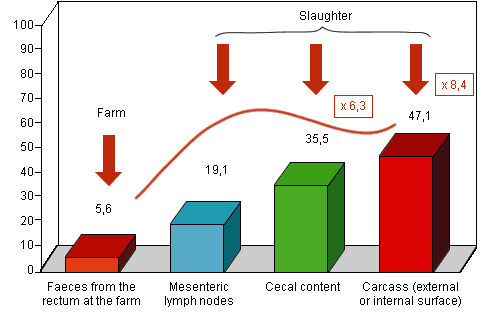
Source: Pedro Rubio, 2004
Transportation stage and stress
The “transportation stage” starts with the selection of the pigs that are going to be sent to the abatttoir/to live (breeding animals), and it ends when they are housed in the holding pens/the farm before the slaughter/production farm. In this stage many stressing factors converge in little time:
- The mixing of animals that haven’t had a previous contact between them.
- The design of the lorry and of the pig transportation and loading premises.
- The loading and unloading processes and the length of the trip.
- Animal density.
- Environmental conditions during the trip.
- Quality of the road and of the driving.
During the transportation there are physiological changes related to these factors that affect, basically, the immunity of the pig and the bacterial ecology of its gastrointestinal tract with important consequences:
- In carrier pigs in a latent state, the spreading of Salmonella is activated.
- In non-carrier pigs there is an increase in their susceptibility to the infection due to the positive animals that are in their same lorry or pen.
Correct fasting
A fasting of 12-18 h before the slaughter, apart from other benefits, also reduces the weight and the size of the gastrointestinal tract, it facilitates the work of the abattoir worker that eviscerates the pig, it avoids lacerations and it avoids the faecal contamination in the farm. An excessive fasting (>24 h) is harmful, because it acts as a stressing factor and it increases the number of carriers that spread Salmonella.
Biosafety and hygiene in the lorries
The contamination due to Salmonella in the lorries before the loading of pigs is something frequent, and this entails a risk of infections and re-infections for those pigs that come from non-infected farms. This situation is not acceptable from a hygienic point of view, but in practice we have limitations:
- The design of the vehicle does not bear the cleaning in mind.
- The “resting” of the vehicle (inactivity) is expensive.
- The need of adequate cleaning premises.
- The changes in the weather conditions affect the results of the disinfectant.
- We must train the staff.
- We need to supervise and to verify.
The studies carried out show the importance of a correct protocol. Graph 2 shows the result of those samples that are positive to Salmonella with “only the cleaning” of the lorry (control), and Graph 3 when a correct “cleaning and disinfection” has been performed.
Graph 2. Lorries with a regular cleaning
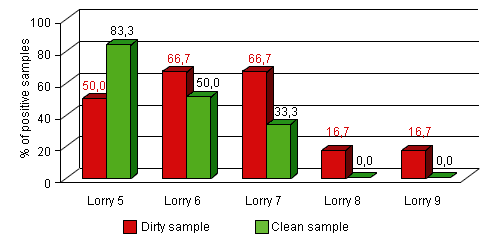
Source: Pedro Rubio, 2004
Graph 3. Lorries with cleaning and disinfection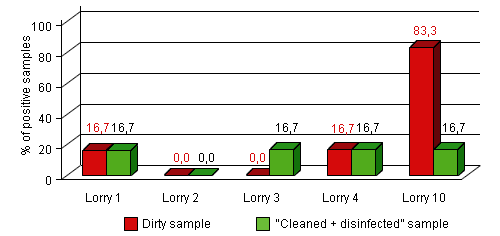
Source: Pedro Rubio, 2004
Risk in the holding pens
Social stress, along with the high contamination generally found in these pens, is an important gateway for Salmonella in the slaughter chain. The longer the waiting period, the higher the probability of contamination and, so, a higher probability of detecting positive carcasses.
Seasonal risks
There is a significant relationship between the heat and the accumulation of Salmonella in the environment. In summer it is even more important that the pigs remain in the lorry for as little time as possible and also the cleaning and disinfection of the lorries and of the holding pens with a higher regularity.
General control measures
The epidemiological complexity of Salmonella and the proven fact that it can enter at any point of the food chain requires the adoption of a global and integrated approach for the control of salmonellosis.
Specific control measures
1. Transportation
- Biosafety and objective confirmation of the hygiene of the lorries between batches.
- Design of the transportation in order to assure a correct cleaning and disinfection.
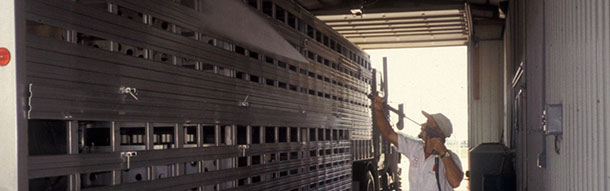
- Programming of the transportation as a critical point. An “internal” transportation for those pigs that will live (breeding animals) and an “external” one for those pigs that will be sold, evaluating the cost-benefit of each operation. Optimal flow of pigs in order to avoid crossed contaminations. Delivery of batches directly to the abattoir (unidirectional flow) and separate transportation of the positive and the negative batches to Salmonella.
- Correct handling during the loading, the transportation and the unloading in order to minimize stress, avoiding the mixing of pigs as much as possible.
2. Holding pens
- Minimize the waiting period, at least for those pigs that come from negative farms.
- Strict separation of batches for the positive as well as for the negative batches.
- Avoid the mixing of pigs and handle them with the aim of minimizing stress.
- Maintain and handle the pigs in small groups (≤15).
- Clean and disinfect between batches and thorough hygiene at the end of the slaughter day.
- Control of the superficial dirt on the animals.
3. Environment, during the increase of the temperature:
- Reduce the waiting period.
- Reduce the density in the pens as well as during the transportation.
- Cool/sprinkle water to the pigs during the waiting period.
4. Processes control:
- Visual and bacteriological control of the cleaning and disinfection procedures carried out.
5. Other:
- Analyze the combined effect of the fasting and the transportation on the spreading of Salmonella.
- Study alternative systems in order to avoid crossed contaminations during the transportation and the waiting/holding period and in the carcasses in the abattoir.