Reducing the cost of pig feed (I)
16-Jan-2012 (14 years 8 months 21 days ago)
Part 1. Formulation and processing
We all know the importance of feed in production costs. In recent years the price of raw materials has followed an erratic pattern, making it difficult to anticipate its evolution. At the same time, the price of meat is not tied to raw materials, and this creates an imbalance difficult to face. Since these two points are complicated to act on from the standpoint of the producer, we must focus on those actions that are in our hands to try to improve the profitability of our operations.
Quality Control. It is important to have good quality control that allows a solid assessment of your ingredients, avoiding having to use large safety margins in formulas. Today there are technologies (NIR) that let you know the composition of a feed almost immediately.
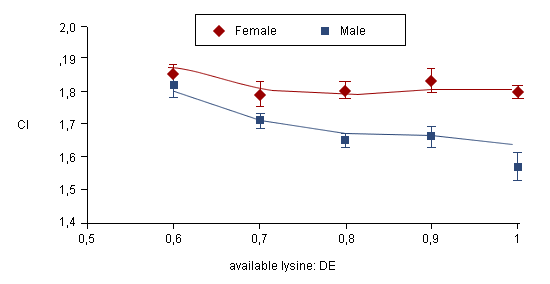
Energy. Energy is the most expensive component of diet at this time. We know that dietary energy conditions the consumption of the animal. On the other hand, lysine is the first limiting amino acid, so having the lysine:energy ratio adjusted to our genetics, weight and sex is vital to reducing feed costs.
Figure 1. Effect of available lysine (g lysine available by MJ DE) on the conversion rate for females and intact males (± SEM) of the 22 to 53 kg live weight.
aAdapted from Moore and Mullan, 2010
Raw materials. Feed consumed by pigs weighing up to 15 kg can be expensive due to high-value ingredients, both nutritionally and economically. The use of these ingredients is not always justified. It can be a good time to revise and consider eliminating the inclusion of serum, fish meal, plasma, etc... (Landblom et al., 2001). It is possible that the cost-benefit at the moment doesn’t compensate for their inclusion.
Additives. Most additives have a positive effect on animal production but not all return the investment. Review the use of additives in different feed phases and use only those whose use entails a substantial economic and contrasted benefit (Pettigrew, 2006). It is also good to check where they are used; an additive may be profitable in the starter - transition phase, but not so in the fattening-finishing phase.
Increase digestibility. When the price of raw materials is high, it is important to get the most out of them. One way is by improving their digestibility. There are several ways to do this:
- Decreasing particle size: A decrease in particle size improves the digestibility of certain materials, as shown in Table 1 (Goodband et al., 2002).
Table 1. Effect of particle size on apparent digestibility of corn and sorghuma
| Digestibility | ||||
| Particle size (microns) | Dry material | Protein | Energy | Conversion index |
| <700 | 86,1 | 82,9 | 85,8 | 1,74 |
| 700-1.000 | 84,9 | 80,5 | 84,4 | 1,84 |
| >1.000 | 83,7 | 79,1 | 82,6 | 1,92 |
aAdapted from Ohh et al., 1983.
A decrease of 100 microns (in a range of no less than 600 microns to minimize the risk of gastric ulcers) may reduce the conversion rate by 1.2% (National Pork Board, 2011).
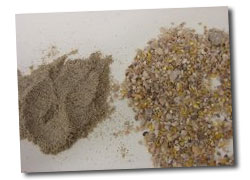
Photo 1. Two particle sizes in a mash.
- Granulation: Granulation may improve the digestibility of feed by 5-8% (Wondra et al., 1995, Amornthewaphat et al., 2000) leading to an improvement of the ADG and the CI.
- Expander: the use of expander improves pellet quality and may improve the digestibility of raw materials, especially fibers, Table 2 (Traylor et al., 1998, Amornthewaphat et al., 2000).
Table 2. Pressure effects of the cone on the characteristics of diet and digestibility of nutrients in a diet based on middlings for pigs in the fattening phasea.
| Cone pressure, psi | ||||
| 0 | 166 | 333 | 500 | |
| Electricity consumed, kWh/t | ||||
| Expander | ||||
| Total | 25,5 | 33,8 | 43,6 | 60 |
| Specific | 0.3 | 8.5 | 18.3 | 34 |
| Granulator | 12.6 | 10.4 | 9.9 | 10 |
| Total | 38.1 | 44.2 | 53.5 | 70 |
| Grain durability index, % | ||||
| Standard | 84.2 | 89.1 | 87 | 89.2 |
| Modified | 73 | 83.9 | 76.7 | 81.6 |
| Gelatinazed starch, % | 33.8 | 51.7 | 51.9 | 69.9 |
| Apparent digestibility, % | ||||
| DM | 70 | 72.6 | 72.4 | 75.6 |
| N | 69.2 | 74.5 | 77.1 | 78.3 |
| RE | 69.8 | 73.8 | 74.5 | 77 |
| RE diet, Kcal/lb | 1233 | 1347 | 1357 | 1417 |
a Adapted from Traylor et al., 1998.
The use of expander, on the other hand, carries a high electricity cost and therefore will not always be profitable.
- Additives: the use of phytase and other enzymes in certain grains has been shown to improve the digestibility of certain nutrients (Kornegay et al., 1996, Bedford et al., 1998). Even so, we must be careful not over-value these enzymes.
- Digestible AAc: Formulating with digestible amino acids, digestible phosphorus and net energy is the best way to approach real needs for pigs and to optimize diet.
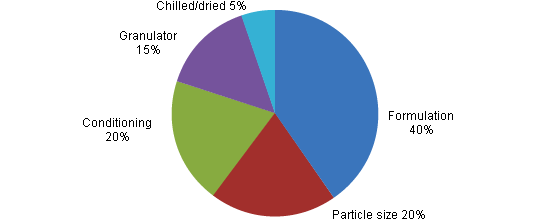
Feed Presentation. Numerous studies show that pelleted feed supply is an improvement of the ADG and the conversion rate with respect to flour (Potter et al., 20100, Wondra et al., 1995). However, pellet quality may determine the extent of this improvement.
Figure 2. Factors affecting the durability of granules.a
aAdapted from Hancock et al., 1996
The amount of fines in the feed trough should not exceed 20% (National Pork Board, 2011). Presentation of a liquid diet also supposes a significant improvement of both the digestibility and the conversion rate but its implementation requires a higher cost than the dry feed system.
Photo 2. Detail of dry hoppers.
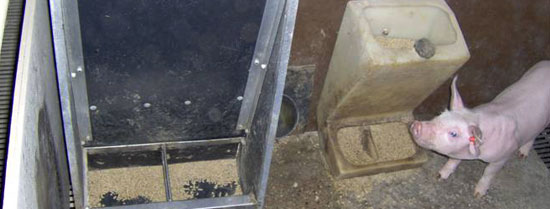
Photo 3. Liquid feed system.