
Clinical case: Altrenogest for the prevention of premature farrowings
18-Oct-2011 (15 years 2 days ago)
Farm Introduction
This case study began midway through the spring of 2009 at a genetic multiplier in the province of Manitoba in western Canada. The farm had a capacity of 1250 sows and weans at 3 weeks of age into neighboring nursery facilities.
At the time of this case report, the farm was testing positive for Porcine Respiratory Coronavirus (PRCV) and Swine Influenza Virus (SIV serotypes H1N1 and H3N2). Although it was negative for Mycoplasma hyopneumoniae, the sows were being vaccinated due to the risk of infection from neighboring farms more than 5 km away. The protocol for vaccination, as recommended by the genetics company included the following vaccines:
- Lawsonia intracellularis (all gilts prior to arrival)
- Mycoplasma hyopneumoniae (all gilts prior to entry into the farm and all sows halfway through each gestation)
- H1N1 and H3N2 Influenza virus (all gilts prior to entry into the farm and all sows halfway through each gestation)
- Parvovirus, leptospirosis, erysipelas (all gilts upon entry to the farm and halfway through each gestation)
- Rotavirus (all sows, pre-partum)
- E. coli (all sows, pre-partum)
The sows were housed in gestation stalls during the breeding and gestation phases of production. They were moved into farrowing crates prior to their due date. This herd weaned 4 times per week (Monday, Tuesday, Thursday and Friday) at 18-21 days of age.The unit weaned a total of 650 piglets per week.
All weaned piglets (i.e. males and females) were moved to the neighboring facilities. Once per week, the males and 10% of the females are sold at the age of 21 – 28 days old from the nursery into the commercial market.The remaining females are finished on site as commercial F1 gilts.
Veterinary visit and case description
During a regular veterinary inspection visit, the farm manager presented a production problem that he felt was causing significant financial losses to the farm on a weekly basis. He explained that he was managing the breeding targets and weaning to maximize farrowing crate utilization. He had been doing this for sometime and now his aggressive approach was creating a serious problem. The farm was consistently meeting or exceeding its weekly breeding targets. At the same time, they were extending the lactation length of individual litters as long as possible. As a result, they were experiencing an increased number of early farrowing events in the gestation area. This issue was intensified on the weekends.
The manager noted that on weekends there was a lower number of staff working in the barn. In addition, the weekend staff only worked the minimum number of hours necessary to complete the basic tasks. As a result, the amount of time spent looking for sows in the gestation area that might be ready to farrow early was not significant when compared to a normal weekday. There were essentially 2 full days when sows were not being transfered as necessary due to labor shortages. Sows that were due to farrow on a Tuesday, were being moved to the farrowing crates on Monday (day 114 of gestation) instead of on Friday. This avoided weaning litters at a young age on a Friday weaning but risked farrowings in gestation (primarily on Sundays). If a sow farrowed early in the gestation area, the piglet mortality rate of these early farrowings was almost 100%.
The farmer asked the veterinarian if there was any way that he might correct this problem without decreasing his high and consistent breeding targets. As an independantly owned business that depended upon profitability to survive in a very challenging market place, the farm management was very focussed on overall farm efficiency as long as it did not compromise the the animal health and piglet quality. Obtaining the highest productivity was the team goal.
It was clear that strategies which were being used to maximize farrowing crate utilization and lactation length might also increase the likelihood of early farrowings in gestation. For review, these strategies included:
- Multiple weanings per week which allowed them to move smaller groups of sows to farrowing rooms very close to their forecasted farrowing due dates.
- A low average weaning age of 18-21 days which maximize the turns per farrowing crate per year.
- Minimizing the piglet age variability by maintaining a very short wean to farrow interval (wean, wash and disinfect, enter, and farrow) of 2-3 days.
The farmer recognized the problems that the farm was having and the cost of these losses to the farm. He also understood the issues leading up to the problem. By routinely attaining and surpassing their weekly breeding targets they were running their facility on the edge of its capacity and they were paying a price for their success. While the farm manager recognized the issues leading up to his problems, he wanted to know if there was some way to continue the current level of breeding productivity without the piglet losses.
Explanation of altrenogest use for the prevention of early farrowings
The veterinarian thought about the situation and proposed a solution based on previous experience. During a cesarean section project which was completed for a breeding stock company, he utilized altrenogest (i.e. a synthetic progesterone analogue) to prevent the early onset of farrowing prior to the planned surgery date. Genetics companies utilize cesarean section surgeries to introduce piglets carrying valuable genetics into their breeding stock system without introducing unwanted disease causing organisms. Utilizing altrenogest in these projects to insure that sows do not farrow before the planned surgery date is an easily applied technique to insure their investment. He realized that this technique could be implemented in this situation to prevent early farrowings on weekends if applied to high risk pregnancies at the appropriate time.
It is important to note that this farm did not use prostaglandin F2α to induce farrowings. As a result, the gestation length history in their production database was an accurate reflection of the true gestation length on this farm. The histogram in Graph 1 shows the distribution of gestation length on this farm. The length varied from 112 to 119 days. The histogram shows that a high percentage of animals (>33%) gave birth on days 112, 113 or 114 of gestation. It is easy to see that this farm had a significant number of farrowings that occurred at under 115 days of gestation.
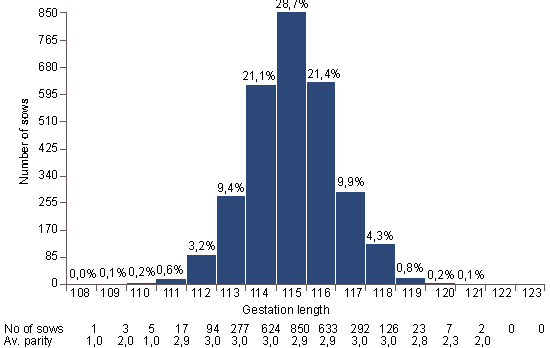
Graph1. Histogram showing normal distribution of gestation days on the farm.
The veterinarian recommended the administration of altrenogest for 3 consecutive days starting on day 111 of gestation with the morning feeding. He explained that when sows receive a daily dose of altrenogest during this timeframe, the birthing mechanism would be delayed (in most cases) until the treatment was stopped. In general, sows that receive this product do not give birth before day 115.
It is important to note that the use of veterinary pharmaceutical products is regulated by each country. In Canada, the commercial altrenogest product (2.2 mg/ml) is indicated, by prescription, for use in cycling gilts to synchronize estrus. Altrenogest is a synthetic progestin that functions like progesterone in the pig. Progesterone is a hormone that is naturally produced during the estrus cycle to suppress heats. It is common to use altrenogest for the synchronization of estrus so that gilts can be bred when needed. It is also produced during gestation to suppress estrus and the onset of the farrowing process.
In some countries, veterinarians can create prescriptions to use products in an ‘off label’ manner when they are used in a prudent and scientifically supported way. Using altrenogest prior to the expected farrowing due date to prevent premature farrowings is an example of an ‘off label’ use.
Implementation of altrenogest prefarrowing
The label dose of altrenogest for gilts is 6.8 ml (i.e. 15 mg) per day. For use in heavier mulitparous sows, the veterinarian recommended 9 ml (i.e. 20 mg).
In order to minimize the cost associated with the recommended treatment, there was a focus on the proper selection of candidate sows. The duration of the a sow’s individual gestation length is a relatively heritable trait. Therefore, individual sows tend to have similarly lengthed gestations periods throughout their lifetimes. This means that the gestation length history of each individual sow may be used to predict future gestation lengths. In order to prevent early farrowings during the weekend, the veterinarian made the following recommendations:
- On Thursday of each week, the manager should check the individual sow cards for the gestation history of those sow that would ideally be moved into the farrowing crates prior to the weekend. Typically, he would focus on sows due to farrow on Day 115.
- He should mark the sows with a history of gestation lengths that are less than 115 days.
- The marked sows should receive a 9ml dose of altrenogest for 3 days starting on Friday (Friday=day 111, Saturday=day 112 and Sunday=day 113).
- The individual administration of altrenogest should be given each morning with a small portion of food directly on the floor in front of the target sow.
- Since the treatment would manipulate the historical gestation length of the treated sows in the database, these animals should be flagged in the database in order to indicate a similar treatment prior to future farrowing dates.
Case summary
After one month of weekly treatments, the farm manager noted that, on average, the farm selected between 6 and 7 sows for treatment each week. He noted to the veterinarian that the program was successfully implemented and the weekend births were no longer occurring.
After several months, the farm decided to increase the altrenogest treatment to include 60% of the sows prior to farrowing. They have reported that they haven’t had ‘any’ early farrowings prior to 115 day due dates when the protocol was used. The following histogram (Graph 2) of gestation lengths was created after 3 months of the treatment. The distribution of farrowings had started to reflect the impact of the treatment.
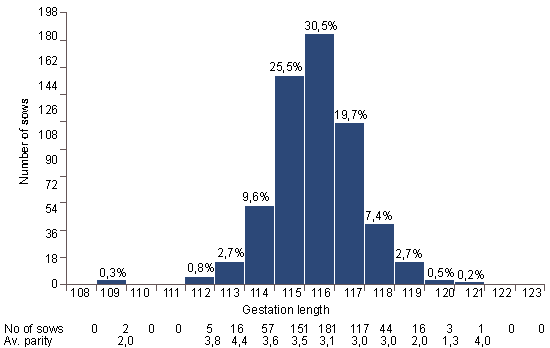
Graph 2. Histogram showing the distribution of gestation days on the farm after 3 months of altrenogest treatment.
It is important to consider the cost of the treatment per animal. Throughout the case study the 3 day altrenogest treatment cost approximately $7 per animal (CDN) (5.12 €) or between $42 - 47 (CDN) (31-34 €) per week for 6-7 animals. Prior to the treatment, the farm was losing as many as 3 litters in gestation with a piglet mortality rate of approximately 100%. At the time of the treatment, the pig value at weaning was approximately $40 (29.2 €). The cost:benefit ratio of the treatment was very high at between 1:25 and 1:35.
Table 1 lists some key parameters from the initial production analysis for this farm following the initial implementation of the altrenogest protocol.
Table 1. Summary of production data before and after altrenogest treatments
| Untreated | Treated | |
| Sows analyzed | 2958 | 663 |
| Sows treated with altrenogest | 0 | 416 |
| % of sows treated with altrenogest | 0 % | 62,70 % |
| Gestation length (not induced) | 115 | 115,9 |
| Total born | 12,6 | 12,9 |
| Stillborn | 6,10 % | 5 % |
| Mummified | 2 % | 1,70 % |
| Pre-weaning mortality rate | 15,40 % | 15,20 % |
| Average of piglets weaned/litter | 9,9 | 10,3 |
| Average weight upon weaning/piglet | 6,3 | 6,1 |
| Lactation length | 18,7 | 19,4 |
ADVANTAGES:
- Farrowing crate utilization is maximized.
- Better quality piglets upon weaning as noted by nursery staff: Although the average weaning weight was similar, the farm management felt there were fewer light weight pigs (i.e. increase of minimum weight) and fewer underage piglets at weaning.
- Increase in average lactation days.
- Increase in average lactational feed consumed per day during lactation due to increase in high consumption lactation days.
- Consequent improvement of reproductive parameters due to increase in lactation length and average feed consumption in lactation.
- Decreased Stillborns and Preweaning mortality due to more viable piglets at farrowing.
- Improved worker moral: eliminated early farrowings in gestation and improved quality of animals upon weaning.
DISADVANTAGES:
- The product has a withdrawal period of 42 days in Canada; the farm had to avoid treating sows that needed to be culled immediately after weaning or plan to house treated animals until the withdrawal period was complete.
- Additional non-productive days added due to withdrawal period and an extended wean to slaughter period with the consequent increase in total feed cost.
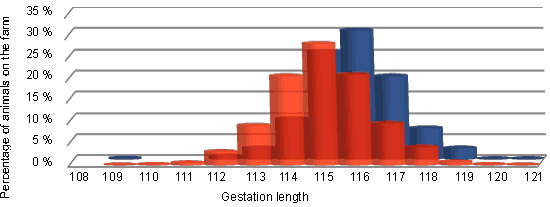
| Histogram before treatment | Histogram after treatment |
Graph 3. Histogram showing the shift in gestation length to the right after treatment with altrenogest.