
Chile: Apparent consumption of pork grew 10% in the first half of 2026
333 Latin America with data from ODEPA.
https://www.odepa.gob.cl/
Slaughter and production: Relative stability and slight growth
The number of swine slaughtered reached 2,775,291 head in the first half of 2026, a 0.8% increase compared to the same period in 2025, maintaining a consistent level of slaughter over the last five years (CAGR of 0.2% between 2022 and 2026). Month-to-month performance so far this year has been more volatile than the net result: January and February saw declines compared to 2025, March and April recovered slightly, May fell by 5.4%, and June closed with an 8.4% increase, reaching 481,932 head, 10.4% higher than last May.
Pork production followed an almost identical pattern: it totaled 290,544 tons (t) in the first half of 2026, an increase of just 0.5% compared to 2025 (CAGR of 0.2% between 2022 and 2026), with June being the most dynamic month, reaching 51,892 t, up 7.8% from June 2025 and 9.4% higher than May. In short, both slaughter and production have shown virtually no change during the first halves of the last five years.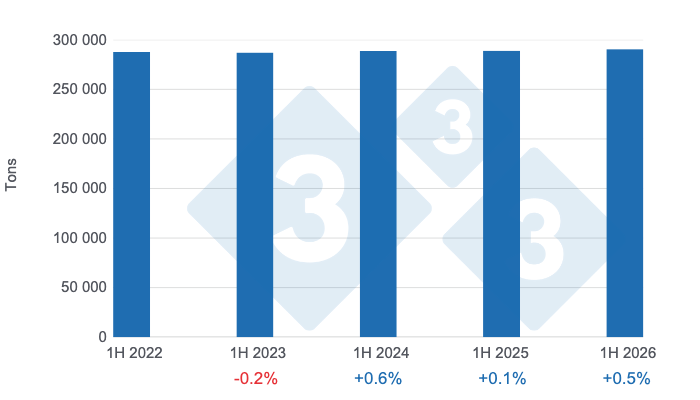
Foreign trade: Imports at record highs, exports on the decline
Foreign trade performance was the most contrasting aspect of the semester. Pork imports through June 2026 totaled 72,960 tons, a 23.2% jump compared to the same period in 2025, with a high compound annual growth rate (16.4% between 2022 and 2026). April was the month with the greatest year-on-year growth during the semester, with 15,340 tons imported, the third highest monthly figure in the entire five-year series, surpassed only by December 2022 (20,770 tons) and July 2025 (15,602 tons). In June, imports reached 12,841 tons, 11.3% higher than in June 2025 and unchanged from May.
Meanwhile, pork exports for the first half of the year reached 124,153 tons, a 5.0% decrease compared to the same period in 2025, deepening the decline of the previous two years (-2.2% in 2024 and -4.4% in 2025). In June, 18,031 tons were exported, 16.7% lower than in June 2025 and 12.0% lower than in May.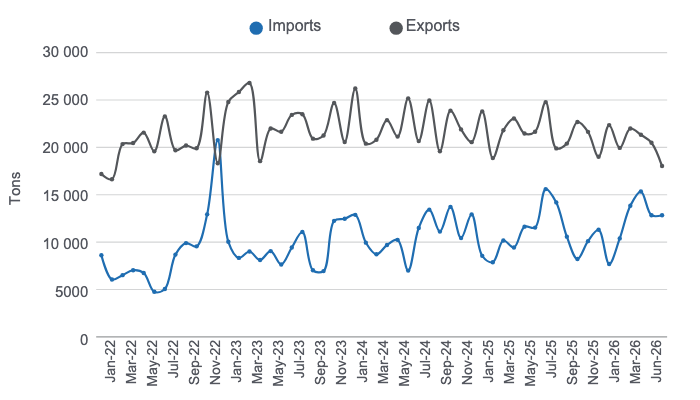
Apparent consumption: The largest imported share of the series
Apparent consumption of pork totaled 239,351 t in the first half of 2026, a growth of 10.0% compared to the same period in 2025, the highest annual variation of the entire period analyzed (CAGR of 3.1% between 2022 and 2026). In this balance, 69.5% of consumption was made up of national production and the remaining 30.5% of imported products, expanding the participation of imports compared to the 27.2% registered in the same period of the previous year. In June, apparent consumption was estimated at 46,702 t, with an increase of 22.9% compared to the same month in 2025 and 17.5% above last May; This result ranks as the second highest monthly record of the entire 2022-2026 series, only below the historical maximum of December 2022 (51,441 t).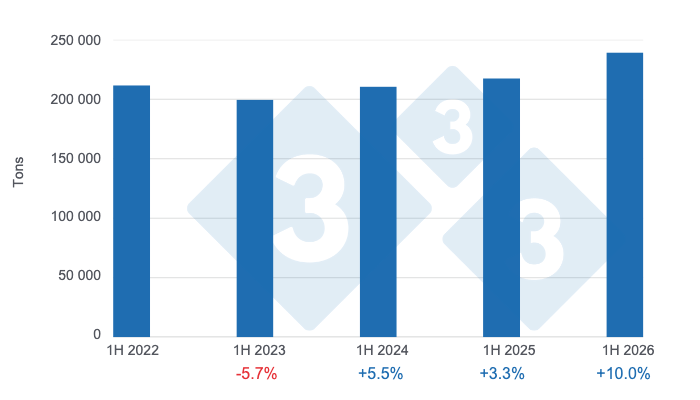
In conclusion
The first half of 2026 confirms that the growth in apparent pork consumption in Chile did not stem from increased domestic production, but rather from a shift in the supply composition: with slaughter and production remaining virtually stable and exports declining for the third consecutive year, imports enabled domestic consumption to reach its highest level in the series. This suggests a hypothesis for the second half of the year: with domestic production remaining relatively stable, the reliance on imports to maintain domestic consumption could continue to deepen.