
The sow shapes the piglet's future (I): How microbial imprinting can transform swine production
03-Sep-2026 (1 months 15 days ago)
Introduction
Over the past twenty years, swine production has seen enormous advances in genetics, nutrition, and biosecurity. However, another, much less visible revolution has taken place in parallel: a microscopic revolution.
Today we know that a piglet's production success doesn't begin at weaning, or even at farrowing. It begins much earlier, when the dam's gut microbiota starts to shape the immune and digestive development of her progeny.
This phenomenon is called maternal microbial imprinting, a concept that is changing our understanding of modern swine production. We are no longer just talking about passing on genes. The sow also passes on microorganisms, metabolites, immunoglobulins, and immunological signals capable of influencing gut development throughout the animal's productive life (Jiang et al., 2019).
There is increasing evidence that modifying the sow's microbiota during gestation and lactation can improve piglets' intestinal colonization, promote a more balanced immune response, and even increase their production performance after weaning (Bravo de Laguna et al., 2022; Saladrigas-García et al., 2022).
Understanding of the microbiota has changed radically over the past 30 years: from seeking to limit it with antibiotic growth promoters (Anderson et al., 2000; Gaskins et al., 2002; and Hughes et al., 2002) to recognizing that the microbiota is no longer simply an accompanying component of the animal, but has become a true metabolic and immunological organ.
The concept of a holobiont is thus defined as a biological unit formed by a host organism and the set of microorganisms (microbiota, fungi, viruses, and archaea) that live in association with it and that, together, function as an integrated system from a physiological, immunological, and metabolic point of view (Margulys, 1991; Bordenstein & Theis, 2015; Rosenberg et al., 2018). The piglet does not inherit only a porcine genome; it inherits the potential to constitute a functional holobiont. The sow transmits an essential part of that holobiont through the vertical transfer of microorganisms, metabolites, and immunological signals. From this perspective, microbial imprinting can be interpreted as the process by which the dam initiates the assembly of the progeny's holobiont.
Evolution of the microbiota during lactation
Piglets are not born with an adult microbiota
One of the biggest conceptual shifts in recent years has been the understanding that the neonatal microbiota is not simply a reduced version of the adult microbiota.
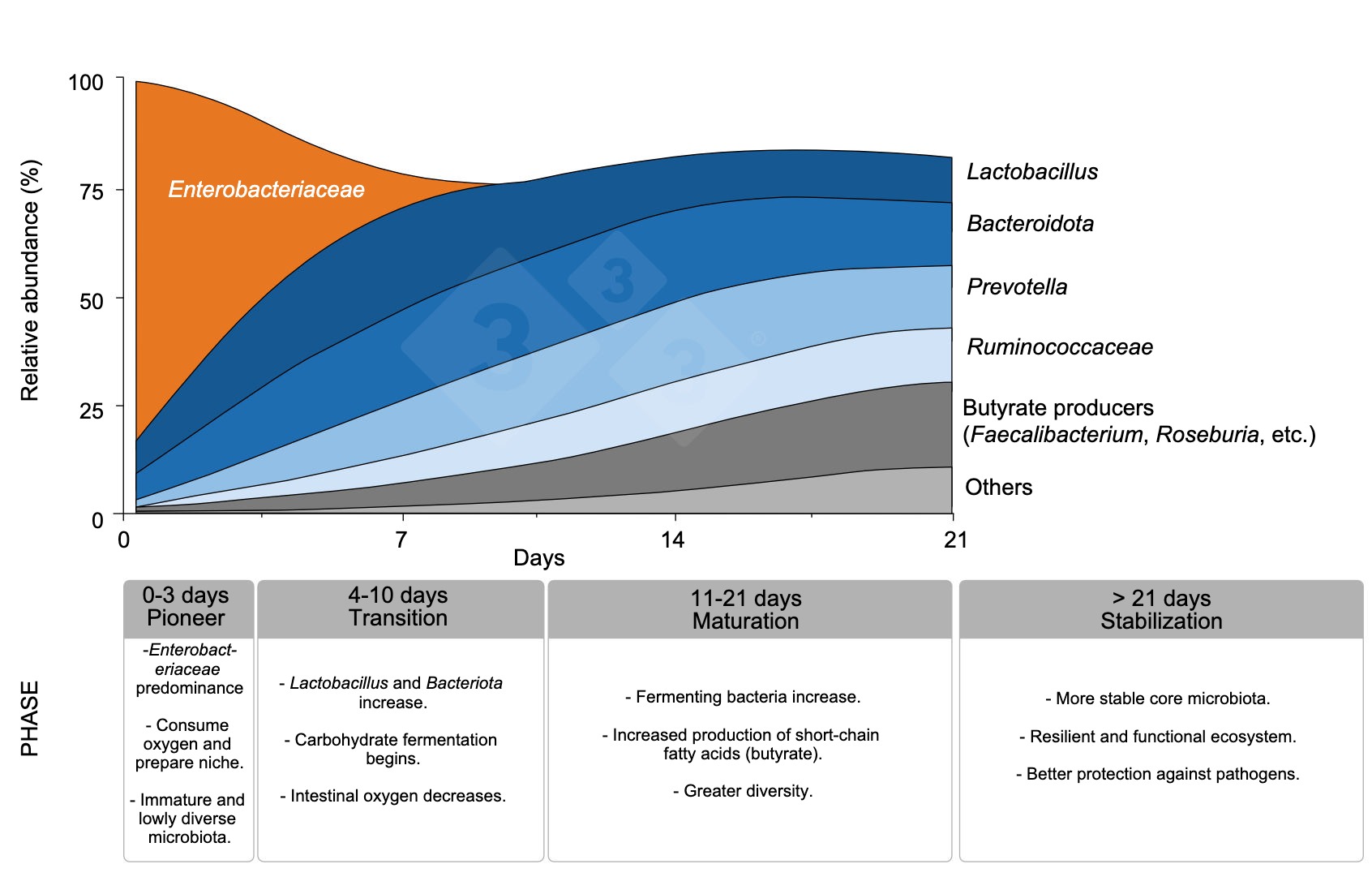
It is actually an extremely dynamic ecosystem. During the first few days, bacteria capable of growing in the presence of oxygen predominate, especially members of the Enterobacteriaceae family, along with other facultative genera. These bacteria rapidly consume the oxygen present in the newborn intestine, creating an anaerobic environment that will later allow much more specialized microorganisms to implant. In other words, the first bacteria act as true "ecological engineers."
Thanks to them, fermenting bacteria such as Bacteroides, Prevotella, Faecalibacterium, Roseburia, Ruminococcus or various butyrate producers appear later, which are essential for intestinal maturation.
Ecological succession is very similar to what happens after a forest fire: first, pioneer species arrive, capable of colonizing a hostile environment; later, they are replaced by much more stable and complex communities.
This transition occupies practically the entire lactation period and continues for weeks after weaning.
Who leads this succession?
Until a few years ago, the answer seemed simple: "the environment." However, today we know that the main architect of this initial colonization is the sow herself. The dam continuously provides microorganisms to the piglet through multiple simultaneous pathways.
| During farrowing |
|
|---|---|
| Colostrum |
|
| Milk |
|
| Continuous contact |
|
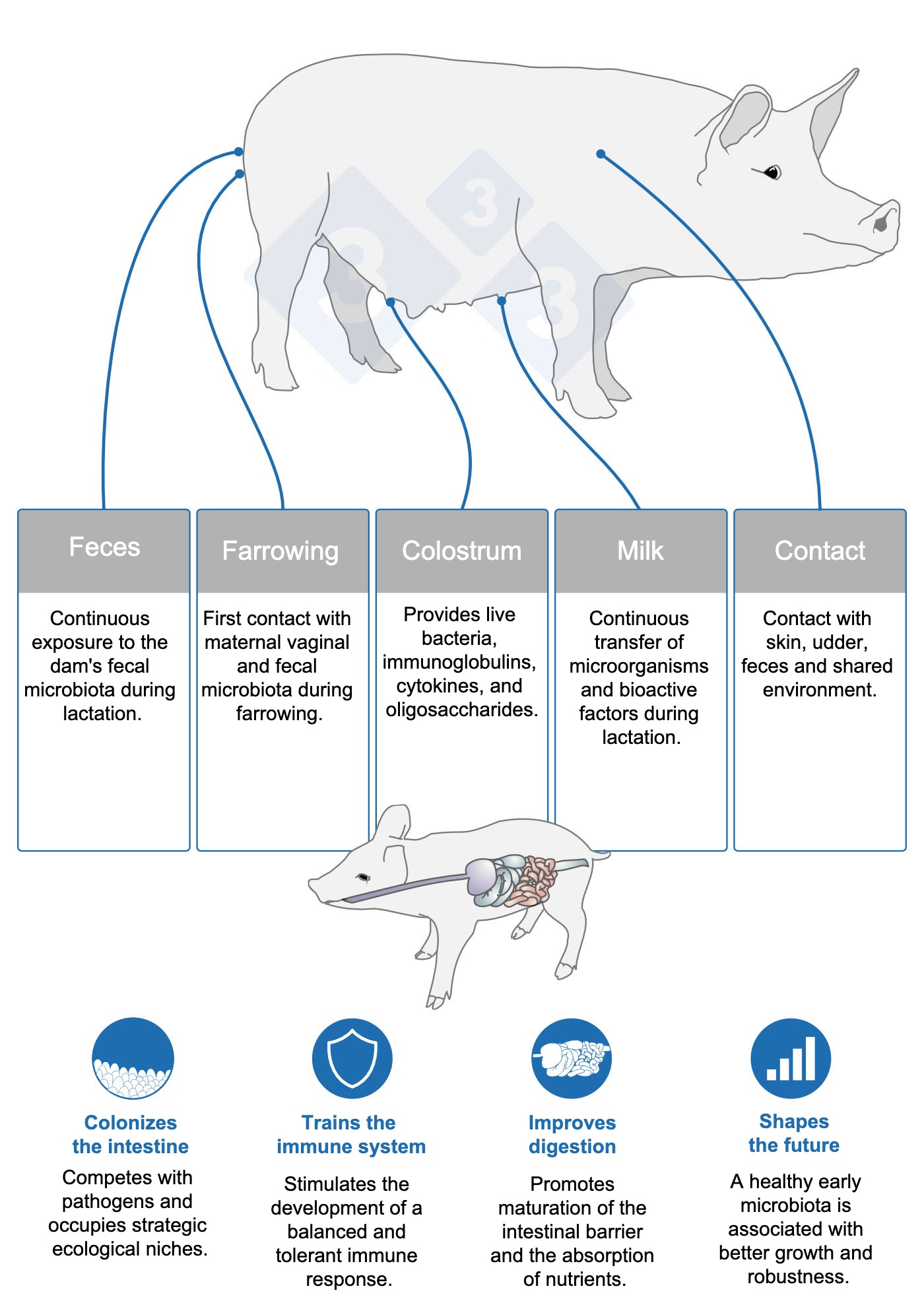
Several studies have shown that the microbial composition of the sow and that of her piglets remains highly correlated even weeks after weaning, which constitutes one of the strongest pieces of evidence of the phenomenon known as maternal microbial imprinting.
Much more than bacteria
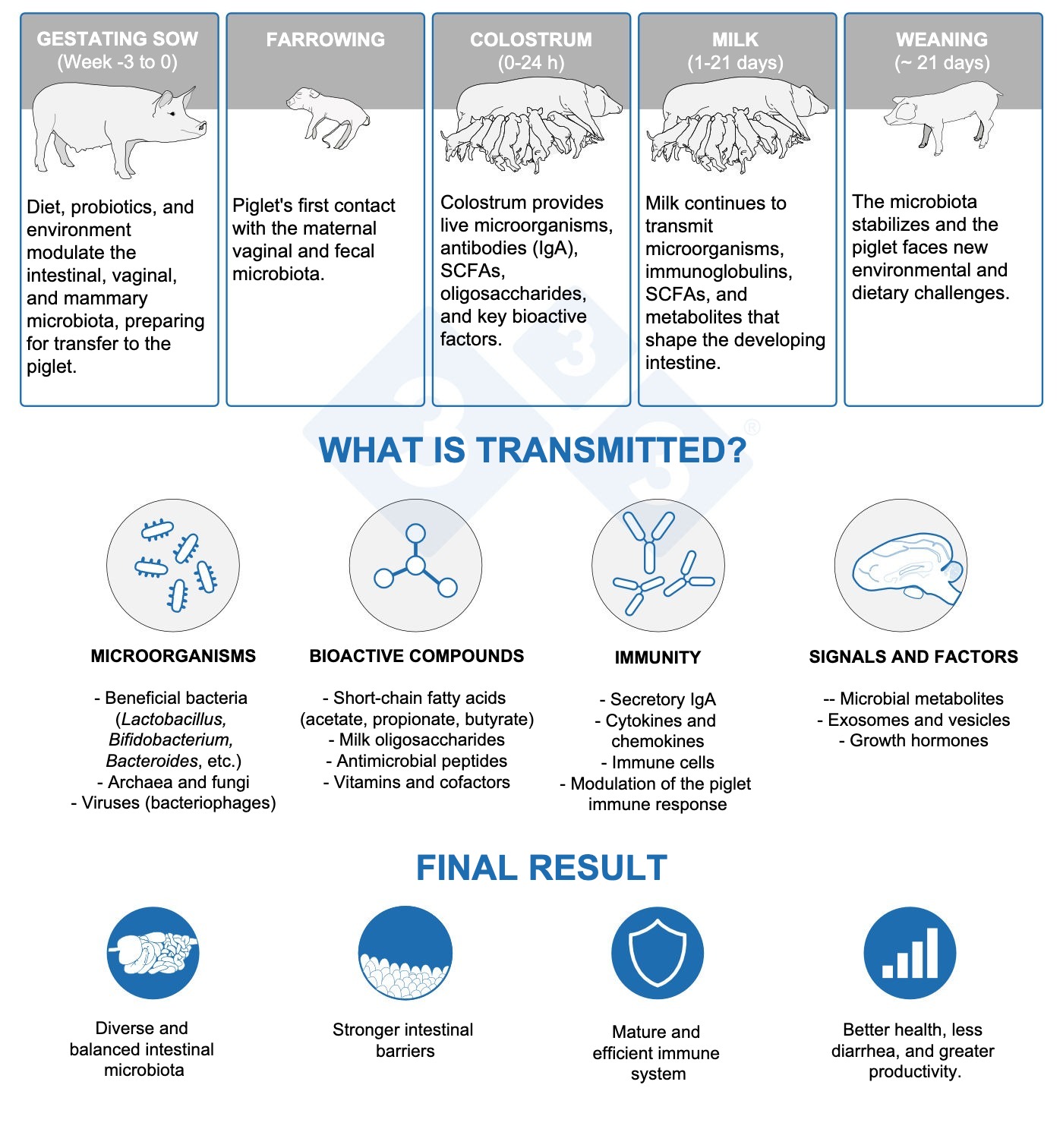
Imprinting is not simply about transmitting microorganisms. The sow simultaneously transmits immunoglobulins (especially IgA), cytokines, metabolites, short-chain fatty acids, milk components, bacteriophages, antimicrobial molecules, and immunological signals.
All of this constitutes a complex system of biological programming that operates during an extremely short window of time, but with consequences that can last for months.
For this very reason, the first few weeks of life likely represent the period of greatest biological plasticity in the entire production cycle.
Beyond diversity
For many years it was assumed that a more diverse microbiota was always a better microbiota. Today we know that this statement is too simplistic.
A healthy microbiota is not necessarily the most diverse, but rather the one that exhibits the greatest functional balance. It must contain a stable core of microorganisms—the so-called core microbiota—capable of maintaining itself over time, resisting disturbances, and performing essential functions for the host.
These functions include production of butyrate and other short-chain fatty acids, maintenance of the integrity of the intestinal barrier, controlled stimulation of the immune system, competitive exclusion of pathogens, and efficient use of nutrients.
Conversely, a high dominance of opportunistic enterobacteria usually reflects an immature or stressed microbiota, especially during the early stages of life.
The natural evolution of the piglet consists precisely in gradually replacing this initial community with a more complex, stable, and functional one.
Can we modify imprinting?
For many years, it was assumed that intestinal colonization was a virtually random process, conditioned solely by the environment. However, research in the last decade has radically changed this view. Today we know that the maternal microbiota can be modified in a targeted way and that these modifications can be partially passed on to progeny.
This concept opens up a fascinating possibility: if we are able to change the microbiota of the sow, we can change the way the microbiota of the future piglet is "written".
It's not about administering probiotics directly to piglets when digestive problems arise, but rather about acting weeks earlier, during gestation and lactation, preparing the intestinal ecosystem that will receive the newborn piglet.
This is a paradigm shift. The strategy is moving from being therapeutic to being preventative.
The sow as a tool for biological programming
The sow's microbiota is not a static community. It changes continuously during gestation, farrowing, and lactation as a result of hormonal, immunological, and nutritional modifications.
During these phases, the composition of colostrum and milk also changes, both nutritionally and immunologically. The concentrations of immunoglobulins, cytokines, oligosaccharides, and metabolites vary dynamically and influence the establishment of the neonatal microbiota.
Therefore, any intervention capable of modifying the maternal microbiota can simultaneously alter several imprinting mechanisms:
- The bacterial composition received by the piglet;
- the immunological quality of the colostrum;
- the milk microbiota;
- the composition of the dam's feces;
-
environmental exposure throughout lactation.
In other words, a single intervention on the sow can act on multiple transmission pathways at the same time.
Knowing this, if the sow's microbiota can shape the piglet's intestinal ecosystem, the next question is inevitable: To what extent do these modifications translate into real production improvements?