
Epidemiological applications of using tongues for PRRSV monitoring
07-Sep-2026 (1 months 12 days ago)
PRRS remains the endemic disease with the greatest economic impact on swine production. However, routine strategies for monitoring outbreaks using serum samples have certain limitations and may not be sufficient to detect residual circulation when prevalence falls below 10%. As virus prevalence decreases, detecting PRRSV requires larger sample sizes. For this reason, more sensitive, efficient, and practical alternatives at the herd level have gained prominence, such as the use of fluid obtained from the tongues of stillborn piglets. This sample has proven to be reliable, sensitive, and effective for detecting viral circulation not only in farrowing but also in the nursery.
In a longitudinal study of PRRSV outbreaks on 10 sow farms with different production management practices, monitoring continued for up to 220 days after the outbreak, yielding data from 34 different batches. In each batch, the presence of the virus was monitored using RT-qPCR on pooled tongue samples from stillborn piglets, and the results were compared with those obtained from pools of 5 sera from 30 weaned piglets from the same batch.
PRRSV was subsequently detected in serum from all batches that tested positive using tongues, with statistical significance (Fisher, p < 0.001). This result indicates that testing using tongues can consistently identify batches that will test positive at weaning with a prevalence of at least 10%. The absence of detection in tongues does not rule out the possibility of viral circulation in the batch of piglets (Figure 1).
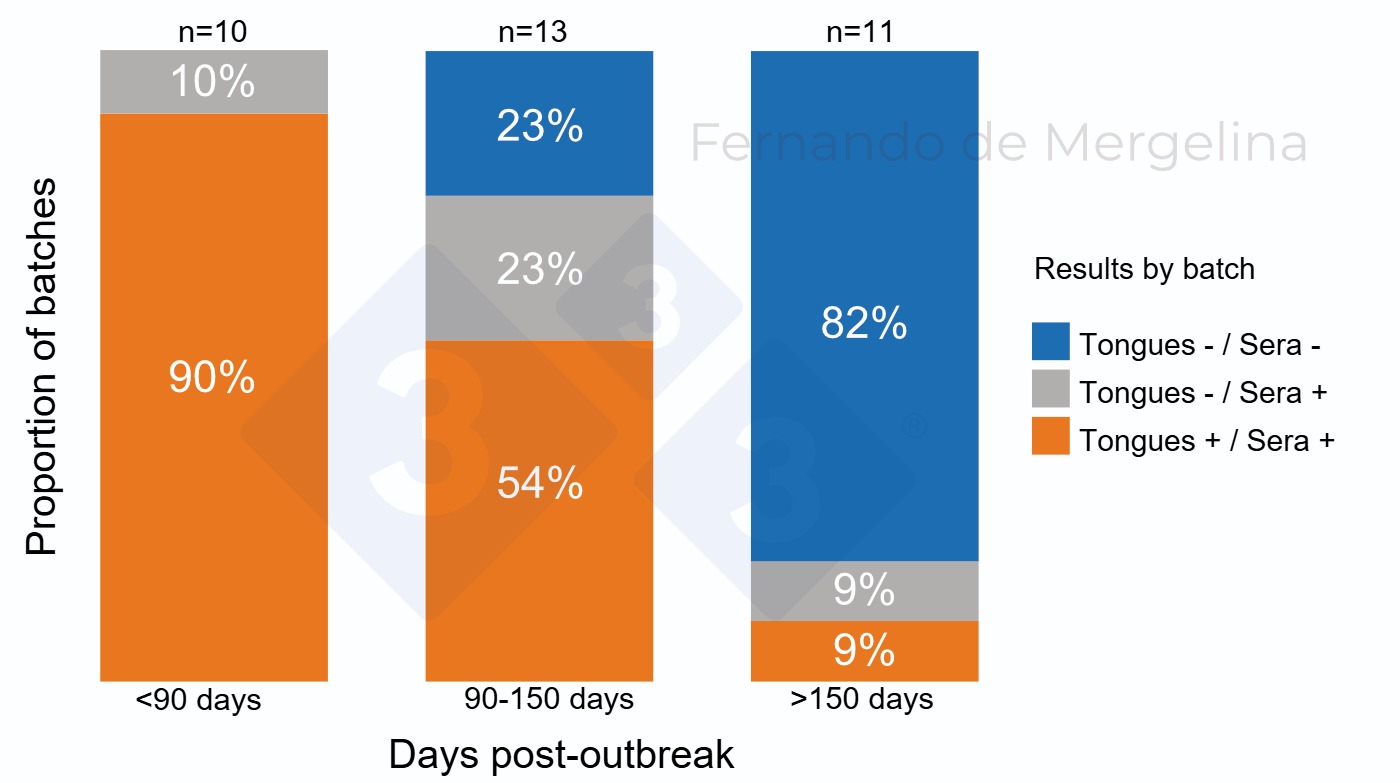
Regarding the Ct values obtained (Table 1), the batches with the lowest Ct values in tongue samples also had lower Ct values in the serum pools at weaning, especially during phases close to the onset of the outbreak. On the other hand, the number of negative batches in both samples increased as time elapsed from the start of the outbreak. However, during intermediate phases of the follow-up, batches were identified in which PRRSV was not detected in the tongues (Ct = NEG), while the virus was detected in the sera at weaning.
Table 1. PRRSV RT-PCR Ct values in tongues from stillborn (SB) piglets and in pools of serum samples collected at weaning by batch, in order of days post-outbreak, showing the evolution of viral detection over time.
| Batch | Days post-outbreak | Ct tongues (SB) | Ct sera pool post-weaninng |
|---|---|---|---|
| Batch 1 | 28 | 35.5 | 15.9 |
| Batch 2 | 42 | 27.8 | 21.8 |
| Batch 3 | 44 | 21.6 | 20.8 |
| Batch 4 | 49 | 26.4 | 23.8 |
| Batch 5 | 49 | 25.3 | 24.2 |
| Batch 6 | 58 | 33.9 | 22.5 |
| Batch 7 | 77 | 26.2 | 28.3 |
| Batch 8 | 78 | 21.1 | 19 |
| Batch 9 | 78 | 31.2 | 23.8 |
| Batch 10 | 80 | NEG | 24.1 |
| Batch 11 | 90 | NEG | NEG |
| Batch 12 | 92 | 25.6 | 24.4 |
| Batch 13 | 95 | 29.7 | 23.5 |
| Batch 14 | 96 | 23.6 | 27.6 |
| Batch 15 | 100 | NEG | 29.1 |
| Batch 16 | 104 | NEG | 26.7 |
| Batch 17 | 116 | 28 | 21.8 |
| Batch 18 | 117 | 38.1 | 33.1 |
| Batch 19 | 127 | 24.6 | 33.2 |
| Batch 20 | 131 | 34 | 30 |
| Batch 21 | 136 | NEG | 27.8 |
| Batch 22 | 136 | NEG | NEG |
| Batch 23 | 138 | NEG | NEG |
| Batch 24 | 154 | NEG | NEG |
| Batch 25 | 165 | NEG | NEG |
| Batch 26 | 168 | 29.2 | 25.5 |
| Batch 27 | 171 | NEG | NEG |
| Batch 28 | 179 | NEG | NEG |
| Batch 29 | 179 | NEG | NEG |
| Batch 30 | 184 | NEG | 28.2 |
| Batch 31 | 209 | NEG | NEG |
| Batch 32 | 211 | NEG | NEG |
| Batch 33 | 217 | NEG | NEG |
| Batch 34 | 217 | NEG | NEG |
This gradual decrease in viral load and intermittent circulation of PRRSV in batches farther from the outbreak demonstrates that the probability of detection depends largely on how sampling is structured. The identification of PRRSV-negative batches in tongues at birth but PRRSV-positive in piglet serum at weaning (Figure 1 and Table 1) suggests the existence of some viral recirculation in the farrowing barn that does not always manifest at the time of farrowing. In these scenarios, it is plausible that a small number of viremic animals are born—which are difficult to detect in the initial sampling—and that the infection progressively spreads during the lactation phase through contact within and between litters, and even between different batches, facilitated by management practices or internal biosecurity failures.
This epidemiological behavior of the virus is consistent with scenarios of low-to-moderate prevalence and focal circulation of PRRSV, where detection through spot sampling is limited. Nursery studies have shown that, when detectable viral shedding is concentrated on one or a few days, the sampling strategy is critical. For example, when the virus is detectable on only one day of the week, the probability of detection through spot sampling is very low (14%), whereas pooling tongue samples from weekly mortality into a single pool increases it to 79%, exceeding 95% when there are two or more positive days. These results reinforce the need to design sampling strategies that integrate the temporal, population-based, and epidemiological components of PRRSV.
The use of tongues has been shown to be a useful tool for developing risk-based monitoring strategies. For example, analysis of tongues from stillborn piglets made it possible to identify litters with active PRRSV circulation, showing that when stillborn tongue sampling in a litter tested positive, their live-born littermates were 17.6 times more likely to be infected.
Prioritizing small litters (≤11 born alive) and those with stillbirths increases the likelihood of detecting the virus in farrowing pens (Machado et al., 2025)
Overall, the targeted collection of these samples improves the sensitivity of monitoring in settings with low prevalence (3-5%), optimizes sampling, and facilitates the control of viral recirculation in farrowing.
The use of stillborn tongue fluid samples is a valuable tool for monitoring PRRSV, as it provides early information on viral circulation at the batch level. However, it should not be used randomly, but rather integrated into risk-based monitoring programs tailored to the current epidemiological situation. In this way, it improves detection and supports health decision-making.