Farm closure programs and new requirements are reshaping the European swine industry
29-Jul-2026 (2 months 23 days ago)
Over the past few years, some of Europe's main pig-producing regions have been undergoing profound structural transformation. The causes, the instruments used, and the pace of this transformation vary considerably from country to country. The Netherlands and Flanders have resorted to public voluntary cessation programs; Germany faces restructuring driven primarily by new regulatory requirements; Denmark is beginning to politically redefine its production model, and Switzerland has opted for industry self-regulation mechanisms. The following is an analysis of the main characteristics of each case.
The Netherlands
The Netherlands represents the most advanced example of public intervention in the structure of European livestock production. Since the early 2000s, the country has been developing policies aimed at reducing ammonia and nitrogen emissions from intensive livestock farming, especially in regions with higher animal density and those near protected areas.
The turning point came in 2013 with the entry into force of the regulation on low-emission animal housing (Besluit emissiearme huisvesting), which required intensive farms to invest in systems designed to reduce ammonia emissions. For producers nearing retirement or unwilling to make the necessary investments to adapt their facilities, the government established transitional mechanisms that allowed them to continue operating for a limited period before final closure.
The situation accelerated following the so-called nitrogen crisis, triggered by the May 2019 ruling of the Dutch Council of State, which compelled the government to seek real and immediate reductions in nitrogen emissions, particularly ammonia from livestock farming. From that point on, programs such as the SRV (Subsidieregeling sanering varkenshouderijen)—the first major voluntary buyout and closure scheme specifically targeting the swine sector—were accelerated. Interest far exceeded initial expectations. Of the 502 applications submitted, 407 were ultimately approved, forcing the government to increase the budget from the initially planned €180 million to approximately €455 million. Participating farms were required to completely cease operations, remove animals, and dispose of slurry within a maximum of eight months from the date the aid was granted.
Then came the LBV and LBV-plus programs, approved by the European Commission in 2023, aimed at reducing nitrogen emissions from the entire livestock sector. The LBV program targets cattle, poultry, and pig farms, while LBV-plus focuses specifically on farms considered major nitrogen emitters. In both cases, producers receive financial compensation in exchange for permanently closing their operations and relinquishing their production rights. In 2024, the European Commission approved a budget increase that raised the program's funding to €1.102 billion for the LBV and €1.820 billion for LBV-plus. More than 1,300 livestock farmers applied to participate in these programs. In July 2026, the Commission also approved a new program with a budget of €715 million, also aimed at the voluntary, permanent, and irrevocable closure of livestock farms. This new call for applications targets micro-enterprises and small and medium-sized farms raising dairy cattle, pigs, and poultry, among others, located in Natura 2000 areas or within a 1-km radius of these protected areas. The aid will cover between 100% and 110% of eligible costs and will be available for five years, with the objective of further reducing ammonia emissions and nitrogen deposition in the most sensitive areas.
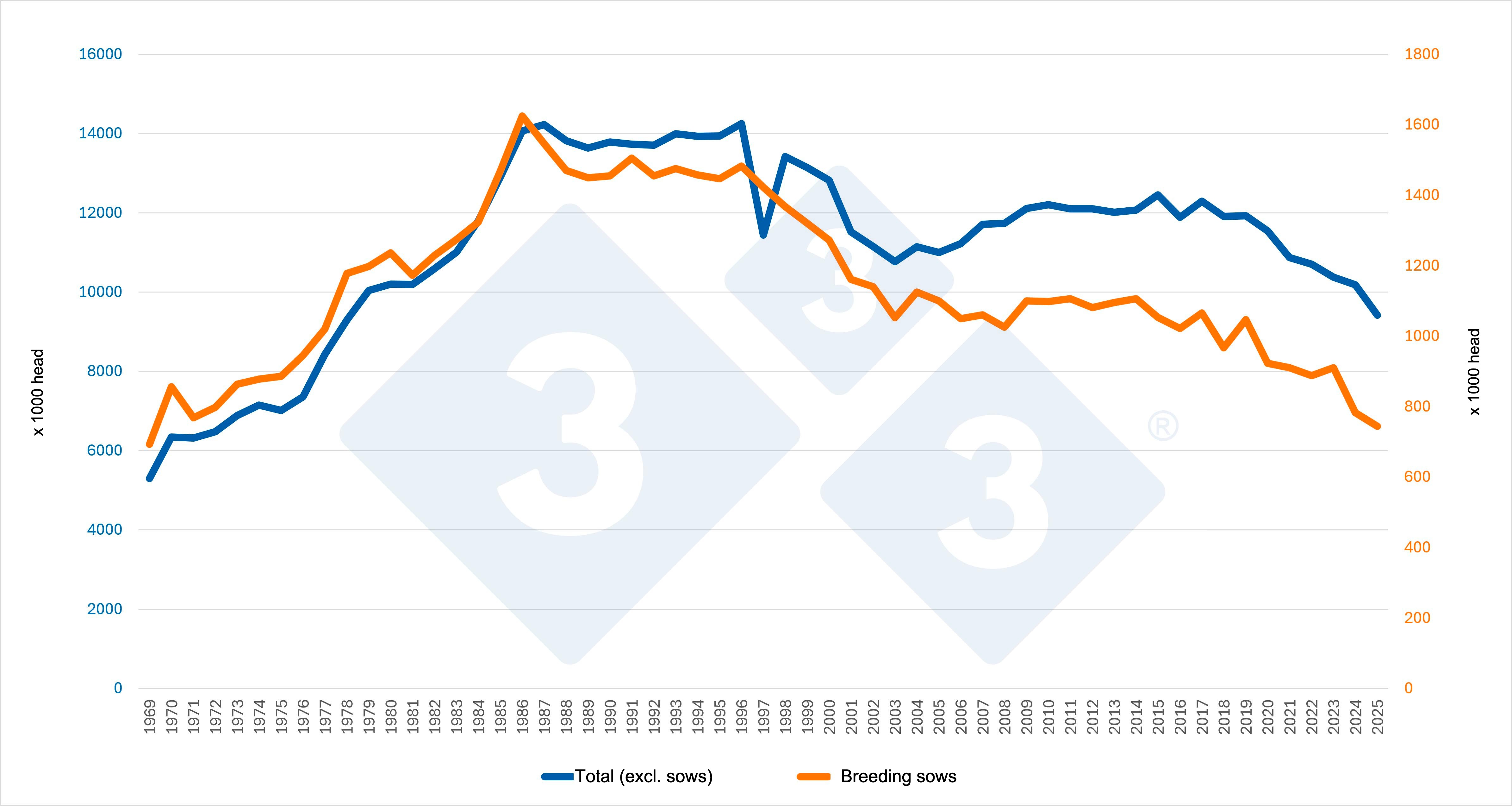
The consequences for the production structure are already starting to be seen. According to the Dutch statistical office, the pig population fell below 10 million animals in 2025 for the first time in 45 years, while the number of farms decreased to 1,900, a 7.1% drop from the previous year. Since 2015, the number of pig farms has decreased by approximately 46%, while the average farm size has increased to around 5,000 animals per farm.
Belgium
The Flanders region, which accounts for 94% of Belgium's pig population, has followed a similar strategy, although it is focused exclusively on the swine sector. With the aim of significantly reducing ammonia emissions in the region, the target is to decrease Flanders' pig inventory by 30% by 2030.
To this end, in March 2023, the European Commission authorized a €200 million program to compensate producers who decided to reduce or completely cease their activity. In the first call for applications, only 156 of the approximately 980 initially eligible producers applied to participate in the program. Therefore, the Flemish authorities decided to relax the eligibility criteria, lowering the impact score from 0.5% to 0.025%. This score reflects the nitrogen deposition a farm generates in nearby natural areas and is the main criterion for determining whether farms can participate in the voluntary cessation program. This reduction allowed the potential number of beneficiaries to be expanded to approximately 3,000 producers. Following this second call for applications, the program ultimately reached 366 participating farms, 156 in the first phase and 210 in the second.
According to the Vlaamse Landmaatschappij (VLM), the measures adopted have resulted in a reduction of approximately 370,000 pig places.
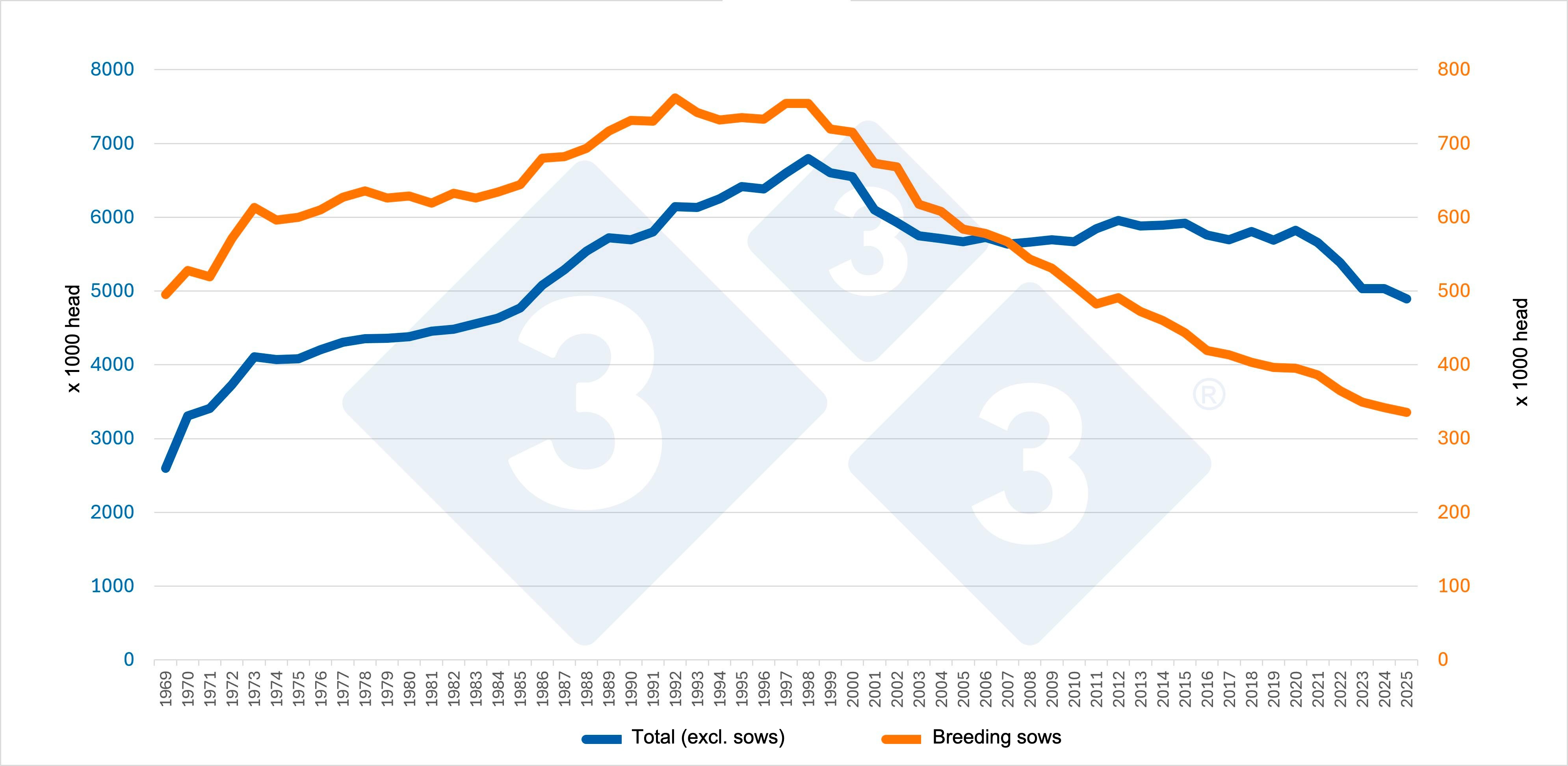
The process is part of a broader downsizing of the Flemish pig sector. With a population exceeding 6 million head in 2012, the herd declined to approximately 5 million pigs in 2024, one of the lowest levels recorded in recent decades.
Germany
The situation in Germany is different; it currently lacks specific public programs to finance the cessation of pig farming comparable to those in the Netherlands or Flanders. However, the sector is undergoing a profound structural transformation driven by stricter animal welfare requirements, the investments needed to adapt facilities, environmental pressures, and the consequences of African swine fever (ASF) and increased production costs following the pandemic and the war in Ukraine, as well as other key factors such as the lack of generational succession.
Regarding animal housing, one of the main elements of change was the progressive implementation of the recommendations derived from the so-called Borchert Commission, created to design the future of German livestock farming and improve the conditions of the animals.
On July 3, 2020, the German Animal Welfare Ordinance (TierSchNutztV) was amended. The new regulations require that breeding areas be converted into fully grouped housing systems by February 9, 2029, guaranteeing, among other requirements, a minimum area of 5 m² per sow. Furthermore, farrowing pens must be converted into free-movement systems with at least 6.5 m² per sow and a maximum of five days of confinement by February 9, 2036.
Many producers consider the necessary investments difficult to amortize in a context of high regulatory uncertainty and tight margins.
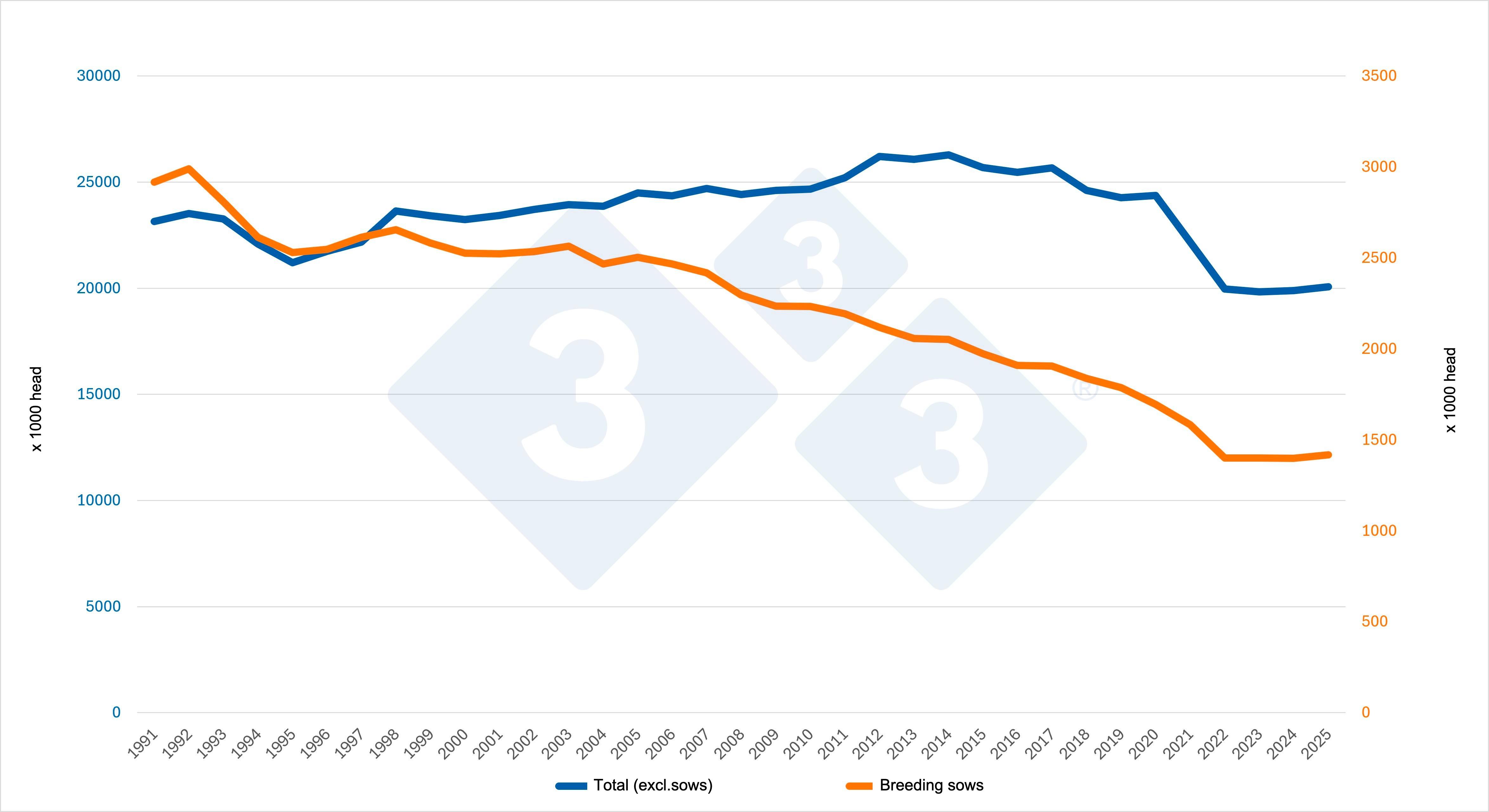
As of May 3, 2026, the pig population stood at approximately 21 million animals, a reduction of almost 23% compared to 10 years prior, although 0.6% higher than the same period of the previous year. The same trend is observed in the number of farms, which has decreased by 40% in the last 10 years, falling from 24,500 in 2016 to the current 14,700. This trend towards larger farms continues: while in 2016 a farm housed an average of 1,100 pigs, ten years later the figure was around 1,400 animals per farm.
The result has been a sharp reduction in the number of pig farms in recent years. This process is leading to a gradual concentration of production in a smaller number of larger farms with greater investment capacity.
Denmark
Denmark, one of the world's largest pork exporters, has embarked on an unprecedented strategic shift. Pressed by climate targets and animal welfare demands, the Danish swine industry is undergoing a restructuring process that includes downsizing, conversion, and a drastic halt of intensive industrial livestock farming.
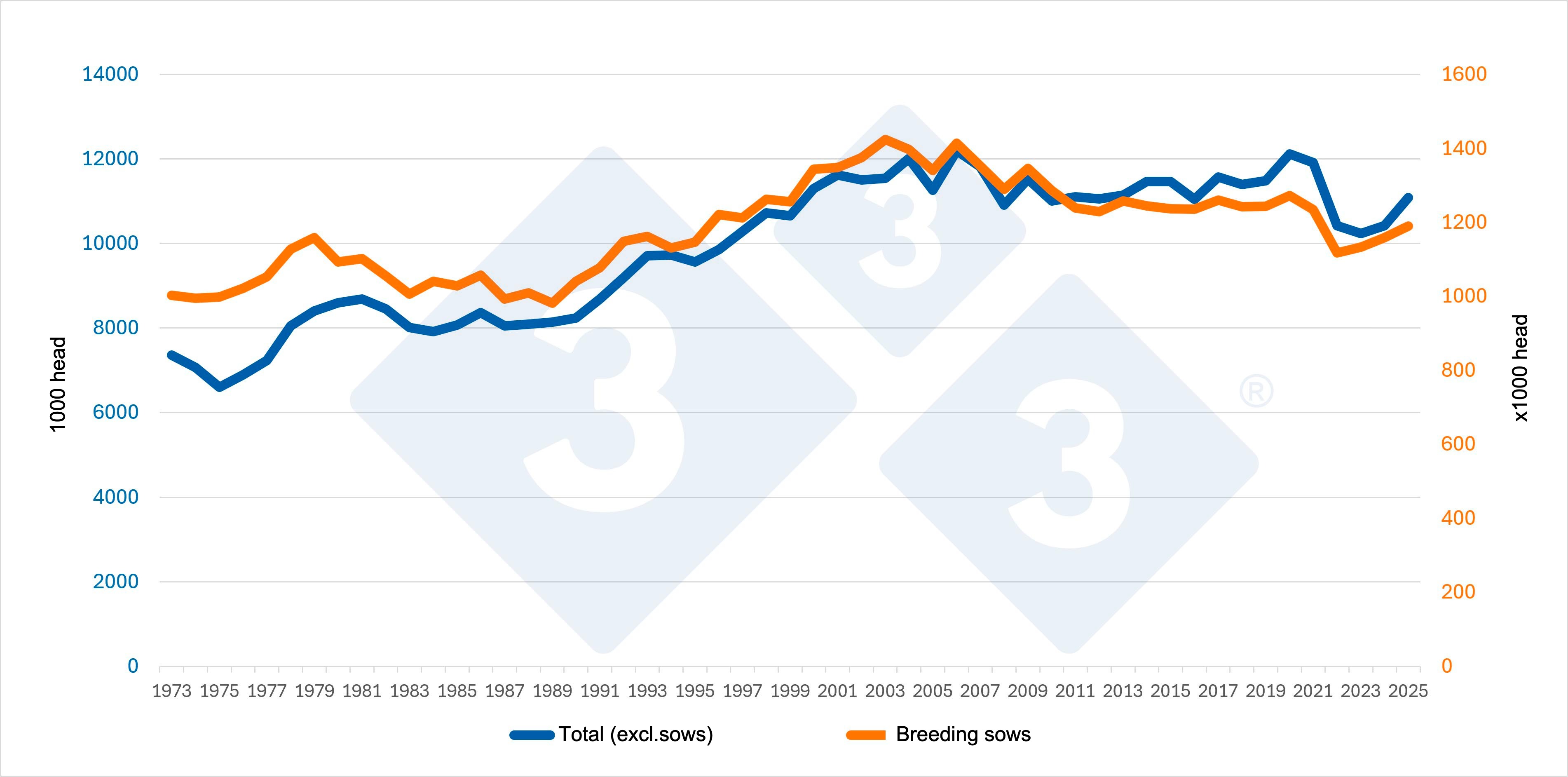
The most unique aspect of Denmark's case is that the debate on the pig farming model came to define the last election campaign and, among other consequences, the new coalition government eliminated the Ministry of Agriculture, creating in its place a Ministry of Nature and Animal Welfare, and reached a political agreement, known as "Det politiske grundlag for firkløverregeringen", which includes a series of strategic guidelines for the future of pig production.
Among the most relevant elements, the text establishes as a long-term objective that Danish swine production be primarily geared towards raising animals that can be used within the country's own food system. This formulation introduces a vision of greater integration between production and domestic consumption, without detailing specific operational measures or implementation timelines.
In this context, the document also envisions the launch of a "firepartsaftale," a four-way dialogue process on the future of pig production. This framework will involve stakeholders from the agricultural sector, environmental and animal welfare organizations, as well as relevant actors in the labor and food sectors.
The political agreement also incorporates measures related to land-use planning and environmental regulations that indirectly affect pig production. Among these, the strengthening of the role of municipalities stands out, as they will be able to reject the expansion or creation of new pig farms based on assessments that take into account the impact on nature, the environment, and local communities.
Likewise, the document considers reinforcing animal welfare policies in the livestock sector, with measures aimed at improving control and regulatory compliance. These include initiatives on production practices, breeding conditions and administrative supervision, within the framework of greater regulatory demands.
Overall, the text outlines a political approach that combines long-term strategic objectives with a strengthening of the regulatory framework and sectoral dialogue, without yet detailing a closed model for the transformation of the Danish pig production system.
Switzerland
Switzerland is an interesting case because it is of a different nature than the other four: it does not have a government-driven environmental or animal welfare plan, but has industry self-regulation in the face of oversupply.
At the beginning of the year, the Swiss pork industry implemented a self-regulation mechanism to curb the oversupply that was putting downward pressure on prices and eroding farm profitability. The measure, promoted by Suisseporcs and supported by the board of directors of Proviande, the country's meat industry association, consisted of a withholding of 0.20 Swiss francs per kilogram of carcass weight on slaughtered pigs. The revenue collected went into a fund, managed by Proviande, intended to "ease the market," including measures ranging from promoting exports to paying bonuses to farmers who reduced their breeding stock, in an attempt to align supply with domestic demand. This last point, however, failed to gain approval at the extraordinary meeting of Suisseporcs on May 27, 2026, and was narrowly rejected.