
Heat waves in finishing: Should you delay meals or ration feed for better recovery?
30-Jul-2026 (2 months 17 days ago)
Given the increase in the frequency, intensity, and duration of heat waves due to global warming, feed management for pigs during the finishing phase has become a strategic factor.
Heat waves directly affect pigs' feed intake and, consequently, their growth.
Heat stress: An immediate deterrent to feed intake
In growing and finishing pigs, acute heat stress causes a rapid drop in feed intake. The animal spontaneously reduces its feed intake to limit metabolic heat production. Although this adaptation provides short-term protection, it negatively affects average daily gain. Furthermore, thermoregulation mobilizes significant physiological resources, including peripheral vasodilation, which reduces blood flow to internal organs and can weaken the intestinal epithelium (Pearce et al., 2013). As a result, even when temperatures decrease, recovery is not always immediate, and feed intake and growth may be affected for some time (Renaudeau, 2021).
The most common strategy used on farms is to schedule feedings for the coolest times of the day, so that the heat produced during digestion occurs when ambient temperatures are lower. However, this approach has several limitations:
- It is effective only if nighttime temperatures drop enough, which does not always happen during a heat wave;
- Logistical constraints may arise depending on the feeding system and farm size;
- Finally, this schedule reduces flexibility in observing feedings, which is needed for the farmer to supervise intake precisely and adjust animal feeding management.
Two summers to conduct the trials...
In this context, a study conducted by the Brittany Chamber of Agriculture at the Crécom experimental station (France) provides specific information on two strategies applicable on the farm, both of which used liquid feed:
- Scheduling feedings for the coolest hours of the day (CH), and
- temporarily restricting feed during the heat wave followed by gradual refeeding (R+R).
The R+R strategy is based on the hypothesis that stricter feeding restrictions during a heat wave help limit disruptions to gut health. Progressive refeeding is intended to allow time for digestive functions to recover optimally. In addition, feed not consumed during the hot period is reintroduced later to promote compensatory growth and reduce the heat wave's impact on technical and economic performance.
The study was conducted during the summers of 2023 and 2024 on batches of 208 pigs (castrated males and females) from the time they entered the finishing phase—at an average age of 60 days old—until they were sent to the slaughterhouse. For the CH strategy, during heat waves, the pigs received the same standard diet but divided into two meals a day—one in the morning and one in the afternoon—instead of the usual three. For the R+R strategy, the pigs were fed 10% less than their usual ration during the heat wave, maintaining three meals per day, followed by a gradual increase in feed (+3.5% per day) after the heat wave to compensate for the deficit, before returning to the standard feeding plan. Outside of hot periods, all animals received the same feed in liquid form, according to an identical plan: 45 g of feed per kg of live weight at the start of finishing, with an increase of 35 g/day up to a maximum of 2.55 kg/day.
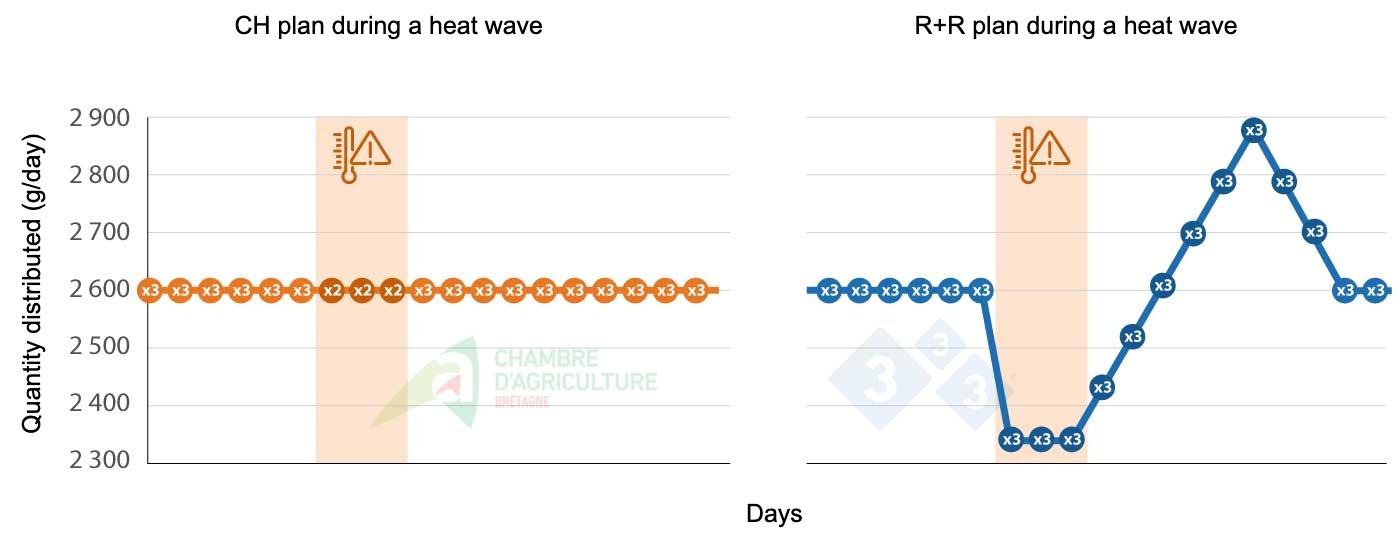
…but two very different summers
In 2023, two natural heat waves lasting three days were recorded when the animals were 79 and 138 days old, with average temperatures of 28.2 °C and 28.4 °C, respectively. However, in 2024, since no heat waves were recorded, a heat episode was simulated by heating the pens for 3 days when the pigs were 131 days old, reaching an average temperature of 27.6 °C during those 3 days.
Feed intake per pen was recorded daily. The pigs were weighed individually when fasting at the start of the finishing phase, during the transition from growing to finishing feed (at approximately 65 kg live weight), and before being sent to the slaughterhouse. In addition, the pens were weighed collectively before and after the heat waves and following the refeeding phase.
The detection and forecasting of heat waves were supported by the CLIMAT BAT app, developed by the Brittany Chamber of Agriculture. This tool uses weather data and the farm's location to calculate the animals' Heat Stress Index (HSI) for the next 6 days based on their physiological condition. If there is a risk of heat stress in the coming days, notifications are sent.
Equivalent overall performance
Throughout the finishing period, no significant differences were observed between the two strategies in the two groups. Average daily feed intake was nearly identical. Average daily weight gain reached 928 g/day for the CH animals compared to 922 g/day for the R+R animals, and the feed conversion ratio stood at 2.48 and 2.52, respectively. No effects were observed on lean meat content or on the added value of the carcasses. In other words, the choice of strategy during hot spells did not alter the technical and economic results.
Table: Animal performance according to feeding strategy for the two groups.
| Item1 | CH | R+R | Statistic2 | |||
|---|---|---|---|---|---|---|
| RSE | Feeding strategy | Batch | Strategy x Batch | |||
| Number of pens | 20 | 20 | ||||
| Number of pigs | 203 | 204 | ||||
| ADFI, kg/day | 2.28 | 2.29 | 0.01 | NS | *** | NS |
| ADG, g/day | 928 | 922 | 92 | NS | NS | NS |
| FCR, kg/kg | 2.48 | 2.52 | 0.10 | NS | * | NS |
| % lean | 61.1 | 60.9 | 1.9 | NS | *** | NS |
1 ADFI: average daily feed intake, ADG: average daily gain, FCR: feed conversion ratio, % lean: percentage of muscle in the cuts.
2 Analysis of variance considering the effects of feeding strategy, sex, batch, and room, as well as interactions among these fixed effects. Initial weight is considered as a covariate. Only the p-values for feeding strategy, batch, and their interaction are presented. RSE: residual standard error. NS: not significant.
Results varied depending on the pigs’ age and weight
During the first heat wave (HW) of batch 1, when the pigs were still relatively young, the R+R strategy allowed for an average daily weight gain comparable to that observed in the CH group (923 g/day vs. 936 g/day), despite the 10% restriction. This is explained by slightly higher feed efficiency in the R+R group (better feed conversion ratio: 2.11 vs. 2.31). During the refeeding phase for the R+R group, no compensatory growth was observed, resulting in similar performance between the two groups after the first heat wave.
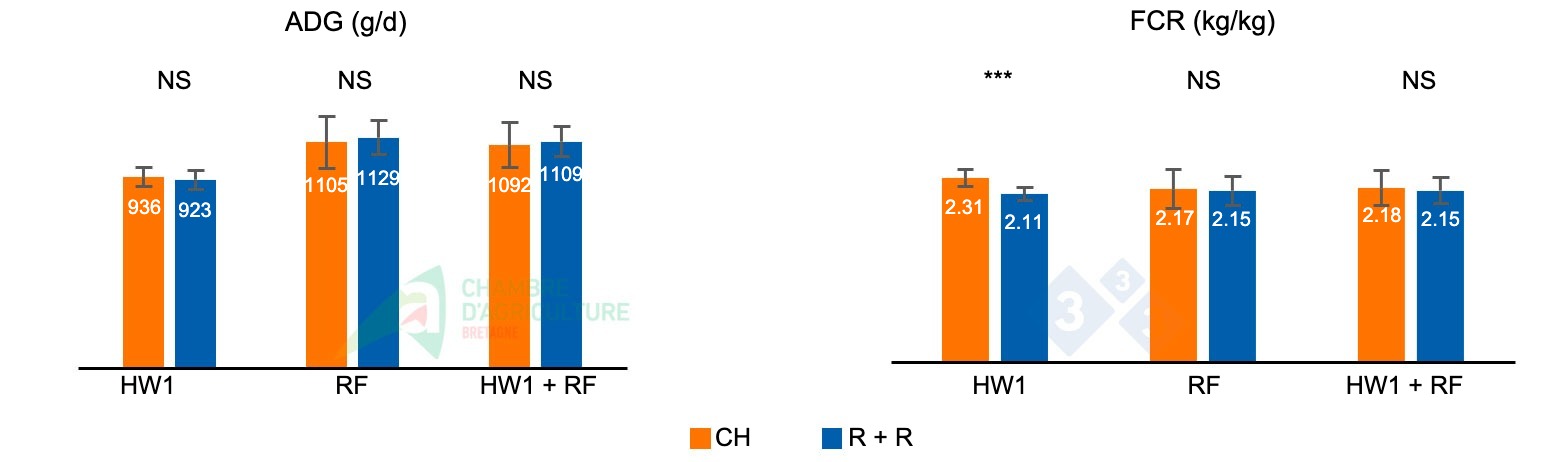
After the second heat wave (HW) of batch 1 and the refeeding phase (HW2 + RF), the pigs in the R+R group exhibited a downward trend in performance compared to the CH group, with a lower ADG (859 vs. 949 g/day; P < 0.1) and a higher FCR (2.98 vs. 2.72; P < 0.1). This decrease appears to be due to a more pronounced drop in weight gain during the heat wave, related to rationing, without a concomitant improvement in feed efficiency. Furthermore, during the refeeding phase, the ADG remained lower, reflecting poorer feed efficiency despite a higher intake level.
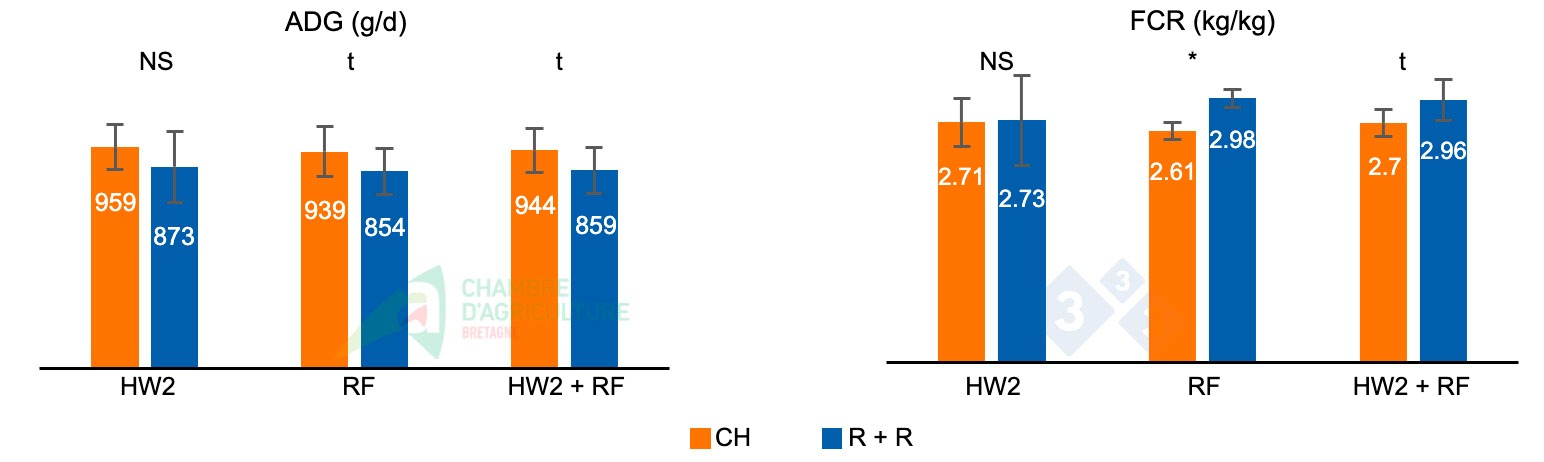
For batch 2, the trends observed were similar, though they did not reach statistical significance, likely because the heat stress was simulated and less intense.
These differences are not due to temperature variations between heat waves but rather to the pigs' age and weight during these heat episodes.
Younger animals seem to benefit more from the R+R strategy than older ones.
As Renaudeau (2021) showed, the decline in ADG under heat stress depends heavily on the animals’ age and weight: heavier pigs experience a more pronounced decline in growth due to higher metabolic heat production.
Therefore, they would require stricter rationing to limit thermoregulatory mechanisms, especially peripheral vasodilation, which can compromise blood flow to internal organs and intestinal health. In contrast, the R+R strategy, based on the hypothesis of compensatory growth, would be more appropriate for young pigs, for whom energy intake is the main factor limiting growth.
The study confirms that scheduling feedings during cooler hours is a simple and effective approach, provided that daily temperature ranges allow sufficient feed intake during those cooler hours, while rationing followed by refeeding may be useful in younger pigs, but its effectiveness depends closely on the physiological stage and the potential for compensatory growth. Further studies are needed to optimize restriction levels and refeeding protocols, especially under more severe heat stress.
This study was conducted as part of the FERMADAPT program, with financial support from the Brittany Region and ADEME.