
Early intake post-weaning: The real turning point for gut health
18-Jun-2026 (4 months ago)
Traditionally, attention surrounding weaned piglets has focused on the prevention and control of post-weaning diarrhea. However, the physiological events that occur during the first few days after weaning remain poorly characterized, despite being critical to intestinal health. Current scientific evidence indicates that feed intake immediately after weaning can have a decisive influence on the animal’s future growth performance. Furthermore, an association has been observed between early feed intake and an increase in lymphocytes in the mucosa, suggesting the diet has a modulating role in maintaining intestinal barrier integrity (Mccracken et al., 1999; Fabà et al., 2024). Based on this premise, the objective of this study is to characterize the evolution of solid feed intake during lactation and the first four days post-weaning, and to correlate these patterns with intestinal inflammation, using fecal calprotectin as a non-invasive biomarker of the local inflammatory response.
Characterizing the population
This study was structured in two distinct phases. The first phase aimed to quantify the prevalence of animals that maintain uninterrupted feed intake during the weaning transition.
To monitor individual feeding behavior, the starter feed was supplemented with an indigestible dye. Consumption was determined by detecting the dye using rectal swabs. This starter feed was provided continuously from day 10 of lactation until four days post-weaning.
At weaning and on day 3 post-weaning, the animals' individual consumption was evaluated and they were classified into three categories:
- CFE: animals that had eaten creep-feed during lactation and maintained continued consumption during weaning.
- PWE: animals that did not eat during lactation, but started eating in the first three days post-weaning.
- NE: animals that did not consume feed during the experimental period.
In addition, these animals were weighed at weaning, on day 3, and on day 10 post-weaning to assess growth progress.
Table 1. Prevalence of piglet consumption and growth according to different consumption categories at weaning: creep-feed eaters (CFE), post-weaning eaters (PWE) and non-eaters (NE).
| Consumption category | P-val | |||
|---|---|---|---|---|
| CFE | NE | PWE | ||
| Prevalence of consumption at weaning (%) |
4.49% (28 / 623) |
95.5% (595 / 623) |
- | - |
| LW weaning (kg) | 5.49 ± 0.24 | 5.90 ± 0.05 | - | 0.092 |
| Prevalence of consumption day 3 post-weaning (%) |
4.49% (28 / 623) |
26.0% (162 / 623) |
69.51% (433 / 623) |
- |
| LW day 3 post-weaning (kg) |
6.13a ± 0,10 | 5.66b ± 0.04 | 5.96a ± 0.03 | < 0.001 |
| LW day 10 post-weaning (kg) |
7.05a ± 0,13 | 6.19c ± 0.05 | 6.61b ± 0.03 | < 0.001 |
| ADG1 weaning day 3 post-weaning (g/d) |
63.0a ± 23.6 | - 63.4b ± 9.9 | 19.9a ± 6.0 | < 0.001 |
| ADG weaning day 10 post-weaning (g/d) |
117a ± 13 | 27.0c ± 5.6 | 72.8b ± 3.4 | < 0.001 |
1 Abbreviations: ADG: average daily gain, LW: live weight.
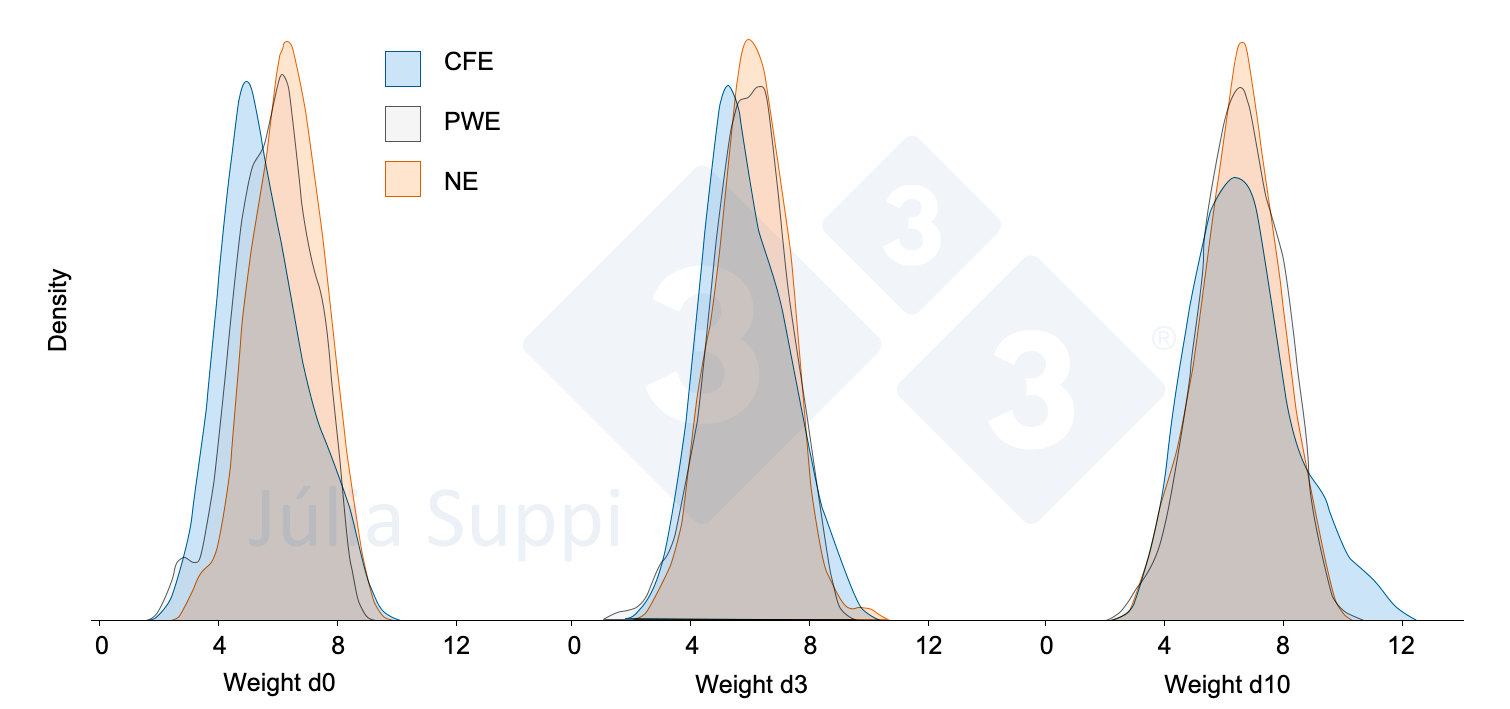
Of a total of 623 animals, only 4.5% consumed creep feed during lactation, compared to 95.5% that did not. Among the CFE animals, most maintained creep feed intake during the first three days post-weaning. Meanwhile, approximately 70% of the total began consuming solid feed during that same period, while a concerning 26% remained fasted for at least four days. If we translate these data into production performance, we observe the CFE piglets weighed, on average, about 400 g less at weaning than the NE animals. However, by 10 days post-weaning, the CFE piglets had not only compensated for this difference but had surpassed it, reaching an average body weight approximately 800 g higher than that of the NE group. This suggests that the truly determining factor may not be feed intake during lactation itself, but rather the ability to initiate and maintain feed intake during the first few days after weaning. This leads to the next question: How does this translate into intestinal inflammation?
Characterization of local inflammation based on consumption
In this second phase, to correlate the different consumption patterns with their possible effect on intestinal inflammation, fecal calprotectin was measured. This molecule, released by neutrophils, is widely used in human medicine for the diagnosis and monitoring of inflammatory bowel diseases, and has been previously validated by our group (Pato et al., 2023; Suppi et al., 2026).
The use of this fecal marker presents several clear advantages: it is a non-invasive method, it allows repeated measurements over time, and it provides localized information at the intestinal level.
For this analysis, a subgroup of 74 animals was selected and sampled daily from weaning until day 3 post-weaning. Figure 2 shows the evolution of fecal calprotectin concentration according to feed category.
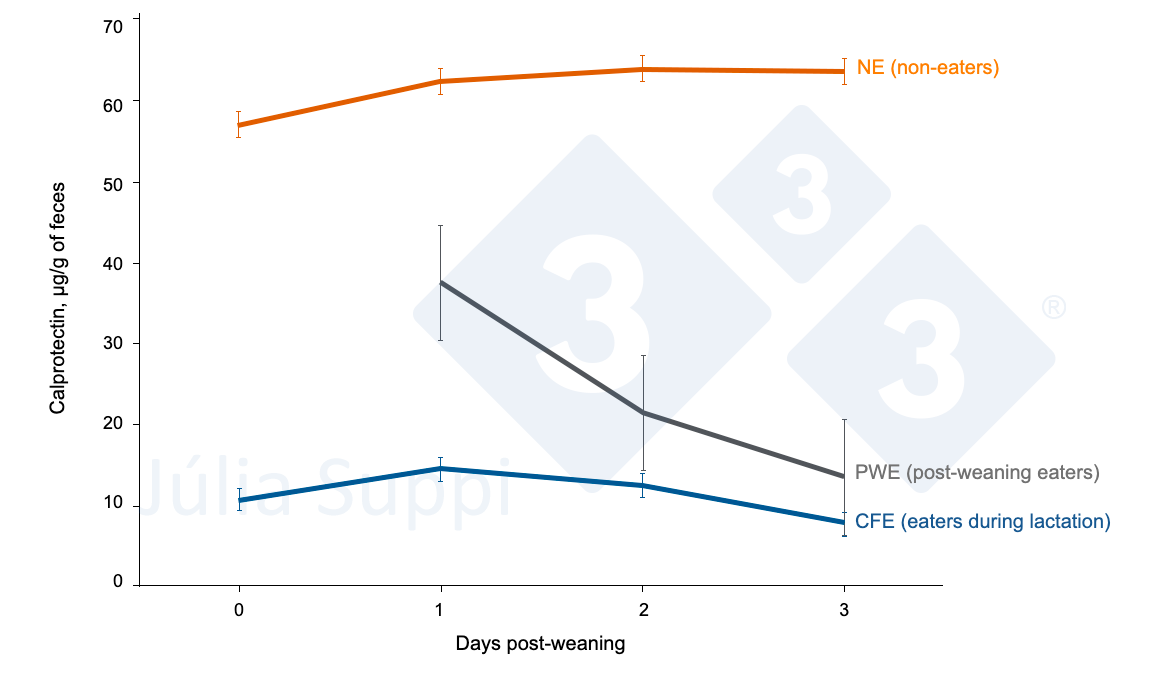
It can be observed that animals classified as NE have significantly higher concentrations on all days compared to continuous eaters (P < 0.001). On the other hand, animals that began consumption during the first three days show a progressive decrease in calprotectin, reaching values similar to those of continuous eaters by day 3 post-weaning.
One particularly striking aspect is that the NE piglets already show significantly higher values from the outset. This does not appear to be coincidental. Considering that these animals tend to be among the heaviest in the population and that, as previously observed, they are more frequently involved in aggressive interactions to establish social hierarchies, it is reasonable to suggest that this increase may be linked to post-weaning stress.
Furthermore, the piglets in the highest category are generally the most active consumers of the sow's milk and therefore have little need to consume creep feed during lactation. As a result, they may be the animals most affected by the transition to solid feed intake after weaning.
On the other hand, since the day 0 samples were collected when the animals had already been regrouped in the pens, this initial increase in calprotectin probably reflects an inflammatory response associated with this stressful situation.
Final discussion
This study demonstrates how common the problem of feed consumption is in the first days post-weaning, especially in short lactations.
Approximately 25% of the population did not start consuming solid feed during the evaluated period.
This lack of intake was correlated with a significant increase in intestinal inflammation, resulting in compromised functional integrity of the epithelium and, consequently, a loss of the animals' growth potential.
On the other hand, creep-feed consumption during lactation is not a minor detail, but a clearly determining factor.
Feed intake during lactation virtually guarantees intake after weaning, minimizing the fasting period. This smooth transition is associated with a reduced intestinal inflammatory response and allows these animals to eventually reach and even surpass the productive performance of their peers, optimizing their future growth curve.