
Colombia: meat consumption reached a record of 81.6 kg in 2025 driven by the pork industry
March 30, 2026 | Department of Economy and Sustainability of 333 Latin America.
Fenavi | https://fenavi.org/ | Fedegan | https://www.fedegan.org.co/ | Porkcolombia | https://porkcolombia.co/ | Fedeacua | https://fedeacua.org/
Meat consumption in 2025
In 2025, total per capita consumption of the main animal proteins (chicken, beef, pork, and fish) reached 81.6 kg/person, representing an increase of 4.1 kg/person (+5.3%) compared to 2024.
- Chicken remained the most consumed protein in the country, with a per capita consumption of 37.8 kg/person in 2025 (+5.9% compared to 2024), representing 46.4% of total consumption. Beef followed, with 18.4 kg/person and a 22.6% share.
- Pork ranked third in consumption in 2025, with 15.8 kg/person (+7.2% compared to 2024) and a 19.4% share of the total.
- Per capita fish consumption reached approximately 9.6 kg/person, representing 11.7% of total consumption.
- In absolute terms, chicken saw the largest increase in per capita consumption in 2025, increasing by 2.1 kg/person compared to 2024. Pork and beef followed, with increases of 1.1 and 0.8 kg/person, respectively, while fish consumption increased by only 0.2 kg/person in the last year.
- Although chicken continues to lead in absolute volume with an increase of 2.1 kg in annual consumption, the pork sector demonstrates greater commercial agility, exhibiting a relative growth rate of 7.5%, surpassing the growth of its direct competitors: chicken (5.9%), beef (4.5%), and fish (1.6%).
- Per capita egg consumption reached 366 units in 2025, while milk consumption registered 168 liters (This value represents the theoretical availability, since real consumption figures according to Asoleche could be closer to 150 liters).
Evolution of meat consumption over the last 11 years
Between 2014 and 2025, pork was the only animal protein that practically doubled its consumption, increasing by 113.3%, from 7.4 to 15.8 kg/person. Fish consumption followed, growing by 56.6%, and chicken consumption increased by 29.0%. In contrast, beef consumption fell by 6.6% over the same period, from 19.7 to 18.4 kg/person.
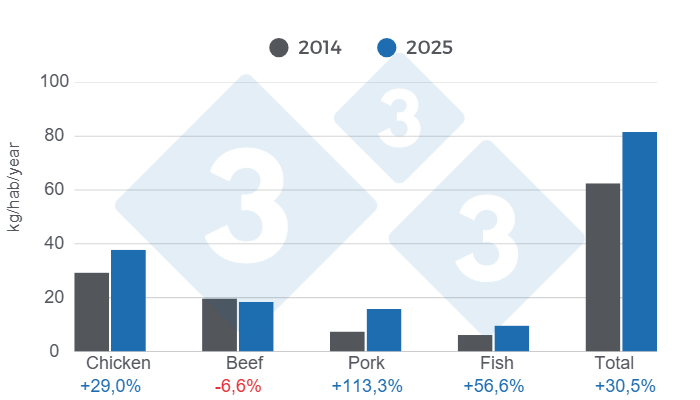
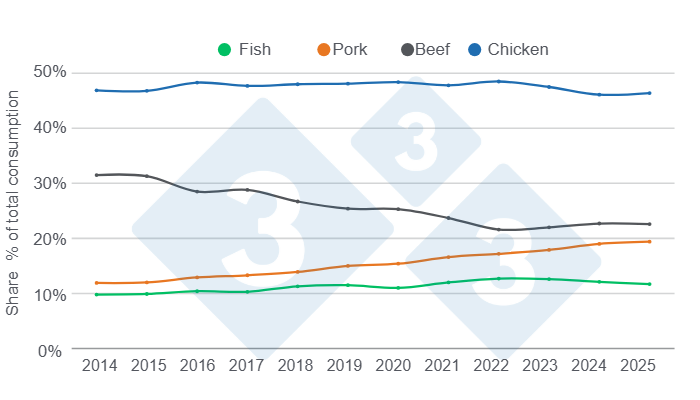
Over the past 11 years, total meat consumption in Colombia has grown at an annual rate of 2.5%, with pork registering the highest average annual growth rate (7.2%), surpassing fish (4.4%) and chicken (2.4%). Meanwhile, beef consumption is estimated to have decreased at an average annual rate of -0.5% during the same period. This suggests a significant structural transformation of the market: beef's share of total consumption went down from 31.5% in 2014 to 22.6% in 2025, a loss of 9 percentage points (pp), while pork increased from 11.9% to 19.4% (+7.5 pp) and fish from 9.8% to 11.7% (+1.9 pp). Meanwhile, chicken, which maintains absolute leadership with a stable share of around 46%, did not show structural gains in market share during the analyzed period.
Trends by species and short-term signals
Pork consolidates a sustained growth trajectory with no significant interruptions—except for the pandemic contraction in 2020, which was the only break in the series—with positive growth in nine of the eleven years analyzed. This consistency, combined with its price competitiveness versus beef, suggests that the substitution effect will continue to favor pork in the short and medium term.
Beef, for its part, showed a recovery in 2024 (+6.0%) and 2025 (+4.5%) after hitting historic lows in market share in 2022, which could indicate a certain stabilization and recovery in consumption.
Chicken, as the dominant protein, shows a more cyclical rather than structural pattern, with temporary declines in 2020 and 2023 and a rebound in 2025.
Fish grows consistently, but at a moderate pace, suggesting that its market share gain (+2 percentage points over 11 years) is driven more by a gradual expansion of the overall market than by an active displacement of other proteins.