
Organic acids and essential oils: how they work, how they differ and why encapsulation changes everything
19-Feb-2026 (7 months 24 days ago)
Organic acids in feed
Acidification is a proven component for postweaning support and Salmonella control (Huber, et al. 2024) and calcium formate (which produces formic acid) is a good example. Beyond feed hygiene, organic acids improve nursery performance via gastric acidification, protein digestibility, and beneficial shifts in gut microbiota- effects moderated by diet buffering and inclusion strategy.
Field work in grow-finish pigs suggests encapsulated organic acids and essential oils in feed can delay seroconversion and lift daily gain versus antimicrobial growth promoters.
How do organic acids work?
- They slip into the cell. A portion of an organic acid is undissociated (uncharged and lipid‑soluble), so it can diffuse across the bacterial membrane.
- They acidify the cytoplasm. Inside the (near‑neutral) cytosol, the acid dissociates, releasing protons (H⁺) that drop intracellular pH. The cell has no choice but to metabolise ATP trying to pump H⁺ back out, collapsing the proton motive force and draining energy.
- Their anions disrupt metabolism. The accompanying acid anions can inhibit enzymes, disturb transport and osmotic balance, and interfere with DNA/RNA and energy pathways—further stalling growth or causing death.
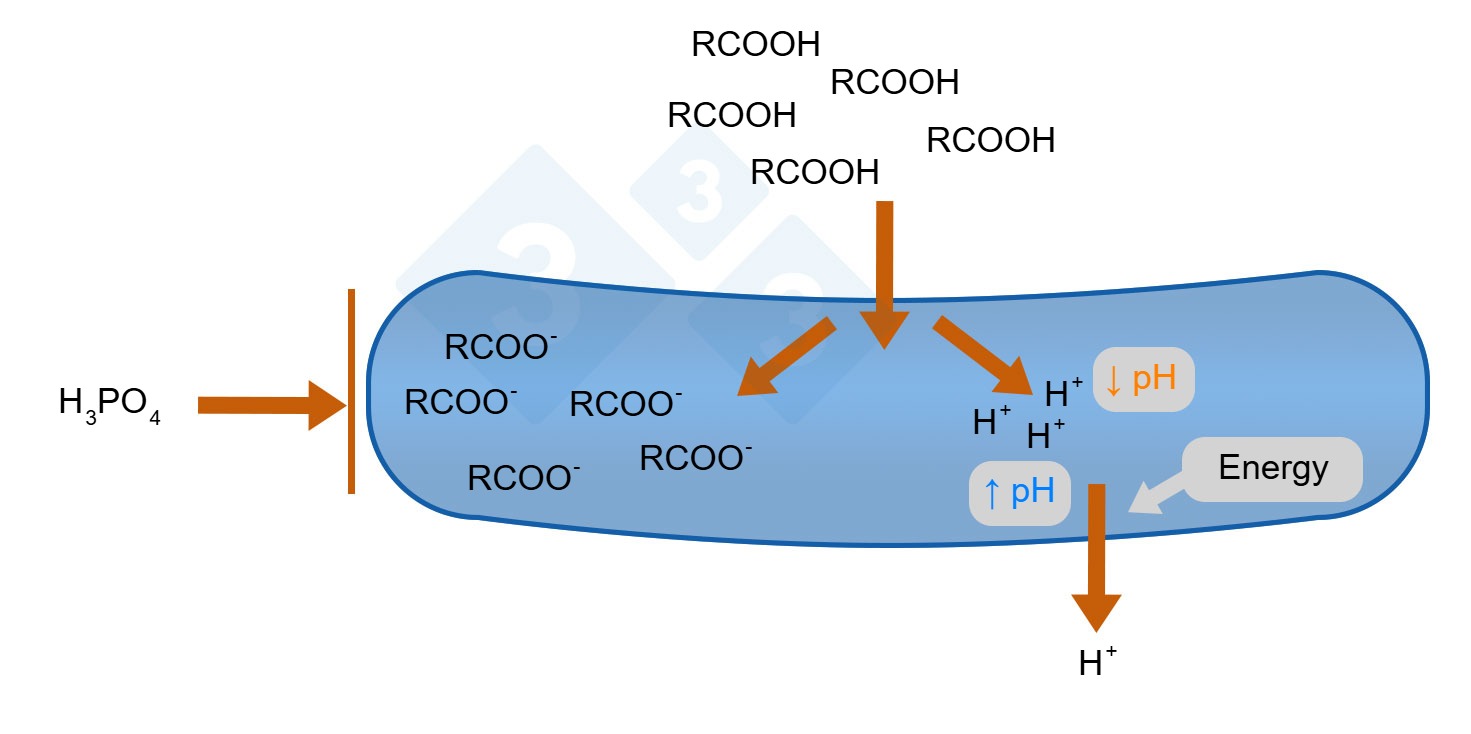
Contrary to popular belief, the organic acids kill the bacteria inside out,
not by changing the pH of the gut.
If that were the case it would be highly ineffective as the body will raise the pH of the intestinal content as soon it drops below physiological levels for that part of the GIT.
Key consideration: Effectiveness depends on acid choice
Antimicrobial impact varies with the acid’s pKₐ, the ambient pH (which sets the undissociated fraction), concentration, and delivery form (e.g., encapsulation to target later gut segments in feed applications). Having a blend of acids where one will act as a proton doner will make the mixture more efficient i.e blending Calcium formate and Citric acid, the later has 3 acid groups and 3 pKa acting as proton doner to the calcium formate.
Effectiveness of organic acids in Salmonella/ pathogen control
The first step in assessing if an acid will control any pathogen is by performing a minimum inhibitory concentration (MIC) test. This will give the first indication whether the specific acid would be a good choice.
Calcium formate is a widely used across pig diets and it is highly effective in enterobacteria control.
Table 1 shows the effectiveness versus several serovars of Salmonella.
Table 1: Inhibition of bacterial growth under different concentrations of calcium formate
| Strain | # | 250/t Prod 159 g/t ForCa |
500 g/t Prod 318 g/t ForCa |
1000 g/t Prod 636 g/t ForCa |
2000 g/t Prod 1272 g/t ForCa |
|---|---|---|---|---|---|
| Salmonella Minnesota | 1 | 4/4 | 4/4 | 4/4 | 4/4 |
| 2 | 4/4 | 4/4 | 4/4 | 4/4 | |
| 3 | 3/4 | 4/4 | 4/4 | 4/4 | |
| Salmonella heidelberg | 1 | 0/4 | 4/4 | 4/4 | 4/4 |
| 2 | 0/4 | 4/4 | 4/4 | 4/4 | |
| 3 | 0/4 | 4/4 | 4/4 | 4/4 | |
| Salmonella infantis | 1 | 0/4 | 4/4 | 4/4 | 4/4 |
| 2 | 1/4 | 4/4 | 4/4 | 4/4 | |
| 3 | 0/4 | 4/4 | 4/4 | 4/4 |
As discussed previously, the acid will work to effectively eliminate Salmonella, but to do this, it needs to arrive undissociated where the pathogens are. For this, encapsulated technologies are widely used.
Why encapsulation matters?
Encapsulation helps carry actives beyond the stomach to modulate distal microbiota, barrier function and SCFAs (propionate, butyrate). Practical responses depend on dose, matrix, and health status.
Added benefit on encapsulation: preserving the production of HCl by the piglet
The encapsulation ensures that the product by-pass the stomach and continues its way to be delivered where pathogenic bacteria are. The encapsulation brings an additional value as: the inclusion of free acids inhibits the development of parietal cells, in the stomach wall, the cells responsible for HCl production.
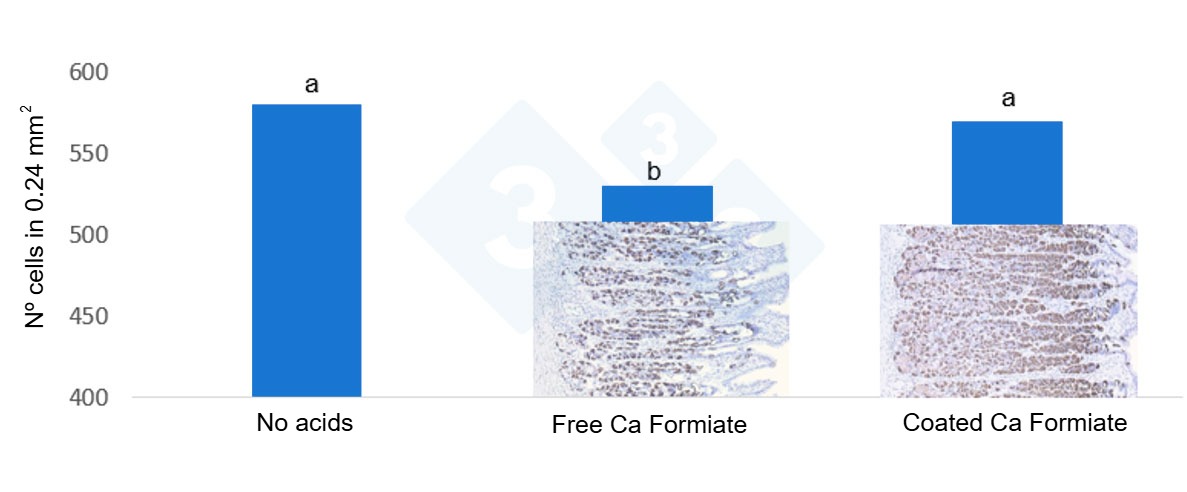
By coating the acids, they are not “perceived” by chemoreceptors, so they do not inhibit the formation of parietal cell in young piglets. Bosi et al. 2006, explored this and evaluated the histomorphology of the stomach comparing.
- Control: no acid supplementation
- Free calcium formate
- Coated calcium formate.
They showed that coated calcium formate did not differ from the control group in terms of number of parietal cells and both had significantly more parietal cells than the free calcium formate (Figure 2). This is crucial, as if after providing free calcium formate to acidify the stomach there will be less parietal cells and therefore HCl production, once the acid is taken out, it will take a couple of days for the stomach to recover. In the meantime, digestion will be suboptimal, more protein will reach the hind gut and will produce diarrhoea.
Combination between organic acids and essential oils
Some pathogens can take out protons quite quickly, and for these cases organic acids might not be enough, therefore utilising a combination with essential oils is desirable.
How do essential oils work?
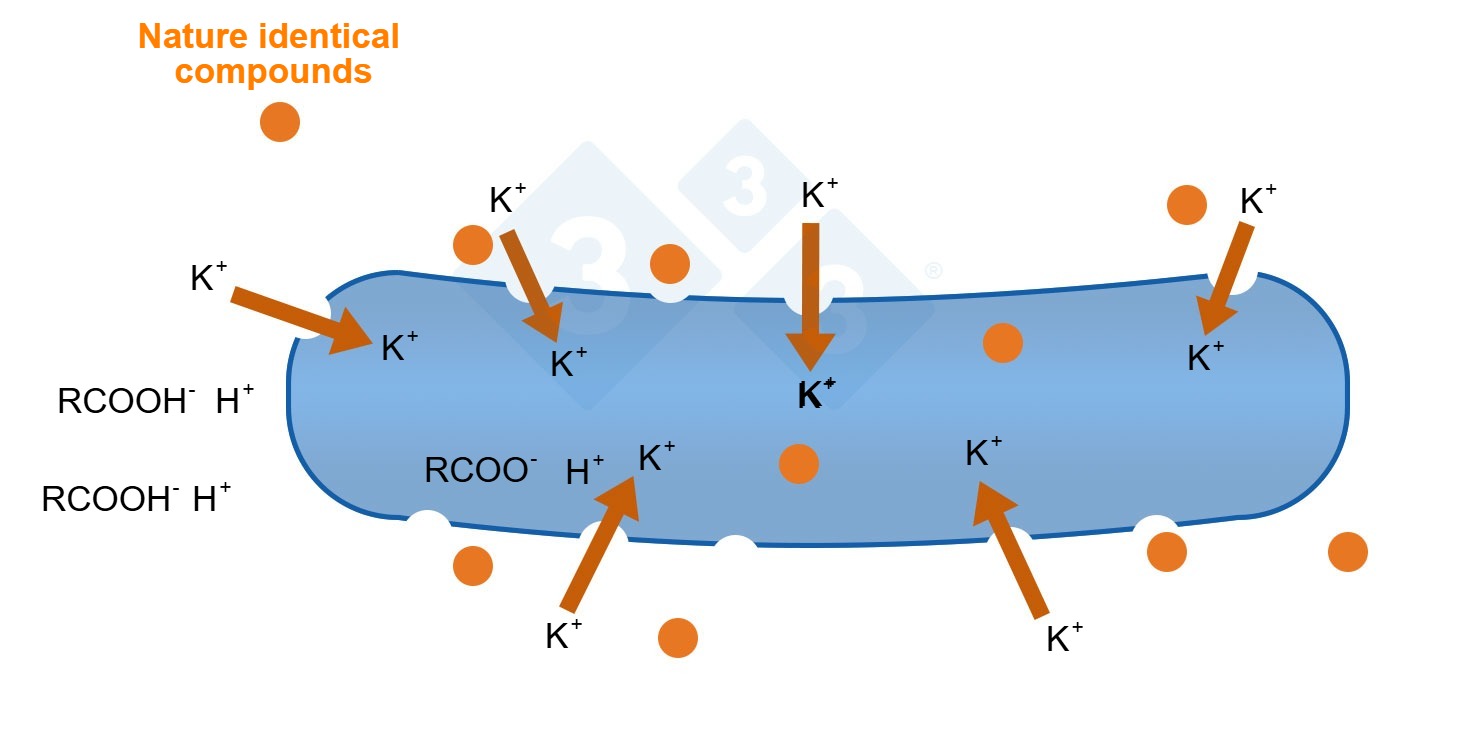
- They disrupt cell membranes. Many essential oils actives (e.g., thymol, carvacrol, eugenol, cinnamaldehyde) insert into the bacterial membrane and increase permeability, allowing H⁺ and K⁺ to leak across the membrane. This collapses ion gradients, depolarises the membrane, and impairs vital processes-leading to growth arrest or cell death.
- They drain cellular energy and damage cell machinery. Once the membrane is compromised, bacteria lose protonmotive force and ATP; essential oils components can also inhibit enzymes and perturb proteins and DNA, compounding the lethal effect.
Effectiveness of a combination of encapsulated organic acids and essential oils
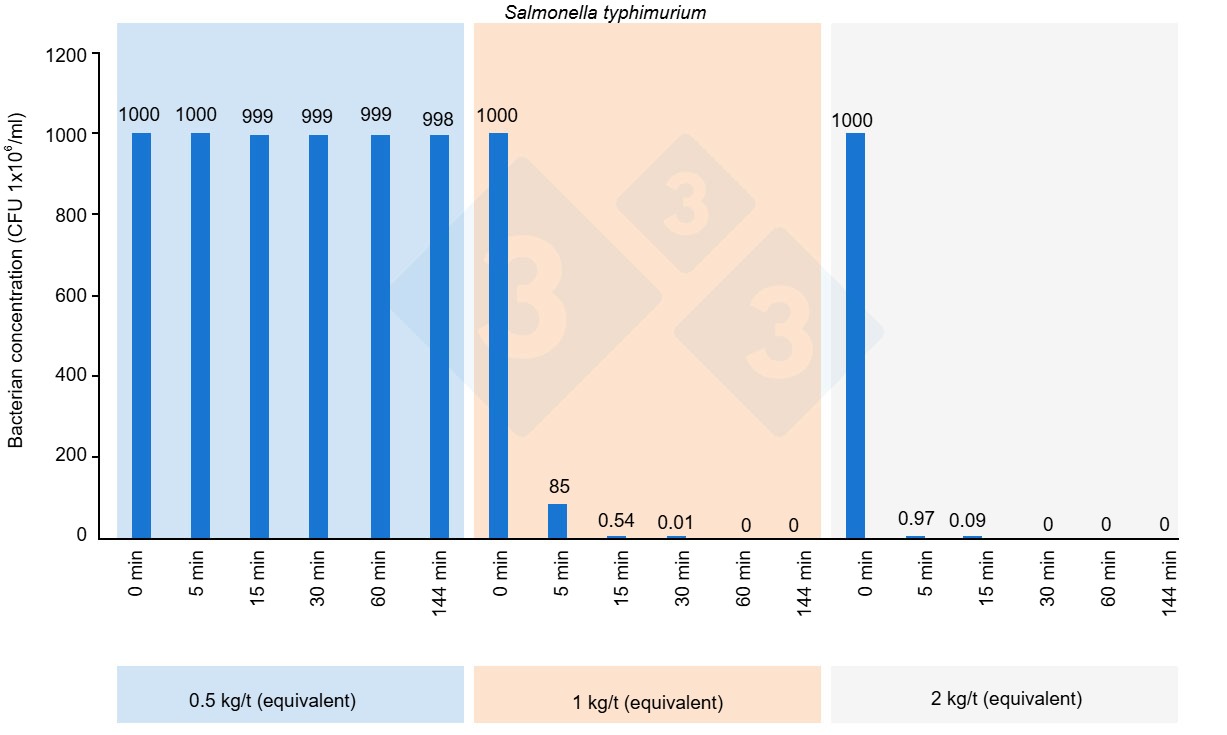
A combination of encapsulated calcium formate, citric acid and essential oils have been assessed in vitro by the authors (Neto et al personal communication) showing that the equivalent of an inclusion level of 2kg/t of feed, significantly reduces the CFU of Salmonella Typhimurium after 5 minutes. This has been seen with other serovars of Salmonella and E. coli.
Experiences across Europe using a combination of encapsulated organic acids and essential oils, but at a different dose of 4kg/t, to ensure it reaches the hind gut and also tackle multiple pathogens (i.e E.Coli and Salmonella), have shown great results controlling Salmonella when fed in pig diets. An example can be seen in the Table 2, where after feeding pigs with the product, a significant reduction in Salmonella isolation in ileocecal lymph nodes was found.
Table 2. Salmonella isolation in ileocecal lymph nodes.
| Negative | Positive | |
|---|---|---|
| Control | 7 | 23 (76.7 %) |
| Treatment | 28 | 2 (6.6 %) |