
Are we optimizing the use of fats in pig nutrition? What factors should we consider?
13-Nov-2025 (11 months 6 days ago)
This review by Alexandra L. Wealleans and colleagues (Wealleans et al.,2021) explores the multifaceted role of fats and oils in pig nutrition, emphasizing their digestion, absorption, and utilization across different life stages. It provides a detailed analysis of lipid classification, digestion mechanisms, energy value estimation, and the impact of various additives and dietary interactions.
1. Importance and complexity of fat digestion
Fats and oils are the most energy-dense ingredients, and they are added to pig diets for various nutritional reasons, the most important achieving the high energy requirements for fast and efficient growth. They provide more energy than carbohydrates or proteins and their inclusion enhances growth, reproduction, and nutrient absorption by slowing feed passage through the digestive tract. However, high fat levels can reduce pellet durability and complicate feed manufacturing.
The digestion of fats involves three key steps:
- Emulsification
- Hydrolysis
- Micelle formation
Digestive Pathways
Fat digestion begins in the mouth, chewing and salivary lipase release fats from food. In the stomach, digestion continues, and fats mix with bile salts and nutrients to form emulsion droplets. In the small intestine, enzymes like lipase and colipase facilitate emulsification and lipases break triglycerides into smaller molecules, which join with bile salts to form micelles. These mixed micelles, formed from monoglycerides, free fatty acids, and fat-soluble nutrients, are absorbed through the intestinal wall, while bile salts are recycled back to the gallbladder.

These processes are influenced by the chemical structure of fats, including chain length, saturation level, and positional distribution on triglycerides. The review highlights that despite their importance, fats and oils remain among the least studied ingredients.
2. Lipid classification
Lipids are categorized into triglycerides, phospholipids, and steroids. Triglycerides are the most predominant in feed fats and oils, and therefore they will be the main subject of this review. They comprise three fatty acids bound to a glycerol backbone.
Fatty acids (FA) vary by:
- Chain length—short (SCFA), medium (MCFA), and long (LCFA)
- Saturation:
- SFA: saturated FA
- MUFA: monounsaturated FA
- PUFA- Polyunsaturated FA.
Only linoleic and linolenic acids are essential for pigs.
3. Energy value and digestibility
The energy pigs derive from fats depends on species, age, and lipid composition. The Wiseman equation estimates digestible energy (DE) and net energy (NE) based on saturation, chain length, and free fatty acid (FFA) content. However, Endogenous Losses of Fat (ELF) and energy-diluting factors like Moisture, Impurities, and Unsaponifiables (MIU) complicate predictions.
Studies show that Moisture, Impurities and Unsaponifiables can reduce the energy value of oils by up to 46%.
A modified Wiseman equation incorporating MIU correction has been proposed to improve accuracy. Additionally, the unsaturated-to-saturated (U:S) fatty acid ratio significantly affects digestibility, with higher U:S ratios (>1.5) yielding better absorption.
4. Factors influencing fat utilization
- Chain length and position:
- Shorter chain fatty acids are absorbed more efficiently.
- The position of fatty acids on triglycerides also matters; sn-2 fatty acids remain attached to the glycerol in monoglycerides; hence they are better digested.
- Oxidation:
- Oxidized fats reduce feed palatability and nutrient digestibility.
- Aldehydes formed during oxidation are linked to poor performance and reduced feed intake.
- Antioxidants can mitigate some effects but may not fully restore performance.
- Additives:
- Nonstarch polysaccharide (NSP) enzymes, like xylanase and beta-glucanase, are known for enhancing fat digestion.
- Emulsifiers can enhance fat emulsification and micelle formation in the digestive tract, improving lipid and overall nutrient absorption.
- Lysolecithin appears to be the most researched emulsifier, providing a higher in vivo effect than glyceryl polyethyleneglycol ricinoleate (Figure 2).
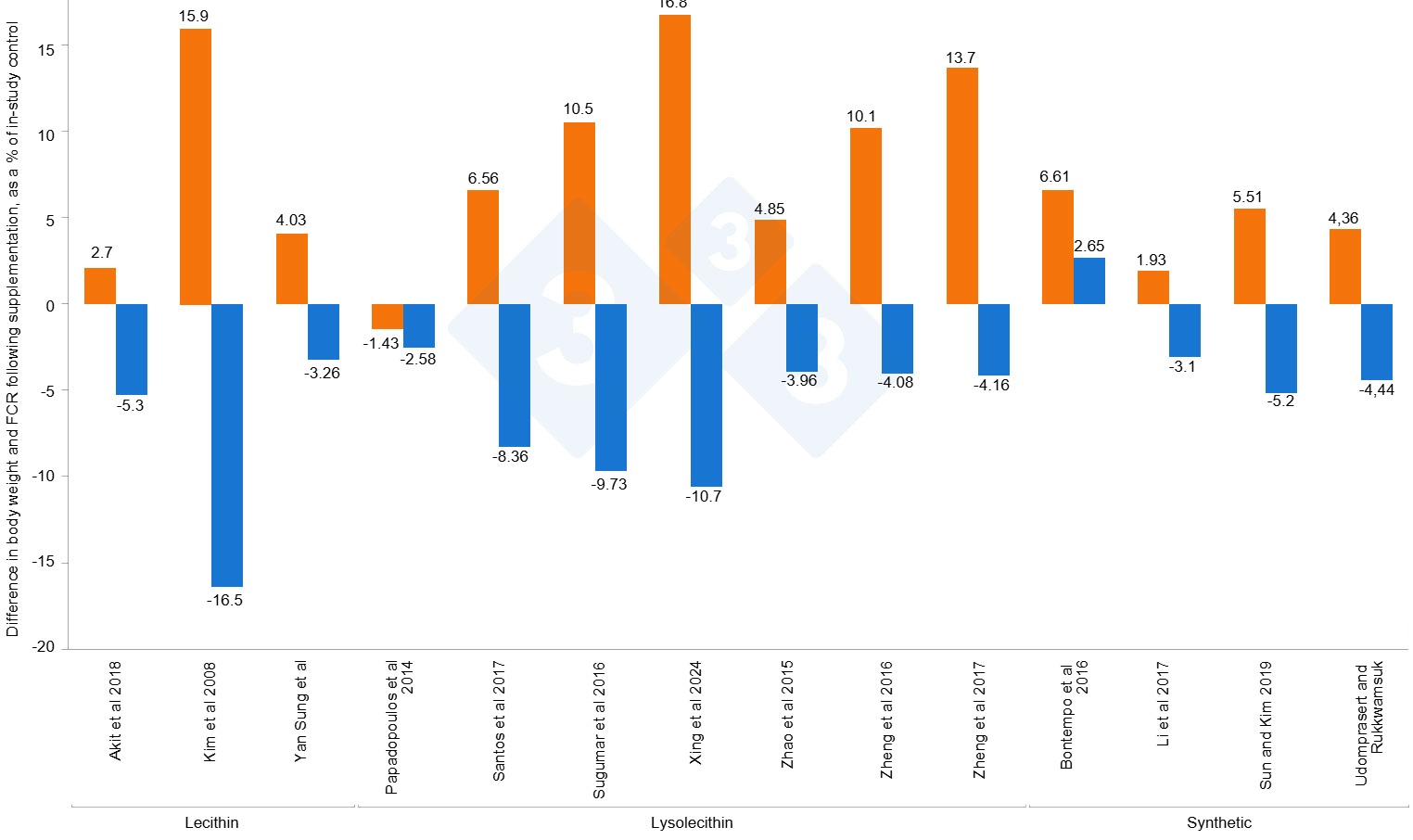
| Difference in body weight vs control, % | Difference in feed conversion ratio vs control, % | |||||
|---|---|---|---|---|---|---|
| Emulsifier | Min. | Mean | Max. | Min. | Mean | Max. |
| Lecithin | -1.75 | 7.315 | 16.15 | -20.38 | -8.338333333 | -2.217 |
| Lysolecithin | -1.43 | 9.9054545455 | 18.21 | -14.46 | -7.366 | -2.58 |
| Synthetic | 0.38 | 4.068 | 6.61 | -5.2 | -2.638 | 2.65 |
5. Nutrient interactions
Fat digestion interacts with other nutrients, especially fiber.
High fiber diets can reduce fat absorption by binding bile acids and inhibiting lipase activity.
Conversely, fats can impair fiber fermentation by coating fiber particles. These interactions affect the bioavailability of fat-soluble nutrients like vitamin E and flavonoids.
6. Life stage-specific utilization
- Sows and Piglets: Lactating sows mobilize body reserves to support piglet growth. Added fat improves milk composition and piglet performance, especially under heat stress. However, excessive fat intake during gestation may impair offspring reproductive health. Lysolecithin supplementation enhances milk fat and piglet intestinal health.
- Weaning Piglets: Responses to added fat are variable due to immature digestive systems. Emulsification and absorption, rather than enzyme activity, are limiting factors. Lysolecithin improves villus height and gut integrity, while antioxidants and prebiotics help mitigate oxidative stress.
- Growing and Finishing Pigs: Added fat is linked to improved growth performance, especially feed efficiency. Although vegetable oils like soybean oil outperform animal fats due to higher digestibility, they can lead to softer and oilier carcasses, which may be less desirable in the slaughterhouse. Emulsifiers show mixed results, with lysolecithin offering more consistent benefits (Gonzalez-Sanchez et al., 2022).
7. Conclusions
The digestion and absorption of fats in pigs are complex and influenced by numerous factors including lipid composition, oxidation status, and dietary interactions. Accurate energy estimation requires consideration of MIU and EDF. Additives like lysolecithin and antioxidants can enhance fat utilization and performance. Further research is needed to optimize fat inclusion strategies across pig life stages and to better understand the interplay between lipid quality, digestive physiology, and nutrient interactions.