
Vitamins: Essential organic compounds. Measurement and requirements
23-Oct-2025 (11 months 28 days ago)
Units of measurement
The vitamin content of foods is expressed in micrograms (µg), milligrams (mg or mg/kg = ppm), and International Units (IU).
The IU is a standardized measure that expresses vitamin activity based on its biological activity (its final effect), rather than its quantity.
The IU differs from one vitamin to another and is established by the WHO Committee on Biological Standardization. There are two reasons for evaluating vitamin activity in terms of IU rather than expressing it in weight units:
- The first is that there are provitamins or different chemical forms of the same vitamin whose potential activity differs, and it is a way of expressing their equivalent activity.
- The second is that very often, instead of determining the content, biological and microbiological tests are carried out, which do not necessarily give the quantity, but rather an estimate of the activity.
For example, there are three chemical forms of vitamin A, and each has different equivalents for pigs:
| Retinol acetate (3a672a) | — | 1 IU = 0.344 µg retinol acetate | |
| Retinol palmitate (3a672b) | — | 1 IU = 0.5458 µg retinol palmitate | |
| Retinol propionate (3a672c) | — | 1 IU = 0.3585 µg retinol propionate |
Calculating requirements and safety margin
It is impossible to determine the exact vitamin requirements of animals, as these compounds are found in minute quantities in the body. Therefore, the values in the various recommendation tables are obtained from estimates based on two criteria:
- Knowledge of the function and organic metabolism of each vitamin.
- Knowledge of the symptoms of deficiency
Requirements are estimated based on experimental response tests in order to determine: 1) minimum requirements, i.e., the minimum daily amount of vitamin capable of preventing deficiency symptoms, and 2) optimal requirements, i.e., the daily amount of vitamin an animal needs to receive in order to achieve maximum production.
The recommended requirements in nutritional reference tables, such as FEDNA (2013) or NRC (2012), define the amount of a vitamin that must be administered (per day or per kg of feed) to a pig to meet its minimum requirements with a safety margin.
It is common to find an average value and a range for each vitamin in the tables.
For example, FEDNA (2013) recommends between 6.0 and 8.5 M IU/kg of feed of vitamin A, with 7.5 M IU/kg of feed recommended in growing pig feed. Figure 1 illustrates how the animal's response varies depending on the level of vitamins provided in the diet:
- Zone 1 (Deficiency): This corresponds to marginal vitamin levels, below minimum requirements, which limits the animal's response and can cause signs of deficiency.
- Zone 2 (Minimum level): Indicates the point at which vitamin inclusion is sufficient to prevent clinical deficiencies, although it does not necessarily ensure maximum performance.
- Zone 3 (Optimal): It represents the appropriate levels that allow the animal to express its genetic potential, ensuring both basic requirements and a safety margin.
- Zone 4 (Tolerance): In this range, vitamin levels exceed what is necessary; however, they do not cause adverse effects.
- Zone 5 (Toxicity): Excess vitamin reaches levels that are harmful to the animal, causing toxic effects.
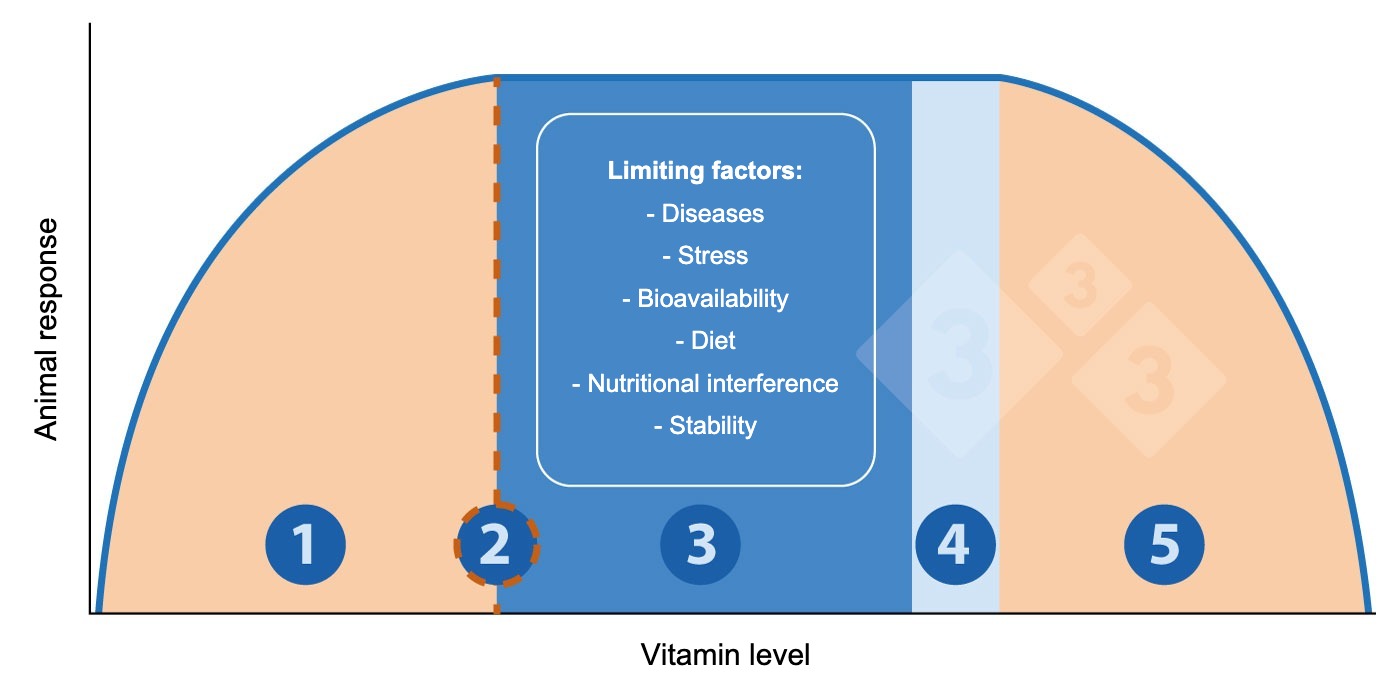
In addition, factors such as infections, high stress levels, or phases with high metabolic requirements, such as lactation or post-weaning, can limit the ability to absorb or produce certain vitamins or modify the animal's response and shift the limits of each zone. In fact, several studies have shown that supranutritional supplementation, i.e., above the recommended standard levels, can have additional beneficial effects. This strategy can improve meat quality thanks to the antioxidant effect of certain vitamins, as well as strengthen the body's antioxidant capacity, reducing oxidative stress and promoting animal welfare (Liu et al., 2016; Smołucha et al., 2024).
In the past, feed was often formulated with an excess of vitamins; without reaching tolerance zone 4, practical levels were commonly on the right side of zone 3 because vitamin compounds were abundant and affordable.
Currently, product availability and quality are sometimes compromised, so it is advisable to periodically review vitamin dosage.
Vitamin stability
Currently, vitamins are obtained chemically through microbial fermentation processes (large-scale fermentation using microorganisms that are modified or selected for their high synthesis capacity) or through chemical synthesis (using synthetic chemical pathways from petrochemical or natural precursors). Both methods allow for strict control of both vitamin quality and activity. However, some vitamins are sensitive to the effects of moisture, heat, light, heavy metal ions, pH, and oxidation and reduction processes (Surson et al., 2011; Saensukjaroenphon et al., 2020; Saensukjaroenphon et al., 2022).
Thus, in vitamin-micromineral premixes, the stability of vitamin activity may be compromised. Therefore, it is essential to ensure proper storage and to follow the manufacturer's instructions regarding the timing and conditions of use of vitamin-micromineral premixes.